

The Chosen is a streaming TV drama based on the Christian Bible from showrunner, writer, and director Dallas Jenkins.
You should read my Season One review first! There, I give the lowdown on the first season, putting together my thoughts on the show as objectively as I can. While I have some bias as a Christian media critic, I really think the first season is deserving of all the praise it gets.
(EDIT: you can also read my reviews of Season Three and Season Four!)
However, does that hold true for season two? Does season two fall apart under the massive weight of the worldwide phenomena it became? How does the show fair?
If I’m being honest… I think this season has even higher highs than the first season. However, it does have a few things that kind of irk me… and a handful of even lower lows. What do I mean?
First, the good. Then, the weird.
The good…
A lot of the things that were great in the first season are great this season.
Moving on.
No, I kid. But seriously, a lot goes on this season, and a lot of it is worthy of praise. When I criticize this show, it’s only because I care about it. A lot. When I watch a rom-com that I’m just watching for fun, I don’t spend the time picking it apart piece by piece; that’s not what I’m watching it for, and I’m not that invested. However, when I review Victor Hugo’s French novel Les Miserables or the Japanese Samurai epic Ran, I pick them apart because I care. They’ve proven that they can do well, and they have my investment.
The Chosen has my investment. So, when I pick apart, I do so with love.
With that out of the way, the good. Oh my gosh, what good there is.
The first episode of the season is great. It brings in all of the conflict we know surrounded the Samaritans in an interesting way, tying in all of the Biblical stories about them into one episode. For example, the “Good Samaritan” parable is referenced here, even though that parable was told later in Jesus’ ministry, as well as an event when James and John ask Jesus if they can call down fire on a Samaritan village for rejecting Jesus soon before he is crucified. This episode takes place early in his ministry, so adaptationally they’ve chosen to shift some events for the sake of the show, but I’m more than fine with that. It also features one of the first scenes of Jesus being truly angry, this time at John and James for their treatment of Samaritans. All of these threads lead to an amazing climax as John gets the “curtain pulled back” for a second. He sees Jesus as God. It moves him to tears.
The second episode introduces Philip and Nathaniel; it’s a good episode, and the climax is good once again. However, I question some of their choices… more on that later. But Philip is a fun character (played by Yoshi Barrigas), and his interactions with Matthew are charming. The three best scenes of the episode involve Philip: as he and Matthew discuss fitting in, as he and Matthew talk about how to make jokes and take the bark off of wood, and as Philip and Nathaniel talk before Nathaniel meets Jesus. “Come and see.” Philip is unique among the disciples for not really having grand personal problems. He’s almost monkish and ascetic, bringing a unique dynamic to the group.
The third is the most unique of the season. The showrunners are showing off a little more this season; the opening of the episode is one 14-minute long take. A “long take” is when a movie or TV show doesn’t stop filming and then go to another camera. Most shows or movies “cut” between different cameras every couple of seconds. Long takes are particularly impressive because you have no easy resets; every single element has to fall into place perfectly. If all a character says is “no,” that 2 second shot can be redone over and over again until it’s just right. But 13 minutes? Whoa boy. It’s extremely impressive, especially as the sun perfectly sets for real in the background as the characters talk.
The conversations in this episode are fun and illuminating, especially from Big James, Little James, and Mother Mary. New details and backstory and understanding are added to each character. The climax, again, is a shot in the heart, as Simon Peter yells at Matthew, saying “I’ll never forgive you!” right when Jesus enters the camp, covered in other people’s blood from healing, exhausted. The point is left for you to draw as the viewer. It’s the epitome of almost all this show does well.
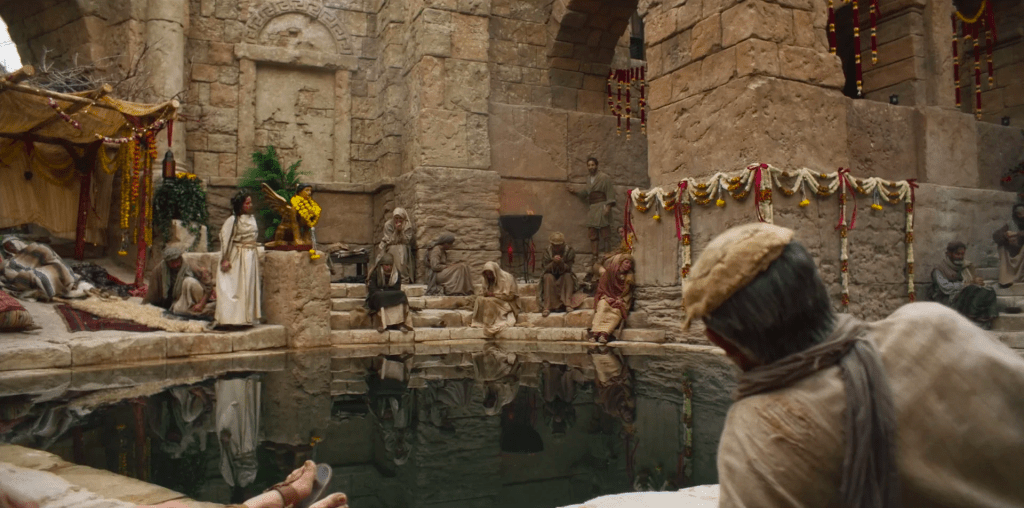
Episodes four through six form a sort of “mini arc.” Episode four features the healing of the man at the pool of Bethesda (John 5) and the group crossing paths with Simon the Zealot. The fifth features the call of Simon, as well as John the Baptist setting out to condemn Herod the Tetrarch for his crass adultery. The sixth features Mary Magdalene giving into her “wild side” again to cope with a demonic encounter, as well as Jesus’ healing of the man with the withered hand in the Synagogue and him allowing his disciples to eat grain on the Sabbath (Matthew 12).
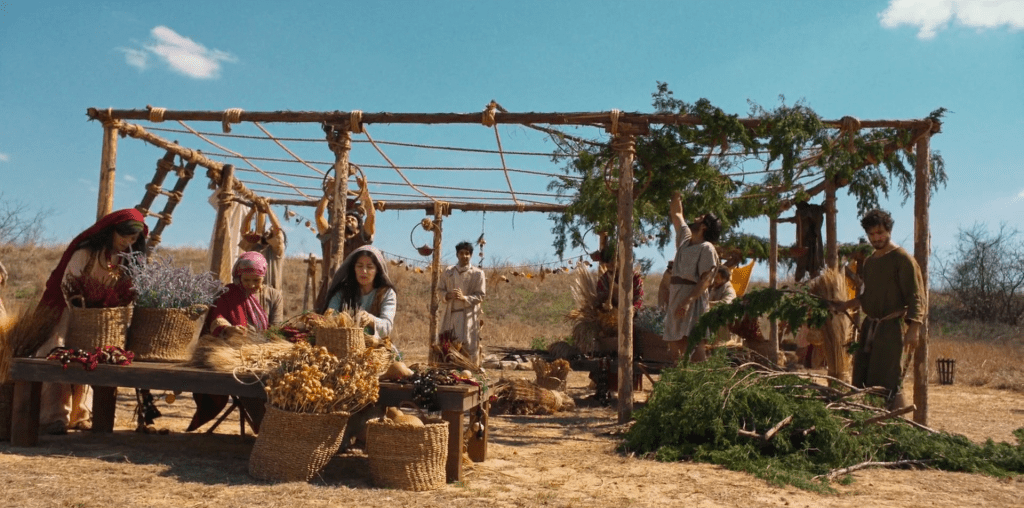
This is the part of the show with the highest highs, but I think also some of the lower lows (more on that later, too). A lot of the key moments are interesting, like the healing at the pool, John and Jesus’ conversation, and Mary’s return to Jesus. There’s a several minute silent sequence at the beginning of episode 4, showing the story of the paralytic at the pool of Bethesda and his invented brother. It’s another filmmaking flex from the showrunners. What is particularly awesome (to me as a Bible nerd) is the including of the Feast of Tabernacles in Episode 4. Probably the most little-known feast out of the Old Testament feasts, it’s a cool chance to educate the characters in the show as well as the show’s audience.
An interesting decision is a scene in episode five in which we hear Jesus preparing the Sermon on the Mount, running through his metaphors and ideas out loud. It caused quite a stir at the time. “But Jesus was perfect!” some said. The showrunners fall back on Luke 2:52: “But Jesus grew in wisdom and in stature, and in favor with God and with men.” As true God, Jesus was all-knowing and all-wise. Somehow, in some way, as true Man, Jesus also had to practice and grow and decide and make decisions. I mentioned this in my previous review of season one, but this show loves to lean into Jesus as true Man. Sometimes he seems to be grasping for words, looking for the perfect way to talk with someone; what he comes up with, though, is always the right response in that moment. This episode plays with this idea. Let me just say that I like it, it’s bold, and it got me thinking of Jesus in a new way. Props to them.
Episode seven and eight are also a “mini arc,” a two-part finale. In episode seven, the group comes back to near Capernaum (apparently… more on THAT later too) to prepare for Jesus giving the Sermon on the Mount. Jesus is brought in to Quintus for questioning, while the disciples panic in his absence. Several are in distress due to John the Baptist being imprisoned for calling out Herod. Episode eight is the sermon on the mount, including the introduction of Judas Iscariot into the group of disciples.
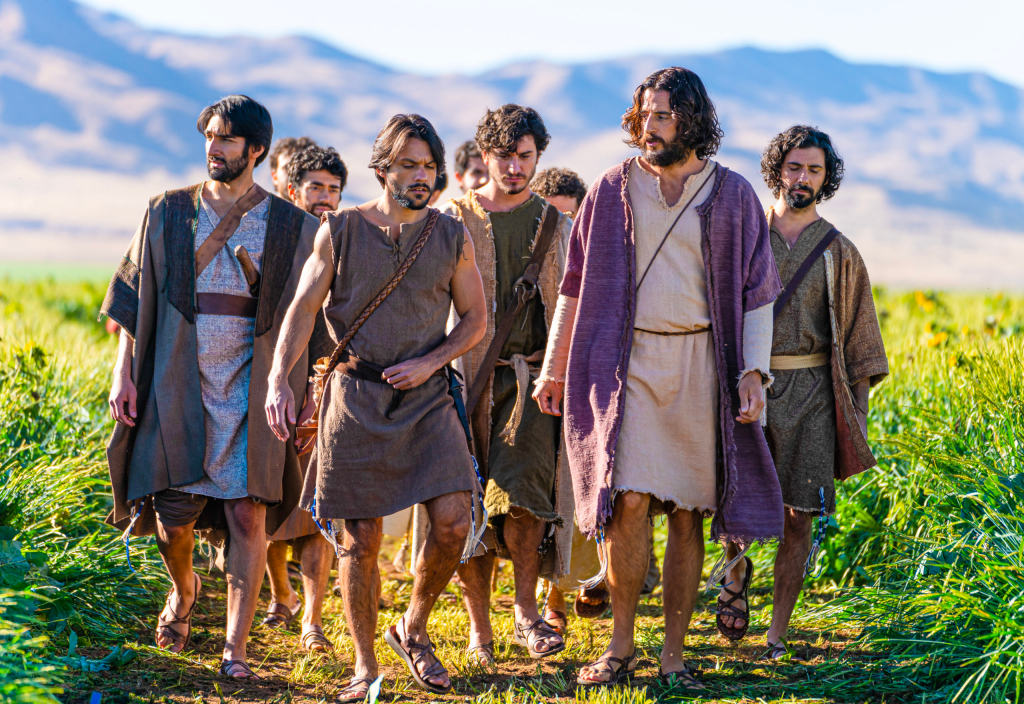
There are quite a few highlights from this “mini-arc,” too. Quintus’s conversation with Jesus is a highlight. As I said in my last review, Brandon Potter as Quintus is an absolute blast to watch, and so the conversation is clearly there for the fun of it all. Judas’s introduction is cool, because he’s likeable. He’s definitely different from the other disciples; he’s ambitious, he wants to be a part of something big and so is drawn to Jesus. But Luke Dimyan, who plays Judas, is keen on omaking him seem… well, normal. All of the disciples were surprised when he was betrayed; so why not the audience?
One of the highlights of the whole season is Jesus working on the Sermon on the Mount with Matthew, who functions as his scribe. Jesus, using his experience from the season, comes up with the Beatitudes we all know and love. The music, Jonathan Roumie’s once-again stellar delivery, and flashing back and forth to the disciples throughout the season shows how much these showrunners thrive on these big-impact, cello-kicking-in, teary-eyed or jaw-dropping moments. There are plenty throughout this season.
However, it is even with the Beatitudes itself that some of the cracks of this season begin to show. Some of the decisions they make are just… weird. There’s one thing in particular that concerns me. But that’s not to downplay the good they do, at all.
… and the weird…
A lot of the weird of this season comes from the show creaking under the strain. Season one was incredibly tight and interwoven, a showcasing of streaming shows at their finest. This season obviously has its eyes on the prize. It’s aiming not just for this season, but for season 3, 4, 5, 6, and 7. The last season gave its all, wondering if that’s all the showrunners would get. This season is more confident, planning long-form storytelling for years to come.
However, in that planning, this season becomes kind of weird. It’s weird for several reasons.
First, just some things that annoy me, personally. I mentioned my annoyance with the over abundance of Romans last season; it’s at this point that it starts affecting the narrative. Simply put, Atticus Aemilius, played by Elijah Alexander, is another character who shouldn’t exist. Cohortus Urbanae mainly functioned within Rome and sometimes broader Italy; they did not work in the provinces. It makes Rome seem like it’s touching every aspect of life. However, when John the Baptist goes to call out Herod the Tetrarch for his adultery, we have no idea how he fits into the greater structure of government. If his soldiers were the ones we saw in Capernaum, interfering with Jesus, we’d have a much better idea of his presence. And a spy of Herod the Tetrarch would make sense, as we know from Luke 23 he was interested in Jesus. Rome’s fingers didn’t reach in this way this far.
Another annoyance? Tamar. No, it’s not because she’s a Black character in the show. Amber Shana Williams is a good actor (though I don’t think she’s the best), and diversity in this already diverse show is welcome. However, her role is… weird, in the grand scheme of things. No Gentiles followed Jesus in his little band of “disciples” (lowercase “d,” not uppercase D 12 Disciples) during his earthly ministry from every indication in the Gospels. The Gentile characters we do see (Matthew 15 for the woman by Tyre, Luke 7 for the faith of Gaius—I mean, the Roman Centurion, Mark 5 for the demon-possessed man), aren’t asked to follow Jesus. They have faith, but for now Jesus’s inner circle are Israelites. I don’t get why they didn’t just make her Jewish, with a Gentile father (Jewish descent was counted through the mother. See Timothy in Acts 16, 2 Timothy 1:15). However, her inclusion hints at larger problems with the show.

The problems are starting to show in “the grand scheme of things.” The Romans are overreaching for the time, Tamar’s role does not fit information we have from the Gospels which could be easily shifted. More grand scheme cracks show.
The first crack is in the fractured feel of the episodes. Episode 1 feels like an epilogue to season one. Episode 2 feels like a true beginning to the season, but then episode 3 is a one-off primarily focused on expanding character identities and relationships in a “bottleneck” episode. Episode 4 through 6 only continues some of the plot points of episode 1 or 2 or 3, such as Matthew slowly fitting in or Simon Peter’s resentment toward Matthew. However, instead we’re off to new people, new places.
Yes, the first season often introduced new characters and new situations and new events each episode. However, each one felt like organic continuations of previous plot points.
Season one, episode four ends with the miraculous catch of fish; Simon, James, Andrew, and John are called. In Five, yes, we’re suddenly going to the wedding at Cana, but it’s also the disciples’ first trip together; they’re getting to know each other; Jesus is using the chance to get them all acquainted with each other. Their report builds. At the wedding we meet the next batch of disciples, Thomas and his girlfriend-hopeful Ramah. In episode 6 of season one, Jesus’s fame spreads, and that leads to a man with leprosy to ask for Jesus’ cleansing power, and Tamar to go fetch her paralyzed friend to be healed. Steps in the process felt logical. Season 2 feels more like, “AND THEN this… AND THEN this… and THEN this,” without the same tight structure and feel.
The second “crack” is what I mentioned before: the pop-up feeling of characters. Atticus comes in out of nowhere, interrupting the flow of the season and adding more elements to an already complicated “world” of Israel. Tamar reappears, bringing problems both in the world of the show (a Gentile in Jesus’ close circle?) and for the creaking plot (we’ve got all of the new disciples, the Pharisees subplot as Shmiel negotiates religious politics, new disciples to introduce…) Other characters “pop up,” too, without much connection to what’s going on. It’s ok for some pop-ups. But while Thomas and Ramah are connected by the wedding banquet, Nathaniel, Simon, and Judas only start having their connections late in their respective episodes. It heightens the “pop-up” feel of this season. Things kind of “pop” without connection.
The third problem this season is in the flow of time and the relationship of geography. It contributes to the fractured structure of the season. After making their way to Caesarea Philippi (a predominately Gentile city) in episode 2 and then over to Tyre and Sidon in episode 3, which are far far far north of Israel, suddenly in 4 they’re in Jerusalem, pretty far south in Israel. That’s a several days walk south, even more if you’re harassed by crowds all day. Six takes place in Jericho, only a day’s walk or so from Jerusalem. Yet it’s a few days after the feast, it seems. And how long have the disciples been together, a few days? A few months? Passage of time is strange this season. Then in seven we’re back by… Capernaum? We’re not sure, because Gaius and Atticus have to walk around Joppa, which is like… NOT near Capernaum at all, a few days’ walk away. So why do they have to go around it? Where are the disciples? What’s going on?
The teleporting geography and time is nitpicky. So, perhaps, is characters “popping up” or coming in and out without organic connections. Maybe, too, is the flow of the season (after all, it’s not like there are set rules for this sort of thing). Plenty of shows don’t care at all for these things. Yet I think that all of these add up piece by piece to make a more confusing season. Several times during the season, my wife had to ask, “Wait… where are we? What’s going on?” All of these simply make for a much less tight season than the last.
I think this fractured approach is most illustrated in the conversation between Jesus and Quintus.
Suddenly, Quintus reappears. The conversation Quintus and Jesus has is one of my highlights of the season, even of the show. It’s a very well-written scene; the two have fun word sparring, and it reveals a lot about Jesus and Quintus. It’s a fan favorite moment, these two getting to meet. However…
We’re picking up a plot thread from season one. His absence hasn’t been addressed until now (why aren’t Romans looking for Jesus?) It feels like a HUGE break from the rest of the season; we’ve seen mounting opposition from Pharisees and people, and suddenly… his opposition is gone? He doesn’t care about Jesus enough to arrest him, the man who supposedly kills people without a second thought? And the rest of the episode spins on its wheels a bit, building up to this moment that’s fun, for sure. But does it fit in with what’s been happening so far? What does it have to do with what’s ahead? Did we need this scene?
Compare this to the conversation with Nicodemus and Jesus, another conversation that happened the episode before a finale. It had a season’s worth of buildup. It tied in so well with the rest of the episode thematically. It was a high point for Nicodemus’s and Jesus’ characters. It was some of the best acting either two did in the show. It had relevance before and ahead: Nicodemus is forever changed from this moment. It’s a key moment in the whole show.
Quintus and Jesus? Fun. It’s a pop up. But it’s also a break. It breaks the show, bit by bit.
… but there’s SO MUCH GOOD.
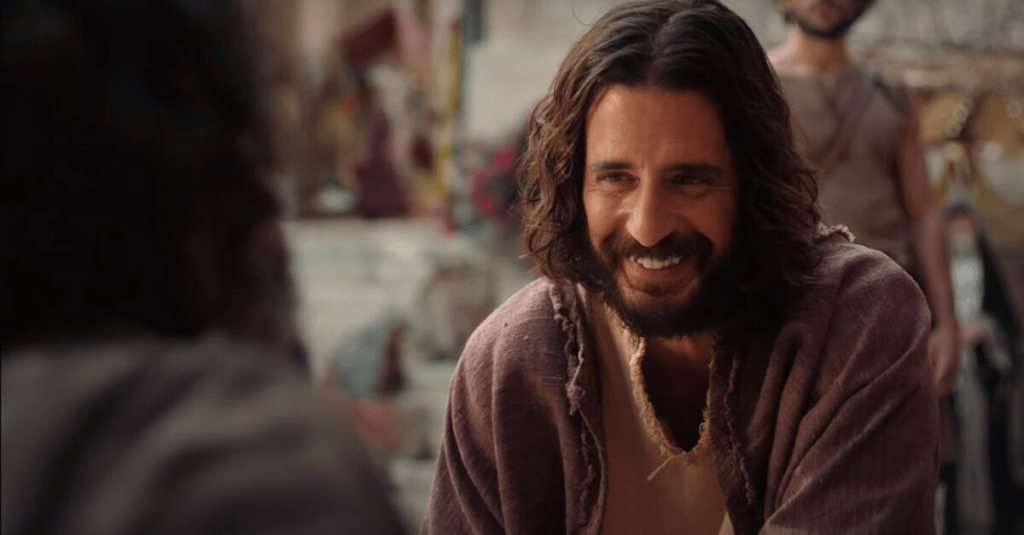
There’s so much good to this show. So much fun and life and energy and vision. I just hope it doesn’t eventually buckle under its own weight. Maybe my concerns will clear up once season 3 comes around. Maybe my fears are unfounded.
Because there’s so much to see. So much to experience. So much fun to be had watching Jesus interact with his disciples and his followers and his opposition. While I have my concerns about the big picture, the moments still stand strong in the sight of it all.

𝙷𝚒! 𝙼𝚢 𝚗𝚊𝚖𝚎 𝚒𝚜 𝙽𝚊𝚝𝚑𝚊𝚗. 𝙸 𝚕𝚘𝚟𝚎 𝚜𝚝𝚘𝚛𝚢𝚝𝚎𝚕𝚕𝚒𝚗𝚐, 𝚕𝚎𝚊𝚛𝚗𝚒𝚗𝚐, 𝚊𝚗𝚍 𝚌𝚛𝚎𝚊𝚝𝚒𝚗𝚐, 𝚊𝚗𝚍 𝚊𝚕𝚜𝚘 𝚕𝚘𝚟𝚎 𝚝𝚘 𝚝𝚊𝚕𝚔 𝚊𝚋𝚘𝚞𝚝 𝚝𝚑𝚎𝚖 (𝚜𝚘𝚖𝚎 𝚠𝚘𝚞𝚕𝚍 𝚜𝚊𝚢 𝚝𝚘𝚘 𝚖𝚞𝚌𝚑!) 𝙵𝚘𝚕𝚕𝚘𝚠 𝚝𝚑𝚒𝚜 𝚋𝚕𝚘𝚐 𝚝𝚘 𝚜𝚎𝚎 𝚖𝚘𝚛𝚎 𝚌𝚘𝚗𝚝𝚎𝚗𝚝!
 Go-To Guru: Film, Literature, Television, and More
Leave a comment