

The Chosen is a streaming TV drama based on the Christian Bible from showrunner, writer, and director Dallas Jenkins.
I’d recommend reading my Season 1 and Season 2 reviews before you read this review of The Chosen, season 3. (EDIT: You can also read my review of Season 4!)
The finale just aired this week. The expectations were high for the third season of the cultural phenomenon. The second season was just as critically acclaimed as the first, so far as I could tell, and it was the season I think the Chosen really caught on in the average person I ran across. Season 2 was huge.
However, I noted in my Season 2 review of some cracks I thought were beginning to show in the grand scheme of the plot the showrunners are constructing. More loose ends led to a more unwieldy show in Season 2. While there were some high highs to that season (VERY high highs), some moments just felt… weird, or off, or disconnected. Unlike the tightly woven first season, the second was a little more bulky and stumbly.
How did Season 3 do?

Warming Up
I’m warming up to this season of the Chosen.
I was a little skeptical out of the gate. I mentioned in my review of Season 2 that that season felt more fractured, less tightly woven, less connected. I got to Episode 6, and I had that concern for Season 3 as well. “What’s going on?” I thought to myself. “Where is this going?” The episodes still felt a little “pop-up-y.” I was concerned. After finishing the show, I felt uncertain. I had loved the climax, but wondered if it was deserved.
Then I thought back over the season. I talked it through with a friend. I rewatched a few clips from the season.
The season is growing on me.

What Doesn’t Work
There are still a few things I don’t think completely work.
First, the timeline. “Ugh,” you’re thinking, “Go-To Guru, we’ve nitpicked the timeline ENOUGH already.” Maybe. Maybe not.
The Feast of Tabernacles, which was in Episode 4 of Season 2, is in September or October. Purim, in Season 3 Episode 7, is in March. There are various Jewish New Year festivals, but the one they’re probably referencing in Season 3, Episode 3 is Tu B’Shvat, the day the first fruits from the olive trees can be eaten. That’s mid January. However, the celebration of Purim is only three weeks after the Two by Two went out (per Season 3, Episode 8). Once again, how much time is passing and how much time the disciples are actually learning with Jesus is weird and wiggly and uncertain. It’s just one way the show is a tad confusing still.
Second, the Olive Grove storyline. While I enjoy the conversation Tamar and Mary are forced to have as they conflict with one another, it feels disconnected from the rest of the season’s plots and themes. It’s cool to see how the women “supported Jesus out of their own means” (Luke 8). The conflict between Tamar and Mary is a Gentile-Jewish conflict, like many of the conflicts this season, so it fits into one of the two major themes we’ll discuss later.
However, that conflict could have happened without the olive grove. It just felt like an unnecessary distraction to me. In episodes already packed-full of content (unlike the first season, every episode is close to an hour long or more), the olive grove just didn’t add much. Arguments about which olives to use, how the oil ended up, tasting the oil, buying or negotiating for the grove, scenes with Zebedee selling stuff or deciding stuff (really below a tertiary character… what’s below tertiary, a quaternary?)… it’s all a little much. We’ve only got this much time; I feel like similar things could be accomplished with far less time.
While Judas does get more scenes because of his moneyhandling skills, again I think the same thing could be accomplished with less scenes. Also, I’m not overly fond of the “support-my-widowed-sister” dynamic. Being an orphan striving for greatness is enough for me; show me more of how he interacts with the disciples, with the women, and others. I didn’t get a good grasp of how Judas fit into the group. We got a lot more on Simon the Zealot, Nathanael, and Philip so we could see their dynamic in the group right away. I wish we got more of Judas.
Along with Judas and interactions and the timeline idea, I wish we would get more time of Jesus actually teaching the disciples as well as the dynamic of the disciples. When the disciples were shocked about being sent out, wondering if they knew enough, I thought, “Yeah… they really DON’T know enough. Judas needs more than one sermon.” This probably applies to the show more in general: since there aren’t really time jumps of more than a few days between episodes, it’s hard to know when the disciples actually LEARNED the parables they recite in Episode 7 and 8. We just need more… time. Focused time.
Along with that, the disciples’ dynamic. While I did enjoy Simon’s and Matthew’s and Gaius’s storylines, I wish the main cast did get more time. I wish the two-by-two story would be more than a montage, but actually fleshed out… perhaps an episode full of little 5 to 10 minute stories, one for each of the “two-by-two.” I’d be great to have a chance of seeing these Chosen at their work, individually, giving each time to shine in their own way. While we’ve gotten TONS on the disciples, and I know each by face and name now, I wish we’d spend more time with them, and perhaps less on some of the other quaternary characters (I’m sticking with it), like Jairus, Veronica (the woman with the bleeding problem), Zebedee, or Yusef.
But that’s a hard question: what do you trim? What do you leave in? I’m not sure. Because overall, this was a tight and engaging season in a way I think the second season wasn’t.
Theme One: Jews and Gentiles
What makes this season much more interconnected than the second is the two themes that run parallel throughout almost every episode this season. The first theme is the relationship between Jews and Gentiles. The second, deeper theme is the relationship between Jesus and his people as his people go through suffering.
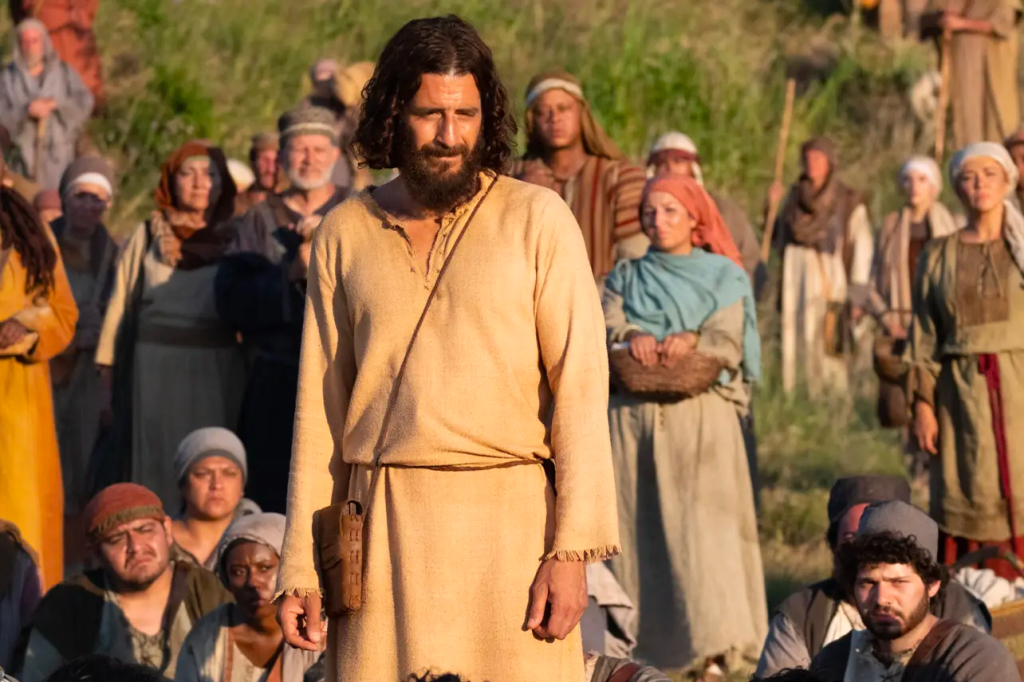
The Jew-Gentile thread is carried throughout the whole season. It starts with Joanna showing up on the Sermon on the Mount. Already there we see tension and shock when she shows up, a Gentile believer in this Jewish Messiah and his forerunner, John. The second episode has it too: The Roman soldiers want to break apart the tent city of pilgrims lingering outside Capernaum. Gaius, however, in a change of heart, attempts to help the Jews. A Gentile, feeling soft toward Jews? Impossible! That tension continues as he helps rebuild the well for the Synagogue and doesn’t crack down on Tent City, despite Quintus’s orders.
It continues in one of my favorite scenes ever in the show. Jesus returns to his home town, and preaches in the Synagogue on Isaiah. “Preaching the good news to the poor.” The Jews, like the Gentiles, must repent. The Jews lack faith, and if they do not repent, God will turn to those who will. The Gentiles. Side note: Jesus’ preaching there is one of the most intense scenes I’ve seen in a show for a long time, period. You read these stories in the Bible, but seeing the expressions, the music kicking in, all of that just makes my skin prick in a way I haven’t experienced in a while. Props to the entire crew for that scene. And it’s thematically relevant!
Tamar and Mary’s scene also plays to Jew-Gentile dynamics. Their argument over culture and “paganism” is another misunderstanding and apprehension as God makes one new people out of two.
The Jew-Gentile dynamic continues in the Decapolis. This feeding of the Five Thousand is a merger of two biblical accounts. The Feeding of the Five Thousand was to a Jewish audience, with a particularly Jewish flavor (John 6). The Feeding of the Four Thousand, however, was near the Decapolis and featured a largely Gentile or Hellenistic Jew crowd. Merging the concepts together creates two episodes intensely focused on this dynamic, and it pays off.
This theme is more plot-based. “How do these groups interact? How do these arguments play out?” There’s plenty of learning growing on here, for us as an audience, as we feel what Jew-Gentile tensions must have been like. However, the grander, deeper, and more fundamental theme is the relationship of suffering to the lives of Jesus’ followers.
Theme Two: Suffering
THIS is the undercurrent of the whole season.
Why does the conversation between Little James and Jesus happen this season, in the end of Episode 2? Suffering. “Why do I suffer?” Little James asks.
Why do we see Jesus crying before the grave of his father? Suffering.
Why do we spend two episodes on Jairus’s daughter and his intense pain? How even his new faith is tested? Suffering.
Why do we spend two episodes on Veronica, the woman with the bleeding affliction? Suffering.
Why do we see Gaius turn to Jesus finally as his illegitimate son gets more and more sick? Suffering.
Why does John the Baptist send his disciples to Jesus? Why does he question Jesus’s role as the Messiah? Suffering.
Why does Jesus allow the people to go hungry, and then feed them? Suffering.
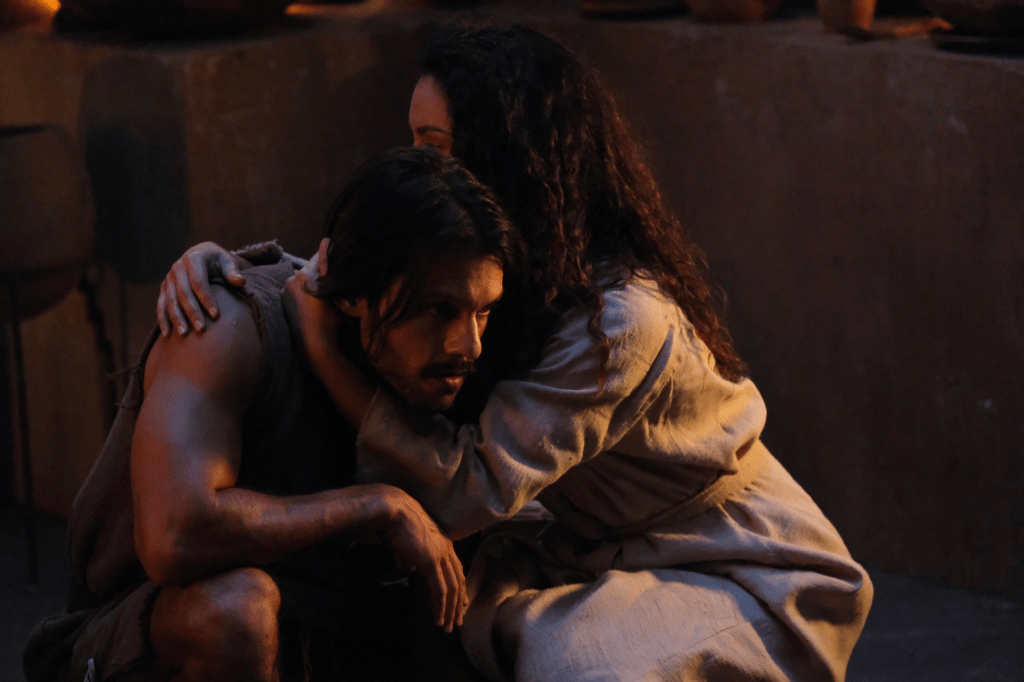
Of course, the biggest and most central way suffering is interwoven in this season is Simon Peter and Eden’s relationship. The crazy thing is that 5 of the 8 things we listed are real Bible stories. Little James, Jesus’ grief, and Simon and Eden are the only additions. In the spirit of Scripture, they’ve added these considerations of suffering. Simon and Eden’s is the beating heart of all of this this season.
The miscarriage is hard. (They even made a new music cue for it!) The scene in Episode 4, “Clean: Part 1,” where Simon comes home is probably one of the most realistic scenes of marital conflict I’ve seen in any filmed media. How people could so talk past each other even when they care for each other. It’s so hard to see these characters, characters we’ve had 3 seasons to fall for, suffering.
When Simon finds out, he is aimless. He is angry. He is so angry with God.
Using Psalm 77 and David as a capstone to Episode 8 was very original. It was a wonderful splicing of the Bible story and this story to encapsulate the theme of suffering. Yusef’s scene with Eden and her mother was touching. It’s rare in media to see a spiritual leader so adept at counseling and consoling. Yusef does his Messiah proud in that moment.
And then, that finale. Rather than ending on the hoo-ra-ra the way Season 2 did, we end on heartbreak and consoling. Jesus and Peter walking on water is by far the most special-effect-complex scene the show has filmed thus far. The special effects are a bit rough in some places (the boat doesn’t move in line with the movements of the waves), but they’re good enough and the actors are talented enough and the story is great enough to hold it all together. Peter sobbing as he tells Jesus, “Don’t let go of me, don’t let go of me, don’t let go of me,” is a great recontextualizing of the line in the Bible. “Oh you of little faith, why did you doubt?” has never sounded so heartwarming and calming to me. The whole season led up to this in a way that Season 2 didn’t quite capture.
I can tell looking back that this was the key scene from the beginning. Peter and Jesus walking on water was the end goal. They aimed for it with all their might, in a way I don’t think they quite got with the Sermon on the Mount. When the Disciples flash before Jesus’ eyes as he comes up with the Beatitudes, some of the images don’t quite fit (“Blessed are the meek” is just an image of Thaddeus and Little James, not even a particular scene from the show up to this point). But when Jesus says, “This is why I put suffering: I make them grow hungry, but I feed them,” the whole season comes into focus in a really cool way. It’s an incredible moment in the show, and restores my faith that the showrunners still know how to do Bingeworthy, streaming-show, season-long stories.

The Verdict
Watch it.
I have my nitpicks of this season. “I wish they would’ve… I think they could’ve… I feel like the should’ve…” You’ve read those.
But this season did a season-long story right. It has themes and interconnection and idea progression through plot. And if you don’t know what any of that means, just know this: This season was good. Very good.
I can’t wait for four.

𝙷𝚒! 𝙼𝚢 𝚗𝚊𝚖𝚎 𝚒𝚜 𝙽𝚊𝚝𝚑𝚊𝚗. 𝙸 𝚕𝚘𝚟𝚎 𝚜𝚝𝚘𝚛𝚢𝚝𝚎𝚕𝚕𝚒𝚗𝚐, 𝚕𝚎𝚊𝚛𝚗𝚒𝚗𝚐, 𝚊𝚗𝚍 𝚌𝚛𝚎𝚊𝚝𝚒𝚗𝚐, 𝚊𝚗𝚍 𝚊𝚕𝚜𝚘 𝚕𝚘𝚟𝚎 𝚝𝚘 𝚝𝚊𝚕𝚔 𝚊𝚋𝚘𝚞𝚝 𝚝𝚑𝚎𝚖 (𝚜𝚘𝚖𝚎 𝚠𝚘𝚞𝚕𝚍 𝚜𝚊𝚢 𝚝𝚘𝚘 𝚖𝚞𝚌𝚑!) 𝙵𝚘𝚕𝚕𝚘𝚠 𝚝𝚑𝚒𝚜 𝚋𝚕𝚘𝚐 𝚝𝚘 𝚜𝚎𝚎 𝚖𝚘𝚛𝚎 𝚌𝚘𝚗𝚝𝚎𝚗𝚝!
 Go-To Guru: Film, Literature, Television, and More
Leave a comment