
Les Miserables is an 1862 French epic historical fiction novel from Victor Hugo.
As I mentioned in my previous review, I will be reviewing one of the five volumes of Les Miserables each month. This month, I turn my attention to Volume Two: Cosette. This review is going to be a lot shorter than the first, as a lot of the same themes crop up in this volume. However, I’ll still give a plot summary, highlight my favorite scene, and then talk about two key themes that permeate this volume.
Volume II: Cosette
The second volume spans hundreds of years, but the main “action” of the plot takes place from 1821 to 1823. Most of this volume is actually taken up by two detours, topical detours where Victor Hugo decides to discuss two big themes he thinks impact the work, French history, and humanity as a whole.
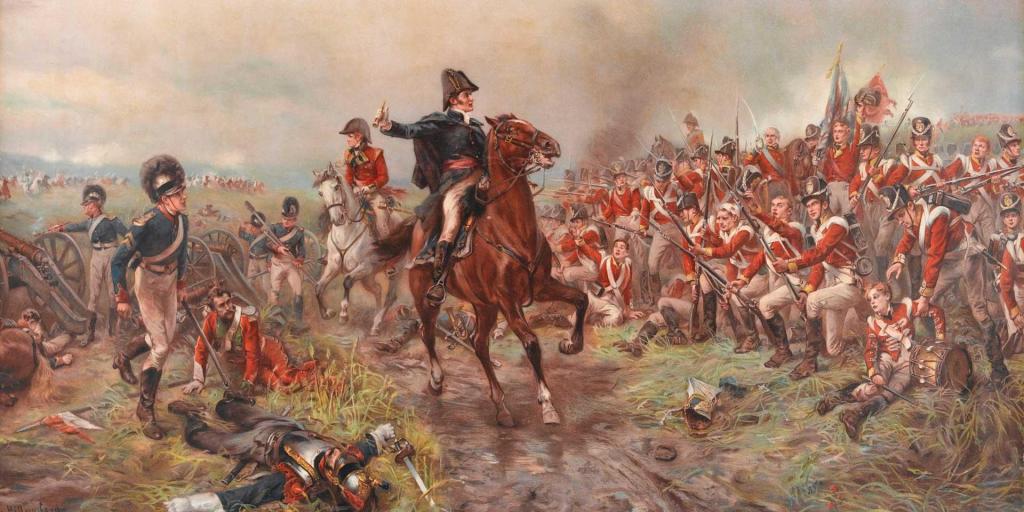
The first of those detours is Book I: Waterloo. Nineteen chapters are spent describing and underlining the course and significance of the Battle of Waterloo, Napolean’s defeat by English and Prussian (among other) forces for the final time. Victor Hugo has extensive knowledge of the battle, what came before and after, the overview of the tactics as well as grisly depictions of what happened in the front lines. He did “War Is Hell” before it was cool. Hugo uses all his vast knowledge to reinforce one theme we’ll talk about later. That theme? Providence.
Book II: The Ship Orion, is short. We see Jean Valjean, first a prisoner; then, we flash back to the circumstances leading to his arrest. Remember, we finished Volume One with him on the run from the law. How was he captured? What happened before and after? There’s some mystery here that will soon be solved. He escapes again in a way that fakes his own death: he plummets from a ship he’s helping dock, presumed dead in the water.
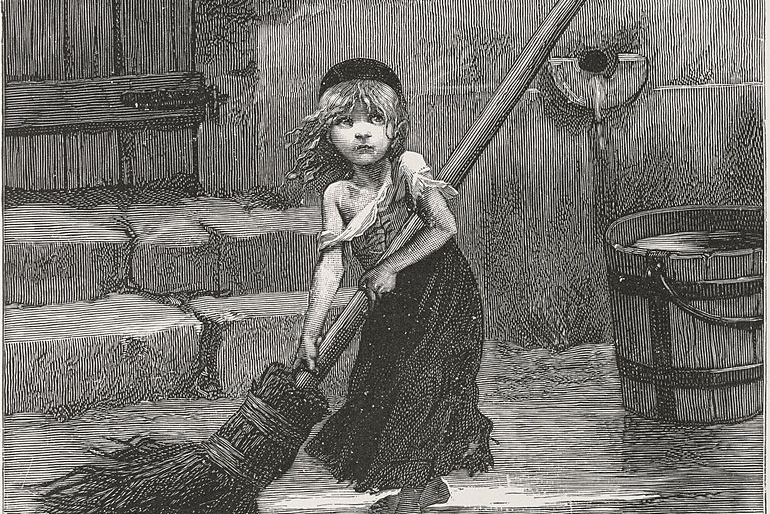
The poor little desperate creature could not refrain from crying, “O my God! my God!” At that moment she suddenly became conscious that her bucket no longer weighed anything at all.
Cosette meets Jean Valjean
Book III describes the childhood of Cosette and more fully the activity of the Thenardiers, her adopted parents who fleeced Fantine of all her money. Jean Valjean, escaped from the chain gain but this time presumed dead, finds Cosette. This book has some of the most concentrated sorrow and then joy of the whole novel. I’ll be discussing later what is my favorite scene from the book so far later: the scene when Jean Valjean appears to help Cosette. After that, he liberates her from the Thenardiers using a small portion of the 600,000 francs he hid before being caught the second time. He only escaped from prison the first time in order to hide his money, so that when he faked his death, he’d be able to find it again. He frees Cosette, outsmarts the Thenardiers, and makes his way to Paris.
In Book IV, hiding in Paris, Jean Valjean softens. He had been a virtuous man. Now, he is a loving man. He cares for Cosette in some of the most blissful time of his life. Cosette, too, begins to brighten and recover from her time in fearful oppression. Yet all that falls apart when he’s pursued by police again.
Book V is entirely taken up with the chase of Jean Valjean. We learn that Javert, through intense detective work at his new job in the best police force in the country of France—that is, the Paris police force—discovered Jean Valjean. The chase is thrilling and intense as Victor Hugo takes us through Paris, a Paris he knows intimately, described with the same finesse he described Napolean’s battle tactics. Valjean uses his wits, his guile learned in the chain gang, and his immense strength to escape into a convent. It just so happens that a man Jean Valjean had previously rescued while he was Mayor Madeleine is in this convent as a gardener. He offers to protect Madeleine and Cosette, assuming Cosette is a granddaughter.
Book VI is entirely spent on the origin, life, and practices of this convent, Le Petit-Picpus. Book VII then discusses the idea of convents and what they are good for. This comes to another major theme, accompanied by the unconstrained vision and law versus grace which we saw in the first volume (again see my previous review for a discussion on those) as well as providence. This theme is “humanity in isolation.” What happens when people are alone? Is that better… or worse?
Who knows? He might have ended by returning gradually to hatred. The convent stopped him down that downward path.
About Jean Valjean’s Time in the Convent
Part of Le Petit-Picpus is its strict policy of no contact with men. The gardener, Fauchelevent, must wear a bell at all times so the nuns and the children they are educating know he is approaching as he repairs and gardens. So, in Book VIII, they need to both get Jean Valjean out AND back in again. This book is all about that reverse-heist, and it is just as thrilling as the chase. When a sister dies but wishes to be buried under the chapel of the convent (the traditional location of burial outlawed by the new French government after Napolean), Fauchelevent comes up with a plan. Smuggle Valjean out in the coffin meant for the sister who died; smuggle him back him by pretending he’s his brother who has come to help him garden. The twists and turns of this plan are just as intense as the chase through the city. It shows how Victor Hugo is just as good at harrowing plot as he is at philosophy.
Volume Two is brought to a close. Cosette is happy, studying in the convent with Jean Valjean close by. Jean Valjean is safe from the police. Time will pass in this convent peacefully as Jean Valjean has his virtue and his love solidified rather than lost.
My Favorite Scene
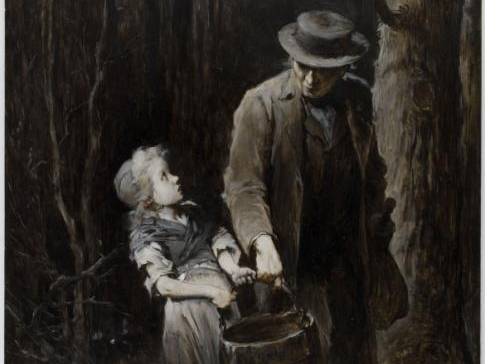
My favorite scene of the whole book up until this point is when Cosette meets Jean Valjean.
“My child, what you are carrying is very heavy for you. Give it to me,” said the man; “I will carry it for you.”
Jean Valjean unknowingly meets Cosette
It is recounted for us three times. The first, when Cosette, in chapter 5, is all alone in the woods with a bucket of water. Her foster “mother” forced her to get it on Christmas Eve night since they happened to run our of water. So through the cold and snow she walks barefoot to the nearest stream.
The bucket is too heavy. It is all too much for her. She cries out to God for the first time in her life. When she does, a mysterious man grabs the bucket, and it becomes weightless.
A chapter later, we see the same scene from Jean Valjean’s point of view. He comes up behind the little girl, after finding to location he hid his money before being captured the second time. Pitying the little girl, who he does not know and has never met, he grabs the bucket silently.
Finally, chapter 7 describes the first conversation between Jean Valjean and Cosette. It is at this moment that I almost cried.
She had never been taught to turn to Providence and to pray; nevertheless, she felt within her something which resembled hope and joy, and which mounted towards heaven.
Cosette inspired by Jean Valjean
Throughout the book, different characters have played the role of “God” in the story. Bishop Bienvenue was like God to Jean Valjean. Jean Valjean was like God to Fantine, then described as Jesus to the poor man mistaken as him. Now, Jean Valjean is God again to Cosette. When Cosette cries out to God is the exact moment Jean Valjean appears. The first thing Valjean says to Cosette is carry her load for her, since it is too heavy for her.
The comparison between Jean Valjean and Jesus is plain to see: he carries her load. He causes joy within her to rise to heaven. And, in this first conversation, all he does is ask her questions. He just asks and asks and asks, forever interested in her, forever forgetting himself.
It is a vivid moment, one where Victor Hugo weaves God into his story.

Two Key Themes
The two key themes of this volume are providence and isolation.
Providence is key to understanding this volume. It’s why Victor Hugo spends 18 chapters recounting the Battle of Waterloo. It’s why Jean Valjean just so happens to come across Cosette in the woods when he might never have found her otherwise. It’s why Jean Valjean just so happens to climb into the one convent where he convinced the convent to employ a man whose life he saved. All over this chapter, Victor Hugo is discussing the nature of God’s hand in the events of the world. A key quote about the battle of Waterloo makes that clear:
If it had not rained in the night between the 17th and the 18th of June, 1815, the fate of Europe would have been different. A few drops of water, more or less, decided the downfall of Napoleon.
Victor Hugo on the Battle of Waterloo
All God need to send was a cloud, traversing the sky out of season; and that sufficed to make a world crumble. God is in control; Napoleon, who squinted his eyes to stare at God’s face and say, “You wouldn’t dare,” embarrassed God. And so the Infinite leveled the Emperor.
The other key theme is the key of isolation versus community. Jean Valjean finds Cosette, and this for the first time unlocks true love and not just virtue for him. This is the reason we spend nineteen chapters on the Convent, Le Petit-Picpus. How do humans isolate? Why do they? Does bring them closer to God? And even if they do isolate, why do they tend to gather together, like they do in the isolated community of Le Petit-Picpus?
This cloistered existence is not life, for it is not liberty.
Victor Hugo on Cloisters
This isolation, this separation and constraining of the human so that it lacks love for another, is not life, for it is not liberty; therefore, it is not community. Victor Hugo respects the nuns for their love of God; but he does not need their piety. What he needs is community and liberty.
Conclusion
Les Miserables: Volume Two continues the depth and themes of the first volume. It’s fun to recount it for you. I hope, if you haven’t considered picking up the book yet, this will invite you to. It’s worth the ride!

𝙷𝚒! 𝙼𝚢 𝚗𝚊𝚖𝚎 𝚒𝚜 𝙽𝚊𝚝𝚑𝚊𝚗. 𝙸 𝚕𝚘𝚟𝚎 𝚜𝚝𝚘𝚛𝚢𝚝𝚎𝚕𝚕𝚒𝚗𝚐, 𝚕𝚎𝚊𝚛𝚗𝚒𝚗𝚐, 𝚊𝚗𝚍 𝚌𝚛𝚎𝚊𝚝𝚒𝚗𝚐, 𝚊𝚗𝚍 𝚊𝚕𝚜𝚘 𝚕𝚘𝚟𝚎 𝚝𝚘 𝚝𝚊𝚕𝚔 𝚊𝚋𝚘𝚞𝚝 𝚝𝚑𝚎𝚖 (𝚜𝚘𝚖𝚎 𝚠𝚘𝚞𝚕𝚍 𝚜𝚊𝚢 𝚝𝚘𝚘 𝚖𝚞𝚌𝚑!) 𝙵𝚘𝚕𝚕𝚘𝚠 𝚝𝚑𝚒𝚜 𝚋𝚕𝚘𝚐 𝚝𝚘 𝚜𝚎𝚎 𝚖𝚘𝚛𝚎 𝚌𝚘𝚗𝚝𝚎𝚗𝚝!
 Go-To Guru: Film, Literature, Television, and More
Leave a comment