
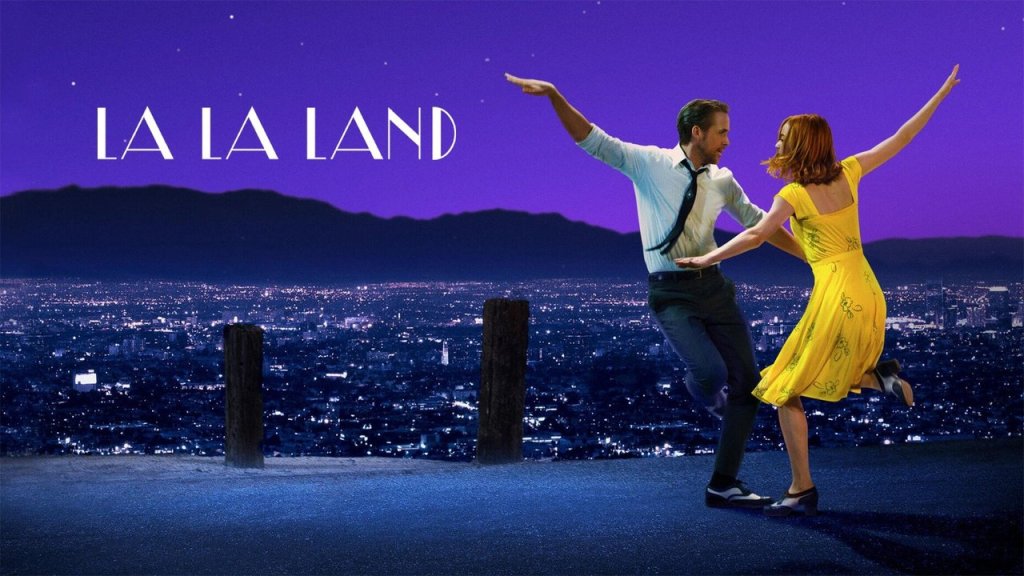
La La Land is a 2016 romantic-drama musical written and directed by Damien Chazelle with music by Justin Hurwitz.
La La Land needs to be talked about more.
I feel like at the time it released (partially because of the infamous Best Picture mistake) it received a lot of ridicule. It was wholly derivative; it’s just idolizing old Hollywood; the dancing isn’t that good; the singing isn’t that great; it went on and on. It became the target of a lot of undue lambasting.
But when I watched it again a week ago for Valentine’s Day? I was reminded all over again why this movie is one of the greats.
Let’s look at three scenes that show how La La Land captures something uniquely beautiful.
The First Date
I remember being a nervous teenager, the first time I held the hand of the girl I liked. Watching a movie with a group of friends. The tension; the anxiety; “Does she want to? What will she think? Are other people watching?”
I’ve never seen a movie capture the feeling of that as well as that scene above from about a third of the way into the movie.
Emma Stone as “Mia,” rushes into the theater. She’s late; she was on a date with her affluent boyfriend, but decides to leave rather than leave Ryan Gosling as “Seb” out to dry. They lock eyes; they sit next to each other in the dark of the theater.
The thing is, they didn’t establish if this was a “date.” It’s “research” for her next audition (which we know she didn’t get, although he doesn’t know that yet).
We cut to what they’re watching, Rebel Without a Cause. Then, a profile (from the side) closeup on Seb’s face, paying attention to the movie… but also trying not to pay attention too much to who’s sitting next to him. Cut to… I don’t know, is it still a medium wide shot when they’re sitting down? Two subjects in frame. Seb doesn’t move, so our focus is caught immediately by Mia, who shifts her hand.
Seb notices; he looks down. Her hand is awkwardly sneaking up her leg toward her knee. No one normally sits like that. It’s a medium shot, or a medium close up; somewhere in that continuum where we aren’t right on their legs; it looks like from Seb’s point of view, looking down. Back to the medium wide shot; Seb looks back up, trying to be inconspicuous. We don’t care what the movie is saying at this point, just like they don’t. It’s muffled; we can barely hear it.
Seb hesitates a moment, looks back down, and shifts. We’re back to the view of the legs, and now he’s moved his hand down. Cut for the first time to a profile closeup of Mia; Seb’s looking up now, but Mia’s noticed his hand has moved and her breath catches. Suddenly it’s an extreme closeup; nothing else is in focus besides their two hands. They sneak slowly toward each other; their hands visibly tremble. Back to the viewpoint of Seb’s profile, but Mia’s in focus. Then back to the hands that slowly wrap around each other. Back to Mia, and she doesn’t gasp or do an extreme. Instead, we see a smile barely dance on the edge of her lips as they both try to act like nothing’s happened.
The cutting is fast and frantic; we catch our breath with Mia’s. There’s no rhythm to it; each shot is less than three seconds, some less than a second. The longest is when the two hands finally wrap around each other.
I’ve never felt like a movie captured this particular feeling in this way before. While some might rag on this movie–that it’s simply a rip off of old Hollywood musicals–where is this scene? Where is it from? What is it ripped off from? It is completely original. Damien Chazelle (or his frequent collaborator, editor Tom Cross–or both) has a knack for using cuts, especially frantic cuts, to portray emotion.
Well duh, you might say. That’s the point of cutting. But think of the infamously vulgar Whiplash scene where J. K. Simmons enters his first yelling fest (if you don’t know what I’m talking about think: “Not quite my tempo”). Much of that movie cuts in time with the music; that scene does for the first minute or so. But as soon as J. K. Simmons throws the chair at Miles Tellier, the editing is frantic; the camera is focused only on them; the camera shakes; the cuts seem disconnected. Chazelle and Cross have been working together since before that movie and have since then, and they clearly understand each other well.
Same here, but instead of one type of nervous energy, it’s a different kind. It all builds so much anticipation until the two lean in to kiss (which is also the first time they’ve looked each other in the eye the last few minutes; before that, they’re avoiding each other’s gaze like the plague!) The cuts become frantic again; Mia’s profile focusing on Seb, Seb’s focusing on Mia, from in front, from behind silhouetted against the movie; then Bam! The movie cuts out, and they just have to laugh at the irony of it all, a whole weight lifts off your chest, too. And that was just about holding hands!
The Big Argument
The same understanding of humanity and the same rhythmic mix of chaotic editing is open in the “big argument,” about two thirds of the way through the movie.
Seb has joined a pop-influenced Jazz band, touring the country in the “steady job” he thought Mia wanted for him. Mia, meanwhile, is staging a one-woman play that he encouraged her to write and produce. Seb is home for a night between tours, and so prepares a romantic dinner for the two of them.
The first shot is of a record player, playing the love song they were just singing together.
The shots start as medium shots; we see the waist up. You’re looking over Seb’s shoulder at Mia, and over Mia’s at Seb, so you see both reactions (or portions of them) in the same frame. The conversation starts amicably, and the cuts come infrequently: some are only two seconds, some are as long as ten.
Then, as they start fighting, misunderstanding, assumptions of bitterness rising to the surface because of distance and miscommunication (in one of the most realistic scenes of relationship conflict I’ve seen next to Season 3 of The Chosen), the shots are closer; they’re medium close-ups, and we can see their facial expressions more clearly in the dancing candlelight. They begin talking over each other, cutting each other off. The editing sometimes lingers on Seb’s exasperated face, but then within a few seconds will cut repeatedly. It’s hard. The shots stay the same; it’s not bouncing between a bunch of different views like the first date. It’s sticking to these slightly-off-center medium close ups, and it’s unnerving to stare in the face of relationship conflict for six minutes.
Then Seb says the irredeemable; “You were dating me because you wanted to feel better about yourself. And now I’m successful.” We cut to the record; the song is done. It’s run out. It’s the first shot not of the two of them in one of four different viewpoints (and two of those medium shots were only for the first minute or so). It brings the argument to a sharp close.
Again, Damien Chazelle is a master at capturing the realness of human conflict in an unflinching way. Not in war, not in big drama, but in the normal fights that couples have all the time. It’s uncomfortable to watch this reflection of ourselves, performed so well (Emma Stone deserved that Best Actress Oscar for this). This is unique. This is special. This isn’t blatant rip off or homage or whatever you call it; it’s true human conflict bringing us spiraling down to earth.
But then…
The Finale
The finale ten minutes present us with a possible alternate reality, where that argument didn’t happen, Seb didn’t join that band, and the two of them end up together.
The alternate reality is filmed on sound stages that are stripped right out of Singin’ In the Rain, Guys and Dolls, and other Hollywood musicals from that era. The bright colors, the shifting sets, the fantastical costumes feel like a musical.
Musicals on stage are always exaggerated, always larger than life, because of the very nature of the medium of theater. It requires broadcasting to a crowd who might never see the face of the actor. There isn’t the subtlety possible that we see in the argument or the first date. Large crowd theater has many strengths, but that is not one of them. They work in other creative ways to capture your emotion.
This finale is larger than life. It’s meant to be exaggerated. Because it’s the two of them sharing a moment of what could be but what wasn’t.
In that alternate reality, their home is smaller than Mia’s; Seb doesn’t open his club. The two of them are happy, yes. But the feeling is that they wouldn’t have it any other way, as the two smile at each other and nod. They are happy for each other.
Reality and fantastical crash together; one, so much larger than life, the characters small figures moving across colorful sets; the other, subtle. Sad. Blues and blacks and shadows cloak the room. The piano is slow and mournful, not hugely orchestral or recounting a life lived well with jolliness.
That is what made La La Land so unique and wonderful. It’s “la la land,” imaginary, nonexistent, like a kid zoning out in class. But it’s also “LA, LA Land,” Los Angeles, Los Angeles Land. It’s a real place with real people. And for two hours you see two real people in this larger-than-life story deal out dreams.
In one, life is a dream; in the other, they obtain their dreams. Which is better? Fantasy, or reality?
Why not both?
La La Land was written and directed by Damien Chazelle. It stars Ryan Gosling, Emma Stone, and John Legend. Music was by Justin Hurwitz, lyrics were written by Benj Pasek and Justin Paul (Pasek and Paul), and choreography was by Mandy Moore. Cinematography was by Linus Sandgren. 128 minutes.
𝙷𝚒! 𝙼𝚢 𝚗𝚊𝚖𝚎 𝚒𝚜 𝙽𝚊𝚝𝚑𝚊𝚗. 𝙸 𝚕𝚘𝚟𝚎 𝚜𝚝𝚘𝚛𝚢𝚝𝚎𝚕𝚕𝚒𝚗𝚐, 𝚕𝚎𝚊𝚛𝚗𝚒𝚗𝚐, 𝚊𝚗𝚍 𝚌𝚛𝚎𝚊𝚝𝚒𝚗𝚐, 𝚊𝚗𝚍 𝚊𝚕𝚜𝚘 𝚕𝚘𝚟𝚎 𝚝𝚘 𝚝𝚊𝚕𝚔 𝚊𝚋𝚘𝚞𝚝 𝚝𝚑𝚎𝚖 (𝚜𝚘𝚖𝚎 𝚠𝚘𝚞𝚕𝚍 𝚜𝚊𝚢 𝚝𝚘𝚘 𝚖𝚞𝚌𝚑!) 𝙵𝚘𝚕𝚕𝚘𝚠 𝚝𝚑𝚒𝚜 𝚋𝚕𝚘𝚐 𝚝𝚘 𝚜𝚎𝚎 𝚖𝚘𝚛𝚎 𝚌𝚘𝚗𝚝𝚎𝚗𝚝!
 Go-To Guru: Film, Literature, Television, and More
Leave a comment