
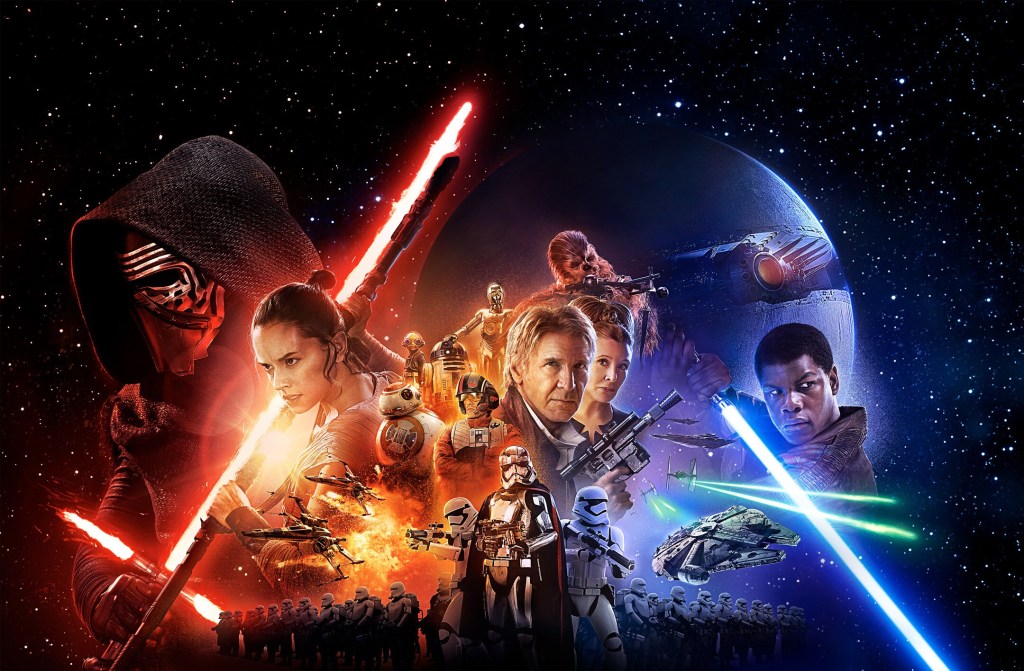
Star Wars: Episode 7: The Force Awakens is a 2015 film directed by J. J. Abram, and written by Abrams, Lawrence Kasdan, and Michael Arndt. It stars an ensemble cast of veterans to the series and new actors and characters.
Disney Star Wars has been divisive, to say the least. Star Wars: The Last Jedi, the sequel to The Force Awakens and the eighth canonical Star Wars movie, fractured moviegoers and fans. Some heralded it as the greatest movie in the saga; some, an average entry not to write home about; others, as an unmitigated disaster and a slap to the face of fans of the series as a whole. The Rise of Skywalker, the ninth mainstream Star Wars film, met with low returns for a supposedly “hit” blockbuster. It made below even Captain Marvel, an off entry in the Marvel universe before Endgame. The obvious flaws of Rise of Skywalker have been meme’d to death.
But what many people don’t see is that the derailment didn’t start with The Last Jedi. It wasn’t with The Rise of Skywalker. The Force Awakens began it.
Because The Force Awakens is a textbook case of Frantic Filmmaking, in two forms. First, the film itself is extremely frantic. The story never gets chance to breathe while it catapults from nonsensical setpiece to nonsensical setpiece, never letting anything sink in. Second, the production of the movie was frantic; there was no plan going forward into the new trilogy and the movie was made frantically to capitalize on Disney’s mega investment in Lucasfilm, and it shows.
Frantic Movie
“This movie never gives you a chance to breathe.”
This could be a great review for a horror movie, or a thriller movie, or an intense action movie.
Is that a great review of a galactic fantasy adventure movie? Not in this case.
The Force Awakens has only one scene that I would say is a genuine character-building scene. The first minute and a half montaging without dialogue through Rey’s life on Jakku does an alright job building what life looks life for our desert scavenger. We see how she longs to leave this planet as she looks at a starship, how she sits alone at her ruined home inside a walker counting the days she’s been left alone for. It builds the image of a lonesome character, who has little to no human interaction, and who longs for more and better.
There’s also that scene where Rey looks out over Takodona and says, “I’ve never seen so much green in the whole world.”
Pretty much any other character scene is compromised and contradicted by the movie’s frantic filmmaking.
Action scenes occur in this movie about every 5 minutes. There’s the initial raid on Jakku. The interrogations of Lor San Tekka and Poe are intermixed with bursts of action, including Kylo killing Tekka. Then, Finn helps Poe escape; more action! (Why did they take Poe back to the star destroyer when they could just interrogate him there? In fact, what they’re looking for is probably literally right there. But don’t think about it!) Finn finds Rey; more immediate storm trooper action! They fly, then fly away from Jakku (convenient the Star Destroyer isn’t screening every ship leaving the planet, huh? And why aren’t there more ships than 3 TIE fighters preventing ships from escaping?) Then they extremely conveniently find Han Solo and Chewbacca, before instantly ANOTHER action scene with the pirates and the Rathtars. They slow down for a bit at Takodona, but within minutes the First Order have found them and teleported across the galaxy (remember in the Original Trilogy when hyperspace took… you know… time? Hours, even days?). Then Rey’s captured (why do they take her back to Starkiller? Why not just interrogate her in space outside Takodona?), but she escapes pretty quickly before the next action scene starts…
You get it. The movie is trying to have you feel constantly excited, interjecting nonsensical action scenes that don’t contribute much to the characters: or, what they do contribute is nonsensical. Why did Han Solo just so happen to be in this part of the galaxy at this specific time? How did these pirates find Han Solo? Did they track him through hyperspace? If they found Han, why didn’t the First Order? Why isn’t the First Order screening every ship in this section? And why are the pirates eager to work for the First Order, but don’t call up the First Order until after the big fight? And why do the Rathtars immediately eat every single pirate, but instead just “grab” Finn for several seconds?
Even then, this action scene isn’t well constructed to give characters opportunities to shine in their own ways. While Rey gets a chance to close some doors for Finn, Finn doesn’t have any moment where he objects to violence (because remember how his whole arc started with him objecting to violence?). Han Solo never struggles in the fight (if he’s washed up and old and lost his mettle, why is he still “so good” at fighting?). BB-8 doesn’t get to do anything but wheel around. Chewie gets shot and Han takes his bowcaster, which leads to some comedy, and Chewie isn’t too important to begin with. But we’re still not using Chewie’s unique abilities in any meaningful way, or giving small character moments to him and Han.
Yes, we see Poe be an awesome pilot later; yes, we see a stormtrooper call Finn “Traitor!” (by the way, why was that not Phasma? That’d make so much more sense); yes, we see Chewie rage briefly when Han dies. Those are at least some moments where we recognize character can show through action. But even then, they are often brief, or not carried through to a meaningful impact (Finn never mentions that “traitor” comment again, nor does it seem to shake him or even give him pause). Action gives you ways to develop your characters, but it takes a talented writer to do that.
By the way, that Lor San Tekka lightsaber slice takes 5 frantic cuts in 3 seconds. Cuts often come quick and choppy throughout the movie to give the appearance of excitement and motion. Rey and Finn are flying, and bam a ship appears, and bam they go into smuggling compartments, and bam bam bam. When they get back to the rebel–sorry, Resistance–base, Poe is magically there. Wait, what? How did he get back? Why didn’t the First Order catch him if they have an entire Star Destroyer and all its resources on the planet? But nope, we’re moving on, don’t think about it! Nothing is allowed to breathe; when the camera isn’t epicly slow panning when Han is explaining the force, it’s flipping all over the place, cutting fast from moment to moment. It gives you the appearance of excitement so you don’t think about it too much.
There’s also a lot of meta in this script. When Han enters the Millennium Falcon cockpit, there’s a music swell and he looks reverently around. But that’s how the audience would react; it’s fan service for us. But would Han act that way? Would he be reverent, or excited, or relieved,? And wait, if he loves this thing so much that it’s his “home,” why did he give it away in the first place? But it’s how the audience would react, so he reacts that way.
Why does Han say, “There’s always a way to blow these up” when they’re looking at the Starkiller base plans? Why is there even a Starkiller base? Oh, references! And why does Rey say to Kylo, “You monster, take off your mask!” We’d expect him to be scarred or something underneath cuz of Vader, but why would Rey expect that? Those stormtroopers are people, and they’re wearing masks. Besides, isn’t that a bit racist? She’s lived around mostly aliens her whole life; she shouldn’t see them as “monsters” necessarily. But it’s meta. We’d expect him to be scarred, so she does. Again, it gives you the appearance, the feeling, of understanding. You get your fuzzies tickled because you’re “in the know.” You like it. But it’s not a good script. It’s shallow, very shallow, even frantic in the way it rockets through these references.
Don’t get me started on the impossible world building. At the time, people clapped that it wasn’t about all that “politics” that the prequels had (that seems to be a pretty big goal with this whole movie, really: “DON’T be the prequels!”) But… it’s nonsense. Who’s Snoke? We find out in Rise of Skywalker that he was a creation of Palpatine, but how did he come to power? Why did people follow him? How does the First Order have so many resources, when it took years for the Empire with a galaxy’s worth of resources to build the Death Star? How much power does the New Republic have? Why is the Rebellion–wait, I mean the Resistance their military (oh yeah, references to how it was in the OT!) How did Snoke take Kylo’s mind? How do they know that he did, if it was secret persuasion or something? Why is everything the characters of the OT accomplished an utter failure, all of their work destroyed by a rebellious kid and a giant planet laser? It’s all frantic worldbuilding, just trying to recreate the world of the original Star Wars movies, to get you excited and full of nostalgia, with none of the careful effort that went into the originals.
There’s nonsense all over this script. It’s written to give you the feels. It’s written to make you feel excited, just enough not to look deeper. Quick cuts combined with ever-present action and excitement cover over the nonsensical aspects of this story. It’s frantically trying to get you to like it.
At the time, it worked. Yeah, some people saw through the whole Starkiller base thing. But overall, people were impressed with the movie. It worked. It grossed $2 billion at the box office and still is the highest-grossing movie in the United States (also called the “domestic” gross).
But from day one, this frantic movie was fueled by a frantic production.
Frantic Production
Disney bought Lucasfilm in October of 2012. The Force Awakens was released in December 2015. 3 years is about average production for a movie. There were three years between each of the Star Wars prequel films. However, those release dates (1999, 2002, and 2005) don’t tell the whole story. And that story showcases the problems from the get-go with the sequel trilogy.
Production on The Phantom Menace didn’t actually begin in 1996; it began in 1993 when Lucas started drafting the outline of the story. By 1994, they were creating creature and planet designs, casting actors, creating sets, and working from a pretty solid script (it would change form as the sets were created, but it was pretty close to the final result). The film was completely storyboarded for filming from start to finish.
All of that work, and that movie was still rough in lots of ways. While you can definitely see the passion in the design, and many have said the world of the prequels is much more expansive than the execution of the story itself, there still is the story itself. It’s bogged down by ineffective worldbuilding, weird directing choices, politics untethered from characters that grind the movie down, and unfocused characters. Seven years, and the writing fell short, not the design or the world.
The prequels are often lambasted for their use of CGI over practical effects. But that really wasn’t the problem. A movie can have bad or good CGI, but if the story’s good, people will stay and love it far later on then the special effects. The special effects are cool. Design is cool. The stories of the special effects of Episode 1 through 3 are, frankly, insane and really interesting. But seven years lead to still-rough story.
Three years. Three years to decide how to redirect an entire franchise, to continue a world in an organic way that was already finished.
The sequels learned the wrong lessons from the prequels. Not to tether politics to characters, but no politics at all. Not special effects tied to a coherent story, but “No CGI!” Not complex characters written well, but “Let’s make ’em as likable as we can!” Frantically trying to identify themselves as not the prequels.
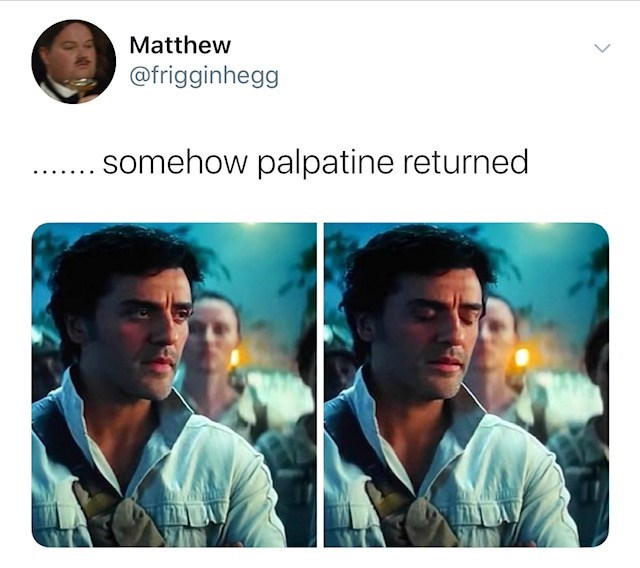
The decision to have Poe Dameron reappear in the film instead of dying on Jakku occurred after Oscar Isaac had been hired for the role. One of the members of the core “trio” of the movie was an afterthought to get a famous actor more screentime. (The cynical side of me says… a famous, diverse actor. But perhaps that’s my bias). JJ Abrams reportedly told Oscar Isaac, “I found it. I found a way for you to be in the whole movie.” That means… “I found a way to magically make you reappear.”
That’s just one sign of the frantic filmmaking under display in this movie. A quick browse through Wikipedia will tell you the script was completed in just 6 weeks (rather than the 18 months Michael Arndt said he needed); that they had no plan for the future movies; that all of the “mystery boxes” in the film, like who Rey’s parents were or who Snoke was, had no answers at all. They were just set up for interest, to peak audience’s interest without them thinking about them so hard because there were no plans. Daisy Ridley’s acting was called “wooden” because her acting was falling short of JJ Abrams’ expectations. Which can happen; but why is JJ Abrams saying this on the first day? Is it because the production isn’t prepared for what they’re doing? They’re just throwing something together? Why? Why just throw something together?
The production was frantically putting out a movie because Disney needed to make back its $4.1 billion investment in Lucasfilm.
Why lean on feel-good and thrills rather than a solid script, written well? Because they needed to make back their investment. It was about making people happy enough to watch the movie, and then recommend it to friends and see it again. It wasn’t about making a good movie. And a good movie isn’t what they made.
𝙷𝚒! 𝙼𝚢 𝚗𝚊𝚖𝚎 𝚒𝚜 𝙽𝚊𝚝𝚑𝚊𝚗. 𝙸 𝚕𝚘𝚟𝚎 𝚜𝚝𝚘𝚛𝚢𝚝𝚎𝚕𝚕𝚒𝚗𝚐, 𝚕𝚎𝚊𝚛𝚗𝚒𝚗𝚐, 𝚊𝚗𝚍 𝚌𝚛𝚎𝚊𝚝𝚒𝚗𝚐, 𝚊𝚗𝚍 𝚊𝚕𝚜𝚘 𝚕𝚘𝚟𝚎 𝚝𝚘 𝚝𝚊𝚕𝚔 𝚊𝚋𝚘𝚞𝚝 𝚝𝚑𝚎𝚖 (𝚜𝚘𝚖𝚎 𝚠𝚘𝚞𝚕𝚍 𝚜𝚊𝚢 𝚝𝚘𝚘 𝚖𝚞𝚌𝚑!) 𝙵𝚘𝚕𝚕𝚘𝚠 𝚝𝚑𝚒𝚜 𝚋𝚕𝚘𝚐 𝚝𝚘 𝚜𝚎𝚎 𝚖𝚘𝚛𝚎 𝚌𝚘𝚗𝚝𝚎𝚗𝚝!
 Go-To Guru: Film, Literature, Television, and More
Leave a comment