
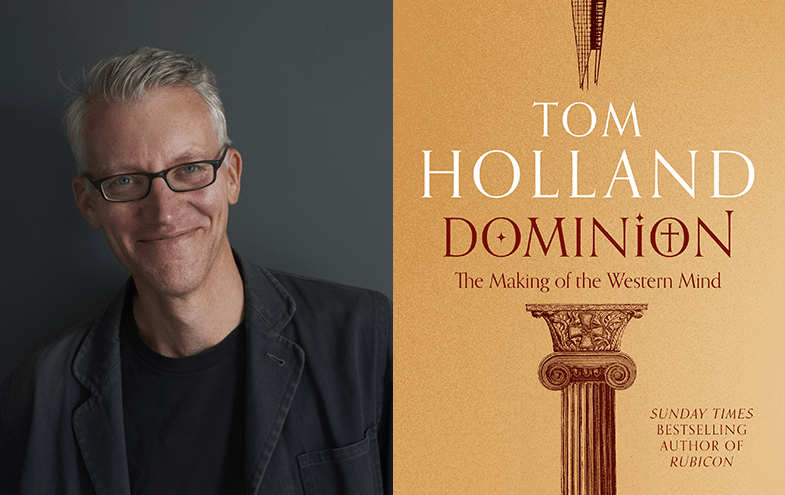
Dominion: How the Christian Revolution Remade the World is a 2019 historical survey on the influence of Christian assumptions on the modern world by popular historian Tom Holland.
Friends and readers of mine who are Christian, and have any political, academic, or historical interest what-so-ever. You need to drop what you’re doing and read this book right now.
Friends and readers of mine who are not Christian, and have any political, academic, or historical interest what-so-ever. You need to drop what you’re doing and read this book right now.
It has completely reframed how I have thought of modern culture, culture wars, politics, and parties. It has substantially altered my picture of the history of the world. It has shaken to the core my preconceptions of the faith I belong to as well as how it has influenced the “faith” of any and every person I come in contact with–whether that person’s faith is Christian, or Lutheran, or Catholic, Muslim, or Jewish, or Hindu, atheist, or agnostic, or anything else.
This book is a powerhouse of scholarly research, with hundreds of references to modern scholarly sources, contemporary popular sources, ancient sources (many of which Tom Holland translated himself with his school-learned Latin and his self-taught Greek), and everything in between. It’s also extremely entertaining, because Tom Holland knows how to tell a story and weave a narrative, with suspense, intrigue, dazzling or harrowing or moving description, all in one three-millennia-spanning package.
No, it’s not the Spider-Man-playing Tom Holland, but popular historian Tom Holland, one of two hosts of The Rest is History podcast, which is among the most downloaded and popular podcasts in the world (in 2022, it was the top podcast of any genre in Britain, Australia, and New Zealand, and that same year it was the top history podcast in Europe). Tom Holland was previously most well-known for his research into ancient history, including books written about Julius Caesar, the Persian Wars, and, most controversially, the early Muslim empire. In 2019, however, Dominion became his most popular book and his writing that catapulted him into popular consciousness and discussion. The Rest is History only drove that popularity higher.
Rather than reviewing the books, or breaking down Tom Holland’s massive argument into all its component parts, I will provide an overview of the various topics covered in the book. Tom Holland will give us insight into how our modern view of the world is completely saturated by Christian assumptions. It’s in the very air we breathe, most crucially in these 5 ways.
Individual Dignity
Why do we believe in human rights? Why do we believe each human has individual dignity, whether male or female, wherever they come from on the planet?
“In 1550, in a debate held in the Spanish city of Valladoilid on whether or not the Indians were titled to self-government, the aged Bartolomé de las Casas held more than his own. … Pagan or not, every human being had been made equally by God. … Every mortal–Christian or not–had rights that derived from God. Derechos humanos, las Casas had termed them: “human rights” (345). Human rights isn’t from all cultures. It’s from a particular cultural tree, from the seed and root of Christianity.
The idea that all people are made in the image of God is one that infiltrated all of Western culture, and then Western culture denied its root. “These human rights… existed naturally within the fabric of things, and had always done so, transcending time and space. Yet this, of course, was quite as fantastical belief as anything to be found in the bible. The evolution of the concept of human rights… derived, not from ancient Greece or Rome, but from the period of history condemned by all right-thinking revolutionaries as a lost millennium, in which any hint of enlightenment had at once been snuffed out by monkish, book-burning fanatics. It was an inheritance from the canon lawyers of the middle Ages” (401-402).
Human rights is now embedded in almost every functioning constitution on planet Earth. The European powers touched all corners of the world and infected others with their assumptions that they assumed were universal.
Humanism is, in reality, a Christian heresy.
Some of these countries had rude awakenings in the past century. When they engaged in practices that in their cultural memory had been acceptable or even honorable, they clashed hard with the idea of individual dignity. As Japanese soldiers beheaded prisoners in the Second World War and kept the picture of it as a trophy, or extremist Muslims boarded buses and demanded women wouldn’t go to school, it horrified Westerners and Americans. “Don’t they know that all people have dignity, all people have rights, all people are sacred? That’s barbaric!”
But half a millennium before, those practices were happening in the West, even if they were frowned upon by monks, pastors, and the more spiritually inclined. The slow process of Christian ideas becoming untethered from Christian roots created assumptions about what “people should do” or “what’s true.” But untethered ideas had no basis; they were just assumptions. “People have rights.” Prove it. Where’s the proof? There isn’t any–except that Westerners assume there should be.
Sacred VS Secular
Why do we believe in a realm of the “sacred” that is separate than the “secular?”
In every culture of the world, from ancient Greece to medieval China, from much of modern Africa to Native American tribes, there was no split between the “sacred” and the “secular.” There wasn’t any concept of a world in which there could be a government that didn’t espouse the same three-dimensional values of the people it supported. Romans were obligated to offer sacrifices to their emperor as a deity. The Japanese Emperor even to today is believed to be descended from a god.
Only four hundred years ago, the major branches of learning in any school involved Theology. Harvard was founded to train pastors. The German Lutheran church is still nationalized and tied to the government, if loosely.
And yet, starting two thousand years ago with the words; “Give to Caesar what is Caesar’s, and to God what is God’s,” a ripple effect would create the modern secular/sacred split. In the 1080s, a Pope attempted to seize power from a Holy Roman Emperor. To do see, he codified the separation between the earthly and the heavenly. “A Church rendered decisively distinct from he dimension of the earthly, from top to bottom, from palace to meanest village” (230). It was this pope who first put forward the term “secularuem” to describe the world that was not of the Church. To him, the church was above and ruled the secular.
In the centuries that followed, the West reversed the distinction. Once again, the Enlightenment tried to find the basis for its assumptions in Greek philosophy when they were thoroughly Christian. The secular would confine the sacred to small areas; to churches and personal devotion, not for the public sphere of government, and not to be featured in art, media, and entertainment. Still, that distinction only existed in the West until the Western world spread its influence. No other cultures ever had the idea that there could be a split between the secular and the sacred. It was the seeds of Christianity that once again split the sacred from the secular.
There Is Neither Male nor Female
In what countries or regions were women originally given equal status to men before both the government and the wider world?
Of course, this does not mean that women are treated perfectly in Western countries or Western-influenced countries. They are not. Nor is this to say there were not matriarchal societies in some peoples at some times in which women had a specific role in governing or deciding.
However, in what societies were men and women first declared equal? Where voting rights, property rights, and more were first enshrined? These arose, so Holland claims, out of Western culture.
For hundreds of years women in Western cultures have campaigned for these rights, from the 1800s, all the way back to the 1200s. Holland provides the stunning examples of women like Guglielma (page 271 and onward) who believed they were bringing heaven on earth by abolishing the cultural and sacral differences between men and women.
Tom Holland, ever the critical scholar, is unafraid to make statements like, “Even Paul, on occasion, had felt unsettled by the sheer subversiveness of his message. The equality of men and women before God was a concept that he had often flinched from putting into practice” (275). He sees radical statements about the status of men and women God’s Kingdom as kernels of truth that would eventually invade all assumptions of women in western culture once the enlightenment was untethered Christian ideas from Biblical moorings.
“There is neither male or female… in Christ,” Paul declares in Galatians 3. But when have these words be an underlying culture assumption for two thousand years, you take away the “in Christ” about the 1750s, eventually the differences between male and female in cultures fade away.
Eventually, even, these cultures might begin transgender movements unlike any seen in history. You can dig back and find instances of extremes in ancient high societies, men who dressed like women, or women who dressed like men. You can find instances of mutilated men, too, in their professions or as slaves. But to have people of all societal levels follow inner feelings and intense emotional upheaval, to then realign their external gender expression? This is unique in history.
What Holland might call “unsettled,” a Christian might call, “balancing the twin realities of an already-but-not-yet worldview.” A worldview where “At the resurrection people will be neither married nor given in marriage” (Matthew 22:30), yet still, in this age and this old creation that is passing away, “Man was not created from woman, but woman from man” (1 Corinthians 11:8). As God tells us our reality but peels the curtain back, so did Paul.
But not everyone gets that. If you untether Paul’s assertions from their Christian moorings, the ship goes adrift into gender egalitarianism… and even modern movements such as the transgender movement. Combine the ideas of “there is no male or female” with “everyone deserves personal dignity” with the following cultural kernel about the power of suffering, and feminism and modern transgenderism are born.
In reality, feminism and transgenderism are Christian heresies.
The Power of Suffering
Romans 5:3 “Not only so, but we also glory in our sufferings.”
Matthew 5:5 “Blessed are the meek, for they shall inherit the earth.”
“This, then, is the great humanistic and historical task of the oppressed: to liberate themselves and their oppressors as well. The oppressors, who oppress, exploit, and rape by virtue of their power, cannot find in this power the strength to liberate either the oppressed or themselves. Only power that springs from the weakness of the oppressed will be sufficiently strong to free both.” Paulo Friere, founder of the Critical Pedagogy movement, which was influenced by critical theories like Critical Race Theory.
The image of God crucified is a startling one. In fact, Holland makes the point that Christians didn’t begin to picture a distressed, bloody Christ until the 800 and 900s. Before, Christ is always pictured as serene on the cross, or even triumphant, like he’s mocking those who are torturing him. Yet over time, the suffering is seen as a virtue. Being in pain, being “martyred,” being poor and weak and lowly and despised, gives you strength.
Monks wander the countryside, whipping themselves in extreme self-discipline so that they may be worthy of heaven. Nuns who submit themselves to rigorous self-discipline are glorified. Saints who gave to the poor and the oppressed are exalted.
“We also glory in our sufferings.”
Marxism is another Christian heresy. Remove God, and we are responsible for exalting the weak. Remove God, and we are responsible for exalting the poor. Remove God, and we are to create heaven on earth by bringing the judgment day, where all history will build toward a single climactic moment. A moment where “the meek shall inherit the earth.” A world where those who suffer, those who are oppressed, and those who are lowly are dignified, while those in power are brought down. “He brings down the mighty from their thrones, but he has lifted up the lowly” (Luke 1:52).
Guess which cultures build toward a single day of judgment where all the all history comes together? Not Eastern cultures, which focus on a revolving cycle of history that one must either escape from or discover the patterns to control them. Not Native American cultures, which by and large pictured time as circular and closed, not evolving and transcending. Not Northern European cultures, which believed in a Ragnarok where all humanity would lose and everything would give into chaos. Not even Greco-Roman cultures, which believed in a cycle of expansion and contraction, where societies grow and then fall and then other societies grow and fall.
Guess which culture exalt the weak and the suffering? Not any of those cultures listed above.
A judgment day, where the world will be flipped. Where the suffering, oppressed, and poor shall inherit the earth. Even now, the oppressed are powerful in their oppression.
Nature won’t tell you that. Tell the squirrel it’s powerful for being hunted by the fox. I don’t think it’ll be convinced.
Why were we horrified so much by the Nazis? Why do Nazis still stand as the paramount of evil, when the Soviet Union under Stalin committed far greater atrocities? Why are the Nazis so demonized? Because they tore down these assumptions. They were a return to cultural ideas 2000 years old. Cull the weak. Get rid of the infirm. Who cares about the oppressed and the suffering? Power is the only way to control and to win. Use quasi-religious rituals to hype up a generation of youth to rabidly follow your cause. There is no individual dignity or rights; murder six million Jews because their race is weaker than ours. Jews are rats, Aryans are wolves. Reward dangerous, animal-like masculinity. The West stood by horrified as the Nazis betrayed every single assumption of Western culture–individual dignity, the sacred versus the secular, individual dignity, male versus female. And so we vilify them. But on what basis? On the basis of Christian assumptions.
Only in cultures saturated with Christianity’s view of suffering dignified in Christ, then remove the in Christ, with the same unique view of a day of judgment where all history will culminate rather than move cyclically, and Bam. You have Critical Theories. You have Marxism. You have theories built on assumptions that are only found within a Western framework.
Suffering is only given power when your culture was Christian for a thousand years.
Universalism
“Go into all the world and preach the goods news to all creation.” Mark 16:15.
“Every tongue shall confess that Jesus Christ is Lord, to the glory of God the Father.” Philippians 2:11.
“The workers of the world has nothing to lose, but their chains, workers of the world unite.” Karl Marx.
“All human beings are born free and equal in dignity and rights. They are endowed with reason and conscience and should act towards one another in a spirit of brotherhood.” Article 1 of the United Nations Universal Declaration of Rights.
Very few cultures think their way of life is universal.
In fact, many throughout history have been unafraid to pilfer other’s gods, or acknowledge fealty to them. Roman temples contained shrines to Egyptian gods. Confucian philosophy was less a philosophy and more a syncretism of local religions mixed with ideas on how to organize local Chinese society with its unique history in relation to the gods. Hinduism feels free to absorb other local religions into its own and fit them into its own network, without contradiction. Athenian democracy was based on the idea that the Athenians themselves had risen out of the dirt and dust. Being children of the earth meant that they all had a place within their government. That was perfectly compatible with holding slaves. Athens, the supposed enlightened haven of the ancient world, was a “democracy” so foreign to “All human beings are born free and equal in dignity and rights.”
It was not “you-do-you”: Christians still died for not paying homage to the demigod Caesar, and Buddhism was still for a time persecuted out of China and Japan. But it was, “us-do-us.” What we as a group do here is what we as a group do here. So should you, if you live here. But Sparta didn’t need to be a democracy. Athens was.
As Western culture spread throughout the world, it carried with it values it assumed applied to all people because the values claimed all people. And anywhere there was contradiction, it was not, “Absorb,” but “Demolish.” Break down what does collides. Abolish slavery in the Ottoman Empire. Force the Middle East into Democracies. Create Communist states across the world. Stand up everywhere for woman’s rights, gay rights, minority rights, governments that are not religious.
All people are created with individual dignity. Anyone’s suffering is dignified suffering. All women should be treated equally to all men. All religion should be separate from states. All religion is a personal matter. There is no corner of the world that untethered Christian ideas do not touch, just as there is no corner of the world that Christian theology does not touch.
And so…
If any of the ideas seem unsubstantiated here, or shallow, or just surface value understands of religions, then pick up Tom Holland’s Dominion for yourself and see if his argument stands. I believe it does. While he might view the untethering of Christianity positively, I am more mixed.
Yes, I am glad that slavery is gone. I am glad that democracy appears to be a more just and fair system of government than monarchy. I am glad that we now think butchering people is wrong, that all people are equal regardless of background, and that religion can be separate from secular.
But I don’t think it’s all good. I don’t think it’s good to deny the root of your ideas. And I think it becomes hard to empathize when you demonize all people who aren’t beholden to values that you deem to be “self-evident.” To many throughout history and the world today, not all men, or women for that matter, are created equal. To assume they’re hundreds of years behind the culminating timeline of history, when history might not be in a straight timeline, can leave many people in your moral dust. “The past might have something to contribute,” I would say, “And you need to examine the past to see where your values have originated from.”
But I still think his argument stands:
Western culture is just a Christian heresy.

𝙷𝚒! 𝙼𝚢 𝚗𝚊𝚖𝚎 𝚒𝚜 𝙽𝚊𝚝𝚑𝚊𝚗. 𝙸 𝚕𝚘𝚟𝚎 𝚜𝚝𝚘𝚛𝚢𝚝𝚎𝚕𝚕𝚒𝚗𝚐, 𝚕𝚎𝚊𝚛𝚗𝚒𝚗𝚐, 𝚊𝚗𝚍 𝚌𝚛𝚎𝚊𝚝𝚒𝚗𝚐, 𝚊𝚗𝚍 𝚊𝚕𝚜𝚘 𝚕𝚘𝚟𝚎 𝚝𝚘 𝚝𝚊𝚕𝚔 𝚊𝚋𝚘𝚞𝚝 𝚝𝚑𝚎𝚖 (𝚜𝚘𝚖𝚎 𝚠𝚘𝚞𝚕𝚍 𝚜𝚊𝚢 𝚝𝚘𝚘 𝚖𝚞𝚌𝚑!) 𝙵𝚘𝚕𝚕𝚘𝚠 𝚝𝚑𝚒𝚜 𝚋𝚕𝚘𝚐 𝚝𝚘 𝚜𝚎𝚎 𝚖𝚘𝚛𝚎 𝚌𝚘𝚗𝚝𝚎𝚗𝚝!
 Go-To Guru: Film, Literature, Television, and More
Leave a comment