
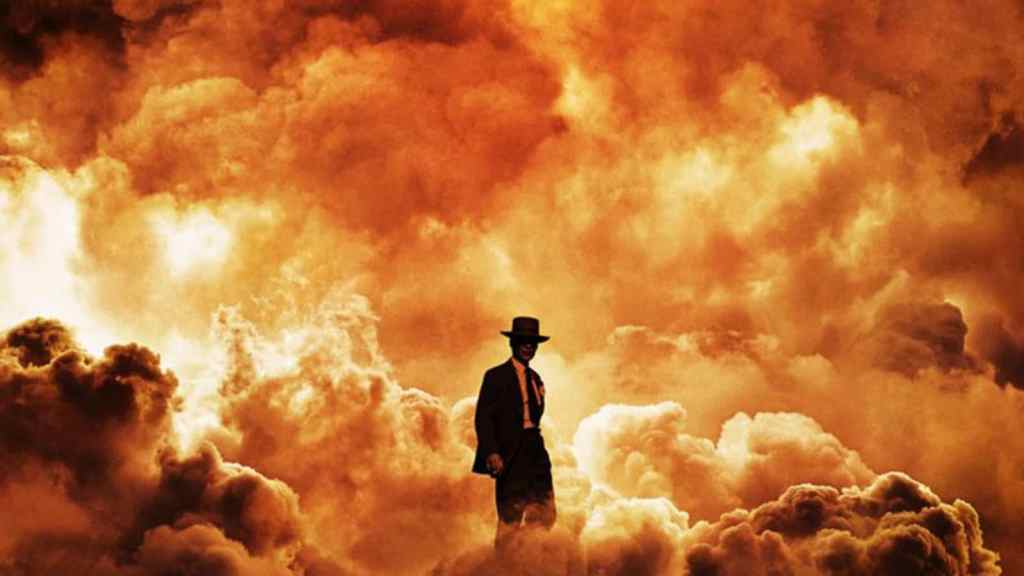
Oppenheimer is a 2023 biopic on the “Father of the Atomic Bomb”, directed and written by Christopher Nolan and starring Cillian Murphy as Robert Oppenheimer.
The Academy Awards, Hollywood’s biggest award night, is coming tomorrow: Sunday, March 10th, 2024. Leading the awards night is Oppenheimer with 13 award nominations.
It’s been a long time in coming. While Nolan has been nominated for tons of awards – the most before this being the 10 nominations of Inception, but The Dark Knight, Interstellar, and Dunkirk had 8 nominations each – he’s never won any of the “Big Awards,” with the exception of “Best Supporting Actor” for Heath Ledger’s performance as the Joker in The Dark Knight. He’s never won Best Director, he’s never won Best Actor or Actress, he’s never won Best Supporting Actress, he’s never won Best Screenplay (Original or Adapted) – and, of course, he’s never won Best Picture, the biggest of the big awards.
This is the most awards he’s ever been nominated for. It’s also the most BIG awards he’s nominated for. Screenplay. Actor. Supporting Actor and Actress. Director. And Picture.
But does Oppenheimer deserve the praise? Is it really Nolan’s best movie or finest movie? Does it match up with his finest work?
Oppenheimer is a weird movie.
There. I said it.
Although Nolan is often nominated for the “technical awards” – Best Editing, Sound Design, Sound Mixing, Visual Effects – this movie is very technically… strange.
There almost isn’t a single moment in this movie without music. In fact, the two scenes without music stand out by their lack – the explosion of the first Atomic Bomb, and the military planning scene when they decide where to drop the bomb. The music plays over every single moment.
That couples with the strange editing. The first hour of this three hour movie feels like a montage. Do you know what a montage is? A montage is a sequence in a movie, often with music, where shots and scenes are short and choppy to attempt to pass over a long period of time. One of the most famous of all time is the Rocky training montage – which you can watch here. You’ll see what I mean. It usually happens either to build tension to a main scene, or to bridge time between two scenes.
The whole first hour of this movie, and a portion of the end too, feel like montages. Often in movies, key scenes are given time to breath. You’ll have multiple short scenes, and then a longer scene with a key moment, conflict, or piece of information. Usually you start slower, get faster, slow down after the middle, get faster again toward the climax, then take your time at the climax. Sometimes you can start fast too, and then slow down the action or information after that to ease back into the story. There are so many ways to do it, and not one right way.
However, this whole first hour feels… weird. The scenes never last more than a few seconds. The cuts are fast and quick. You’re going back and forth between the “past” and the “present” as Oppenheimer and Strauss, Robert Downey Jr.’s character, tell the story of the past. It’s so fast and choppy that it feels like you’re watching a trailer for the first hour.
That feeling doesn’t necessarily let up through the second hour, the creating of the bomb, but it feels more appropriate there as they engage in what they feel is a race against time to create the bomb.
The movie almost plays like a thriller all the way through, but without many of the slow and chopless moments. I get having tension, especially with the subject matter. But nothing – except for, like, 4 scenes in a 3 hour movie – is given a chance to breathe and really settle in. The constant music playing over everything makes it still feel like a trailer or montage, too. You’re constantly bombarded with sights and sounds and pictures and images. It feels almost like an ADHD movie, unable to pay attention for more than a few moments throughout most of the film.
Perhaps that was the point.
Perhaps the point is to feel like the frantic recollection of Oppenheimer as he tries to recount his actions before a court. Perhaps the point is to feel like real life, where you don’t have time to think of the consequences of your actions, and you keep on trucking on until you look back and see the wreckage behind you. Perhaps the point is that you feel the mounting and mounting tension, that you never feel fully settled because Oppenheimer is never fully settled. Perhaps the point is you inhabit the mind of a genius, making quick connections constantly, seeing the world in busy-ness and music constantly because of the amount of information boiling around in your mind.
Yes, it is a weird movie. But as I said, there’s no necessarily right or wrong way to edit. There are simply goals, and if you achieved that goal.
If your goal was to create a thoughtful and slow movie, but you edit fast and choppy, well, you probably didn’t succeed. If your goal was to create a tense action movie, but there are awkward pauses and cuts that ruin the tension, well, you didn’t succeed.
If Nolan’s goal was to make everything feel off, to make everything feel constantly busy and overloaded, then the movie worked. If that was his goal, he succeeded.
Yet Somehow, It Works
Yes, the movie is weird. But it is surreal, visceral, memorable. It sticks with you, drawing you in to the mind of Oppenheimer.
Of course, the performances are amazing. Interestingly, Nolan isn’t exactly known for his deep characters – he often prefers complex plots to complex characters for the most part. But here, the characters are amazingly complex.
Oppenheimer, played brilliantly by Cillian Murphy in his 6th movie with Nolan, is a lot. He’s prideful, he’s guilty-ridden, he’s idealistic, he’s loyal, he’s a cheater, he’s brilliant. There’s so much going on with him, so much hidden. I read some people who said that the movie is unsatisfying because you never really get an answer on who Oppenheimer is. But that’s kind of the point; you’re not supposed to truly know him, just as no one else really knew him in real life. He’s a mystery – why is he doing what he’s doing? Was he a martyr, was he manipulative, was he prideful? You’re left to make your own conclusions. But it isn’t because the movie is bad. Sometimes bad movies try to be artsy and just are poorly written, but Oppenheimer isn’t.
Kitty, Oppenheimer’s wife, is played by Emily Blunt. Again, she’s complicated; she has many layers. She overlooks her husband’s affairs in order to be attached to a powerful man. She clearly cares for him even as she disagrees with many of his decisions. Where Oppenheimer is quietly witty and placative, Kitty is aggressive, defensive, and biting. Their scenes are kinetic, especially when Kitty defends Oppenheimer at his fake trial.
Robert Downey, Jr. as Lewis Strauss is fascinating. He’s clearly meant to be the villain. However, he’s completely understandable. The mystery of Oppenheimer is exemplified in Strauss. Just as you don’t fully understand him, Strauss doesn’t fully understand him. His frustration is understandable, even as you hate him for manipulating everything to make sure Oppenheimer fails.
And these are only three of the 56 named actors on the Wikipedia page alone. The movie is incredibly vast, touching on the lives of dozens involved with this seminal moment in history. Matt Damon as Robert Graves stands out as the general who approves Oppenheimer’s commission and watches over the project. Others with multiple scenes include Benny Safty as Teller, Florence Pugh as Jean Hatlock, and Tom Conti as Albert Einstein. They all make their mark on the movie. Oftentimes, though, characters have one scene that completely defines them. There’s Gary Oldman’s Harry Truman and Casey Affleck’s Borish Pash, both of whom make distinct impressions in their one scene they’re given. The dedication to historical accuracy is commendable in how many people are involved and named even if they’re only in the background. Nolan wants to give these people their moments even if the average viewer won’t notice. But they’re important because they were important to history.
While the movie, at 3 hours, could feel long, the dedication to all of these characters doesn’t make it feel long like The Dark Knight Rises’ 2 hours and 45 minutes, or Tenet‘s 2 and a half hours. Because it’s driven by the drama of people, it’s easy to be immersed in the thoughts, concerns, and questions of these real people.
Of course the technical things are great too.
The visuals are also spectacular. We often get flashes inside Oppenheimer’s mind. He sees physics and atoms and the nuclear bomb playing out in front of his eyes. He imagines the consequences of the bomb playing out in front of him as he gives a speech. Beyond that, the explosion of the nuclear bomb is also spectacular. There are plenty of behind-the-scenes videos (like this one) about how the explosion was created.
The cinematography, coupling with those visuals, is pure eye candy. The black and white scenes with Downey help keep track of the different timelines, just as Nolan did in Memento almost 25 years ago. It also draws out the expressions and lines on Robert Downey, Jr, filling his face with lines and harsh edges. While I don’t think it’s strictly necessary, it does help keep track of the stories. Oppenheimer’s trial also has a rosy-colored look that distinguishes it from the true past, so that story is also easier to separate.
The editing, while it doesn’t work some times, it does work other times. The lead up to the explosion of the bomb, the final scenes where Oppenheimer sees his life play out, the trial of Strauss, the trial of Oppenheimer. The movie is a non-stop thrill ride without a single true action scene.
The costumes and sense of historical presence are key. Without them this movie wouldn’t be as immersive as it is. The makeup, especially as characters are shown much younger and then much older. Cillian Murphy is a believable 20 year old, and a believable 55 year old – although his makeup in his final scene in his 60s isn’t quite as good as the others. Yet all of those increase the immersion as it feels like you’re watching a story play out over decades.
Basically, props go to all departments for making this movie works even in the midst of its weirdness.
Yet it doesn’t end there. The questions it asks are deep, long-reaching, and hard even now. It came out right as world leaders threaten nuclear war again. Right as we ask the questions that Oppenheimer dealt with, we see the mystery of the man who helped us ask those questions in the first place. It proves to us that the solutions we seek aren’t one-note, aren’t single faceted. Just like Oppenheimer’s response to the atom bomb was neither full condemnation nor full endorsement, we wrestle with the grey in the black and white. Yet seeing this mystery of a character in vivid, thriller-like form draws you into the questions in our own lives too, and we’re led to the same place: is there an answer? Is there a way to make sense of all of this? The last shot of the film forces us to ask these questions again, drawing them into the present day.
Conclusion
Yes, Oppenheimer isn’t perfect. It’s a weird movie, and some of its choices make me wonder how this movie would work without those decisions. Perhaps it would be a better movie for it.
But it wouldn’t be this movie, this unique experience inside Oppenheimer’s head and life and world, and the world of Los Alamos, and the world of 50s America.
I don’t know if it’s Nolan’s best movie. But it is a great one, and whatever it gets from the Academy Awards it more than deserves.

𝙷𝚒! 𝙼𝚢 𝚗𝚊𝚖𝚎 𝚒𝚜 𝙽𝚊𝚝𝚑𝚊𝚗. 𝙸 𝚕𝚘𝚟𝚎 𝚜𝚝𝚘𝚛𝚢𝚝𝚎𝚕𝚕𝚒𝚗𝚐, 𝚕𝚎𝚊𝚛𝚗𝚒𝚗𝚐, 𝚊𝚗𝚍 𝚌𝚛𝚎𝚊𝚝𝚒𝚗𝚐, 𝚊𝚗𝚍 𝚊𝚕𝚜𝚘 𝚕𝚘𝚟𝚎 𝚝𝚘 𝚝𝚊𝚕𝚔 𝚊𝚋𝚘𝚞𝚝 𝚝𝚑𝚎𝚖 (𝚜𝚘𝚖𝚎 𝚠𝚘𝚞𝚕𝚍 𝚜𝚊𝚢 𝚝𝚘𝚘 𝚖𝚞𝚌𝚑!) 𝙵𝚘𝚕𝚕𝚘𝚠 𝚝𝚑𝚒𝚜 𝚋𝚕𝚘𝚐 𝚝𝚘 𝚜𝚎𝚎 𝚖𝚘𝚛𝚎 𝚌𝚘𝚗𝚝𝚎𝚗𝚝!
 Go-To Guru: Film, Literature, Television, and More
Leave a comment