

Words of Radiance is the second book in The Stormlight Archive, a still-being-written high fantasy series by acclaimed author Brandon Sanderson. EDIT: Read my reviews of Oathbringer and Rhythm of War once you’re done here!
Three months ago I finished book one of Brandon Sanderson’s primary fantasy series. You can read my review of book one, The Way of Kings, here.
Brandon Sanderson is among the most successful writers working today. He holds the record for the biggest kickstarter of all time, raising $40 million to publish four novels he had written during COVID. That’s in addition to spending 20 years being one of the most celebrated writers for finishing The Wheel of Time series, publishing the acclaimed Mistborn trilogy (and its sequel trilogies), and just being an all-around nerdy fantasy dude who loves his fans and his work. Read more about him in my review of The Way of Kings, again here, where I review Sanderson himself.
But let’s get the fluff out of the way and get to Words of Radiance. Does it deliver on the characters and promises and mystery of book one?
In short, yes. And it even fixes the primary issue I felt with Book One.
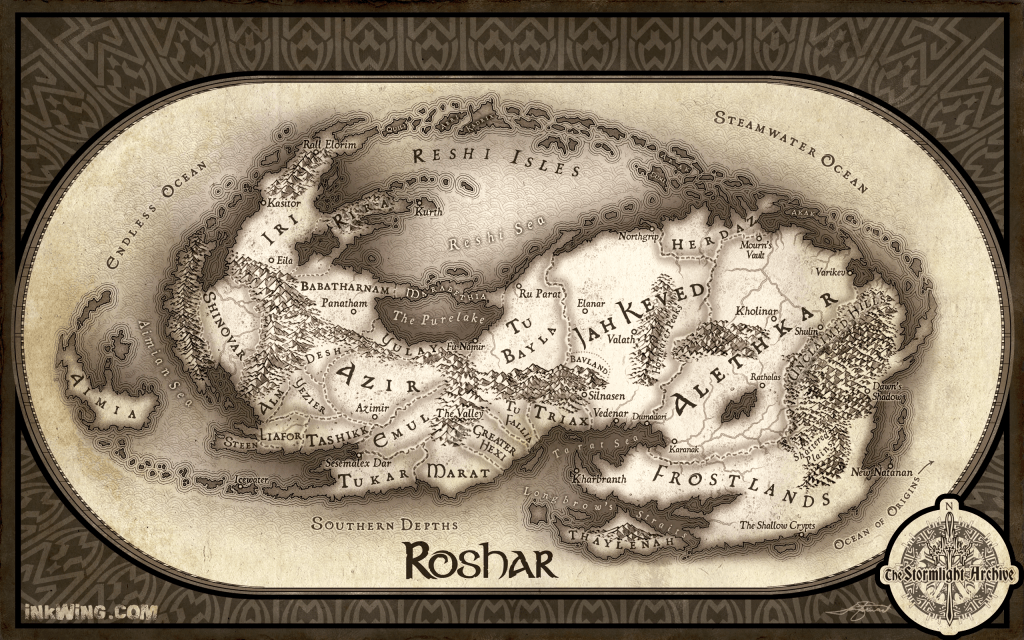
The World of The Stormlight Archive
In The Way of Kings, we see a world completely alien to our own. There are three main ways that Roshar is different. They are in the Highstorms, the Stormlight, and the Spren.
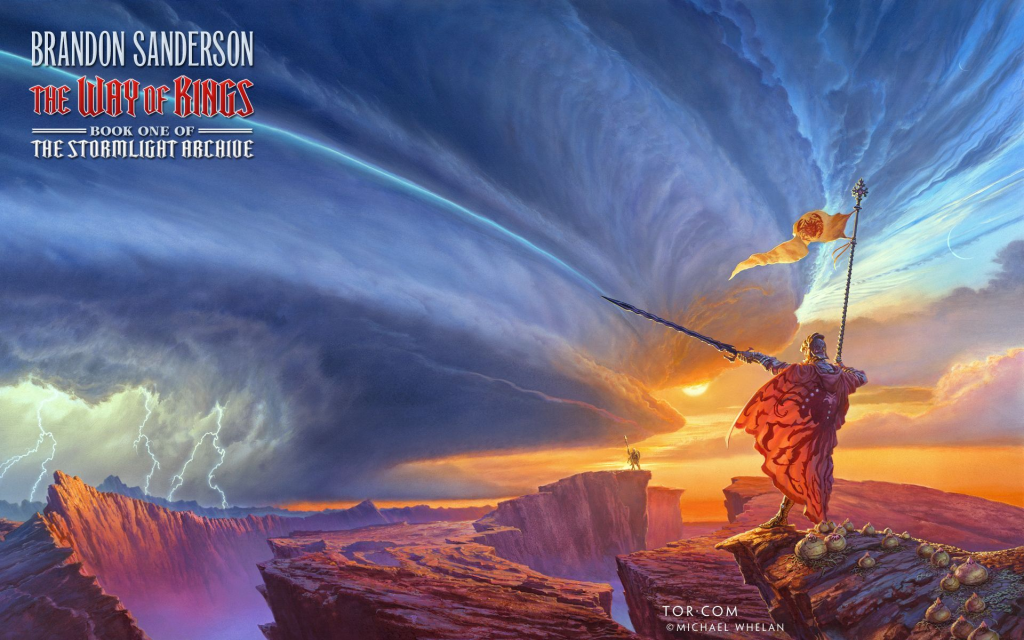
First are the fierce storms called Highstorms rake the continent every few weeks. These storms can throw boulders, break buildings, and tear plants. They always travel from east to west and dissipate as they roll across the continent. The entire world has adapted to this natural phenomenon. Plants live in hard casings called rock buds, that retract when a storm comes. Animals are mostly shelled beasts, land-locked giant hermit crabs called chulls or little crayfish on land called kremlings.
Cultures have adapted to the natural phenomenon. Buildings are built with storm-sides and leeward sides. Some worship the storms, such as the Alethi culture, who believe they come from the Stormfather, the Almighty. Others curse the storms as the work of a devil. All fear and revere them.
The second main difference is in something called Stormlight. When the Highstorm comes through, it infuses this magical energy into gems like diamonds, emeralds, rubies, and more. Not only does this lead to these gems glowing in the dark and being used as currency, it is allows the powering of magical objects similar to how we would use electricity if batteries could charge during a storm.
There are continuing evolutions in this technology by the denizens of Roshar, such as Spanreeds that can write a note to someone on a piece of paper long-distance, or Alternators that can heat an area instead of a fireplace. However, it seems ancient civilizations understood them far better than the present day. They invented near-invincible suits of armor called Shardplate, disappearing swords as light as a feather that separate souls from bodies called Shardblades, and matter-transforming gloves called Soulcasters that are all connected to or powered by Stormlight. These ancient artifacts are coveted by all societies on Roshar.
Finally, the Spren populate the world of Roshar. Much like our forefathers on Earth looked at the world thousands of years ago, spren are spirits that inhabit all aspects of life. There are spren of objects, such as rocks, fire, wind, and rain. There are spren of emotions, like fear and pain and anger. There are also spren of concepts, like creativity and glory.
These spren make the entire world feel alive at any moment. Pain spren come up like orange hands from the ground. Rot spren nibble on infected wounds. Joy spren dance around during a happy wedding. Wind spren play in the sky on a chilly day. Like the spirits of Chinese, Norse, Greek, Native American, and other mythologies, in Roshar you find a world that is uniquely interactive with humans.
The Story So Far
Spoilers for The Way of Kings, and slight spoilers for Words of Radiance (though I won’t spoil much of it!)
In The Stormlight Archives we so far have primarily followed former slave Kaladin, Highprince Dalinar Kholin and his son Adolin, and scholar-in-training Shallan Davar. In their culture, the Alethi culture with its Vorin religion (although Shallan is technically from Jah Keved), men and women have unique roles. Men fight and farm, while women learn reading, writing, arithmetic, and arts. Women also cover their left hands, their “safe hands,” with gloves or long sleeves. In addition, their society is split into Lighteyes (blue or light green eyes) and Darkeyes (brown or black eyes). Lighteyes are considered nobility and Darkeyes are considered peasants, and the two rarely intermingle.
In the first book, Dalinar and his son Adolin attempted to turn his country’s treasure-focused war from one of political squabbling to real unification of his shattered country. Meanwhile, Dalinar received visions from the Stormfather, the Almighty, about a mysterious coming evil and the need for the return of ancient heroes.
Shallan tutored under Dalinar’s neice, discovering secrets about the Spren and the coming of that mysterious evil, the Voidbringers, who were beginning to reemerge on Roshar.
Kaladin ascended from slavery to the leadership, eventually saving Dalinar’s life from a massive betrayal by his former Highprince friend. Kaladin received mysterious powers from a Spren he befriends, including healing, gluing objects together, and flying. It turns out that Spren is an Honor spren, and her return is marking both the coming evil and the return of those very ancient heroes, called the Knights Radiant. He is the glue of Book One, and we learn extensively about him and his backstory.
In book two, Kaladin has become the leader of Dalinar’s personal guard. As he discovers more about his abilities, he also burns with mistrust for Lighteyes who put him in slavery in the first place. Will he be able to keep the balance between honor, secrets, and his newfound abilities?
As Dalinar attempts to reunify the highprinces while also dodging the schemes of his former friend, he fears that he’s too late and that the evil has already arrived. Adolin attempts to help his father, but struggles with his own worthiness, especially when faced with the insolent new guard captain, Kaladin.
Shallan, though, is the glue of this book. Discovering she is also a Knight Radiant, but with completely different abilities of creating illusions and transforming objects, she tries to uncover the secrets of the Spren and the ancient evil. She also attempts to uncover the secret of a group of assassins related to her family. Betrothed to Adolin, she discovers her newfound affection for her fiancé while also slotting in with the politics of Dalinar’s kingdom. We also discover her backstory throughout the book, like we did for Kaladin before.
This Book Is Better Than The First
There, I said it.
I discussed in my first review the problems The Way of Kings has.
The Way of Kings locks its characters into a few key locations, and then repeats scenarios over and over again as the characters slowly learn more about the secrets they hide as well as the secrets of the world. It’s a good introduction into this deep world, but it gets repetitive – especially if you figure out the rough outlines of the secrets early on.
Words of Radiance, however, is far more dynamic. Since Kaladin isn’t a slave, Shallan isn’t stuck in the city of Kharbranth with Dalinar’s neice, and situations are dynamic and change multiple times throughout the book, there is no repetition.
Kaladin’s plot changes a fifth of the way through the Words of Radiance, than a fifth of the way again, and again, and again. He’s being tested through choices that give him more than just figuring out a solution to the same problem. He’s coming against different problems, with different conundrums. It’s not simply, “Should I give up?” It’s, “How can I trust Dalinar, when he trusts my betrayer Amaram? How can I trust Dalinar, when he props up the ineffective King Elhokar? How can I like Adolin, when he is so smug and careless? How can I retain my honor when I don’t know what’s right?” Each time, he’s come up with difficult situations with characters we like, or don’t like, but understand. This gives ton of variability to his story in a way the first book simply didn’t. Yes, Kaladin is still uncovering the mysteries of this world, like in book one. But he’s doing it in a way that puts him to the test.
Shallan changes too. While in the first she tries to be taken in by this niece, then is taken in by the niece, then loses the trust of the niece, then gains the trust of the niece, here she’s thrown into interactions with many characters. She’s trying to navigate a band of bandits and slavers, she’s in the politics of Alethkar, she’s trying to infiltrate the assassins, she’s experimenting with her special spren Pattern, she’s finding the truth of the ancient evil, we’re discovering her struggles in her family. She’s put into so many different situations that test her and push her and develop her and uncover her.
Shallan is also a much better vehicle for the “mysteries of this world,” which is what Sanderson excels in. She’s curious and involved in multiple plots where she’s finding out more about Roshar and its history. Sanderson puts so much thought in how he makes his worlds for fantasy. Mysteries are often tied not just to character choices, but to character choices that directly reflect some element of worldbuilding. Having Shallan search out these clues and hints is much more effective than spoonfeeding them to Kaladin as he hits his head against the brick wall of the first book over and over and over again. Did I really enjoy the first book? Absolutely. But I think this book plays better to the strengths of Sanderson and The Stormlight Archive in general.
The mysteries of the world are also strong in the interlude chapters. I mentioned in my first review that the interlude chapters – chapters in between the five parts of the book that feature secondary, tertiary, or even one-and-done characters – were sometimes not as much of a breath of fresh air as they could’ve been. The exact opposite is true of these interlude chapters. Yes, they still do tie into the mysteries of the main storylines, but instead of feeling like they’re just there to answer one aspect of the mysteries, they often blow mysteries wide-open. Of particular note is the interlude chapters focusing on Eshonai, the commanding general of the enemy of Alethkar. Her first chapter felt blunt to me at first – you’re answering so many of the mysteries of the enemy here and now? – but very quickly you learn that there’s so much more to uncover.
All the interlude chapters help the pace and flow this book so much. When before, they sometimes felt like a chore, here I couldn’t put them down. Maybe it’s because they actually had more to do with the main plot. For example, an interlude chapter in The Way of Kings sticks out to me. In it, you follow an art desecrator who likes destroying rich people’s art. One of the minor characters in that chapter teaches the reader a tidbit about the Nightwatcher, a force you learned about in a previous chapter and then learn about again a few chapters later. One-and-done. However, in a similar interlude chapter in Words of Radiance, you instead see the touching story of an old man and his spren, revelations about the nature of spren, learn about a new mysterious faction, and are simply entertained by the kids the old man helps. It’s thoughtful, insightful, gives information, and provides mysteries all at the same time.
Adolin and Dalinar change more as well. We actually lose Dalinar’s point of view for a whole third of the book, leaving us to guess at his thoughts and motivations through Adolin’s and Kaladin’s eyes. Since we follow Adolin so much, we see growth as he, too, is involved with several plotlines. Some of this is a bit weaker for Adolin, as his plotline involves dueling several characters to win their dangerous shardplates or shardblades. But when the climactic duel occurs midway through the book, it’s all worth the wait. Yet again, we’re saved by repetition since his story then pivots. Yes, there was repeating for a while, but it was just long enough that it didn’t feel stale.
When a book is this long – 40 hours in audiobook format that I listened to, 1088 pages in most physical formats – you hope it really grows and changes your characters. You hope it gives them tons of unique and interesting scenarios to run against. You hope it gives them challenges that they can’t easily solve.
This book delivers. It delivers on the thrills, the character relationships, the mysteries, the action. It delivers on the worldbuilding most of all.
And goodness, does it deliver on the climaxes.
There are several times where I listened to several chapters straight through because I couldn’t wait to see what happened next. The amount of mini-climaxes in the book is worth the price of admission alone. I won’t spoil much here, but there are at least three separate mini-climaxes along with the one big climax that just flood you with action, twists, revelations, and more that make this book so strong. Yes, the first had these ups-and-downs. But Words of Radiance DELIVERS on the ups-and-downs in a way that makes it hard to put down.
To Criticize
A few short criticims.
The first is in coincidence. A few too many times for me, characters just so happen to appear at the same place at the same time as another character. This is particularly egregious for Shallan, who solves her mysteries not always by quick wit but instead by bumbling into scenarios and overhearing people. It works once, maybe twice, but the amount of coincidence in time used to solve problems gets frustrating compared to using coincidences to get into problems. Some of those could be tightened up with less coincidences, especially when solving riddles.
That same coincidence also shows up when characters suddenly unlock abilities or knowledge that they kept hidden from themselves or get at just the right time, often because it feels right. That is a weak reason for events, and it does cheapen a few of the climaxes when you know that the character will get that power boost at just the right time, just when they need it. However, it’s much better when characters use their knowledge and skills without needing those boosts, and there are several amazing instances of that too. It’s just that the occasional coincidences weaken an otherwise outstanding book.
In addition, a lot is discovered and revealed in this book. Much is made public knowledge that wasn’t before. By the end, several characters unlock new powers and abilities that make them near god-like in their options.
I haven’t read the next books yet, but it worries me that like an Anime that runs for too long, the power creep might catch up. “Power creep” is the term for characters getting more, well, powers over time. At some point, a show that started as a simple fistfighting show like Dragon Ball suddenly becomes cosmic battles for the fate of the universe in Dragon Ball Z by the scaling power creep there. Yes, the point of The Stormlight Archive was always a cosmic battle. I just didn’t think the characters would so quickly be able to accomplish some of the things they’re able to. That goes along with the coincidence piece before.
As characters begin juggling more powers, it becomes more and more difficult to account for every power in every situation. Just as in Star Wars, when they introduce Force healing and you think, “Why didn’t they just force heal Qui Gon?” I’m worried that soon I’ll be thinking the same throughout book three. It just might not be as obvious because there are a lot more abilities to juggle in the first place and some of the ramifications might not be as obvious.
But I’m invested now and along for the ride for book three. I can’t wait to pick it up.
A Great Second Book
Words of Radiance is even better than the first book, a tribute to Sanderson’s worldbuilding skill while also delivering a more challenging and less repetitive gauntlet for its intriguing cast of characters.
Prepare to be sucked in to a world of spren, highstorms, Knights Radiant, shardplates, and more. I know I was. I hope the same for you too.

𝙷𝚒! 𝙼𝚢 𝚗𝚊𝚖𝚎 𝚒𝚜 𝙽𝚊𝚝𝚑𝚊𝚗. 𝙸 𝚕𝚘𝚟𝚎 𝚜𝚝𝚘𝚛𝚢𝚝𝚎𝚕𝚕𝚒𝚗𝚐, 𝚕𝚎𝚊𝚛𝚗𝚒𝚗𝚐, 𝚊𝚗𝚍 𝚌𝚛𝚎𝚊𝚝𝚒𝚗𝚐, 𝚊𝚗𝚍 𝚊𝚕𝚜𝚘 𝚕𝚘𝚟𝚎 𝚝𝚘 𝚝𝚊𝚕𝚔 𝚊𝚋𝚘𝚞𝚝 𝚝𝚑𝚎𝚖 (𝚜𝚘𝚖𝚎 𝚠𝚘𝚞𝚕𝚍 𝚜𝚊𝚢 𝚝𝚘𝚘 𝚖𝚞𝚌𝚑!) 𝙵𝚘𝚕𝚕𝚘𝚠 𝚝𝚑𝚒𝚜 𝚋𝚕𝚘𝚐 𝚝𝚘 𝚜𝚎𝚎 𝚖𝚘𝚛𝚎 𝚌𝚘𝚗𝚝𝚎𝚗𝚝!
 Go-To Guru: Film, Literature, Television, and More
Leave a comment