
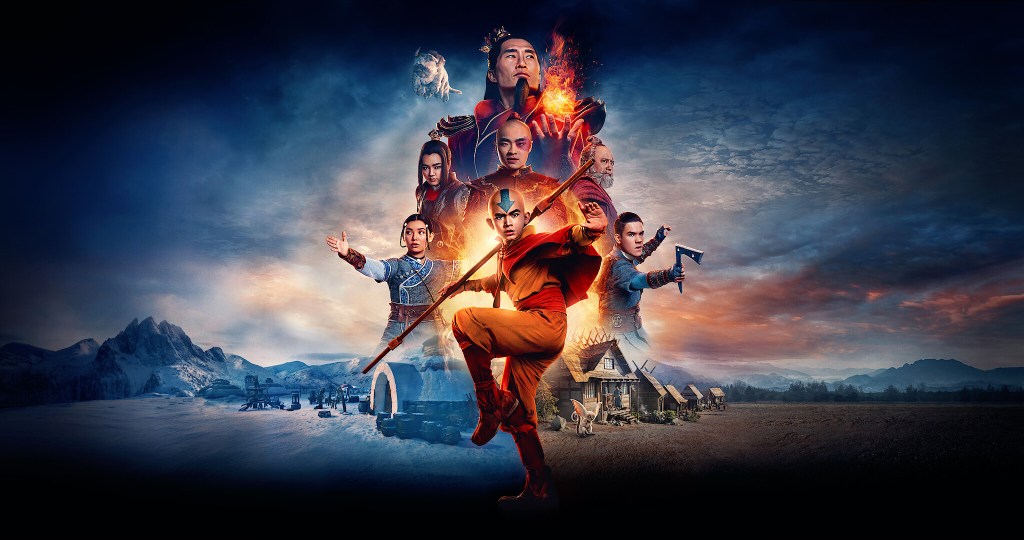
Avatar: The Last Airbender is a 2024 young adult fantasy adventure series based on the 2005-2008 Nickelodeon cartoon adventure series of the same name.
Well, that was…. interesting.
And I really mean it. Avatar: The Last Airbender, the original cartoon from Nickelodeon, is one of my favorite shows and just one of my favorite stories of all time. My brother would place it as one of the best stories ever told.
I’ve been wary of the live-action Netflix version for years. We first heard about it all the way back in 2018. The Legend of Korra, a sequel to Avatar, was released from 2012-2016, and it is… well…. not great. What would the same team do if they came back to Avatar? There’s also the infamous 2010 live action movie from M. Night Shyamalan that really sucks. Would this be any different? But then, the creators of both animated shows left over “creative differences.” Six years later, we finally get Avatar. And it is interesting. Just… probably not in the way the creators meant for it to be.
First, a summary of both shows’ premise.
A Summary of Avatar
Just to give you some context if you don’t know already, you can watch the show intro here. It’s been called one of the best intros of all time for neatly summarizing the plot of the show while bringing you up to speed on what happens next.
If you’re too lazy for that, Avatar: The Last Airbender takes place in a semi-steampunk fantasy setting. There are four nations – the Southern and Northern Water Tribes, the grand and varied Earth Kingdom, the power-hungry Fire Nation, and the temple-dwelling Air Nomads. Each contains people who use Eastern Asian martial arts to manipulate their elements: Water, Earth, Fire, Air. Those people are called Benders.
The cultures and lives of each nation are based on their elements. The Water Tribes live in the north and south pole and are based on Inuit (Eskimo) peoples. They ride boats in icy canals by bending the water around the boat. The Air Nomads are inspired by Tibetan Buddhist monks and achieve enlightenment from disengaging with the world in temples on high mountains. The Earth Kingdom has large buildings, walls, and cities built with their earth bending abilities. The Fire Nation has steampunk technology, making steam engines by throwing fire into them.
There’s one person who can bend all four elements. Their name is the Avatar. When an Avatar dies, he reincarnates into the next nation in the cycle.
Yet when the Fire Nation decides they want to conquer the world, they first kill all the Airbenders, where the Avatar would be coming from next. Then, they declare war for one hundred years, trying to conquer the world.
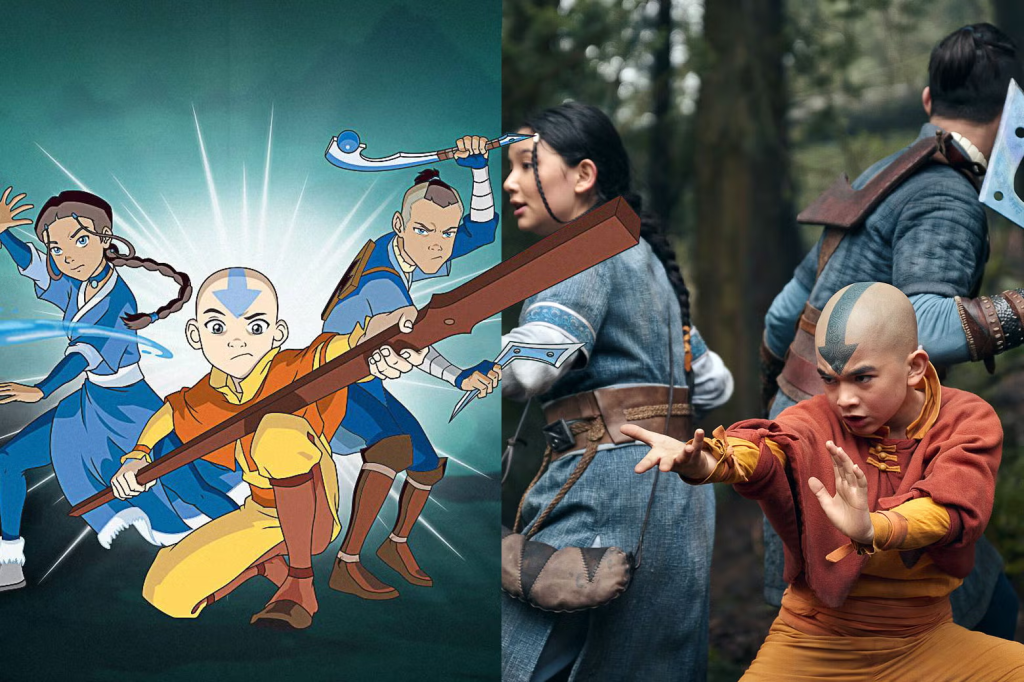
Avatar Aang, the 12-year-old airbending Avatar, survived. Encased in a magical ball of ice, he stayed suspended until two Water Tribe kids found his ball of ice and opened it up. Aang then goes on a quest with brother-sister duo Sokka and Katara to master the three other elements to defeat the Firelord once and for all. Along the way, he makes friends, enemies, and friends again while exploring the stories of the people of these varied cultures and trying to save the world a piece at a time.
This broad outline of the plot stays the same between the two shows. However, my experience with Avatar will tell you what makes the two shows different.
My Avatar Experience
I’m not in the fandom, so to speak. I grew up in Star Wars and teenaged in Lord of the Rings. I know their lores forward and backwards. I had toys, T-shirts, drawings, and spin-off or fan fictions I wrote myself based on the two media. In my high school years, I spent way too much time listening to breakdowns of the two, and I’ve consumed hours-long podcasts breaking them both down.
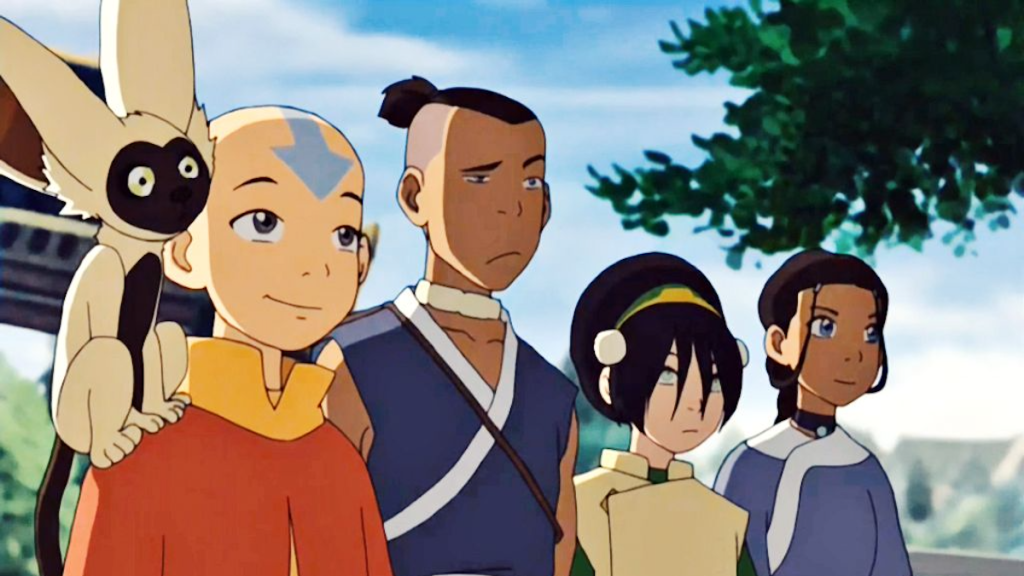
Avatar: The Last Airbender is different for me. I haven’t obsessively watch YouTube breakdowns of the show. I never owned a T-shirt or a piece of merch. I have very fond childhood and high school memories of it, but they’re more connected to my brothers watching it together, or us rediscovering it as young adults and watching it again. My wife and I also first got to know each other at an Avatar watch-party at a friend’s house. My life outside of Avatar is far less affected by it than Star Wars and Lord of the Rings. It’s connected to memories and people, but not to merch or toys or D&D campaigns.
But I love the original show. I adore it. I can quote my way through most episodes. It’s an amazing story, brilliantly and creatively told.
One of the things that sets Avatar apart from other shows is creativity within limitations. As a show on a kids’ network, they weren’t really allowed to show killing, and they are restricted to 23 minute episodes. With all of that, though, restraint guides the story, as multiple worldbuilding tidbits and background stories are running at the same time. You get fun kids’ filler episodes, where the main crew goes to a place and does something, but that event informs you in brilliant ways about the world and about these characters you come to love in so little time. In many instances, one line of dialogue informs an entire character’s story. They clearly and concisely tell you pieces, and then you’re able to weave the story together yourself.
It’s not like some fandoms, where secret storylines are hidden so deeply it takes Wiki pages to uncover. It’s just hidden enough that it’s above your little kid brain, but open enough that it doesn’t take hours of internet research to uncover. It strikes that amazing balance. It’s the joy of childlike storytelling subtly underpinned with the power of adult storytelling all mixed into one.
When you’re a young adult and start putting these pieces together, it’s so rewarding. Things you never noticed before start jumping out at you. It’s an extremely rewarding show, giving you a lot for your attention and time spent on it. It’s worth pouring over with your brother at 11 PM after you finished a few episodes on a Friday night. It’s what bonds people together because of the show.
Avatar As An Adaptation
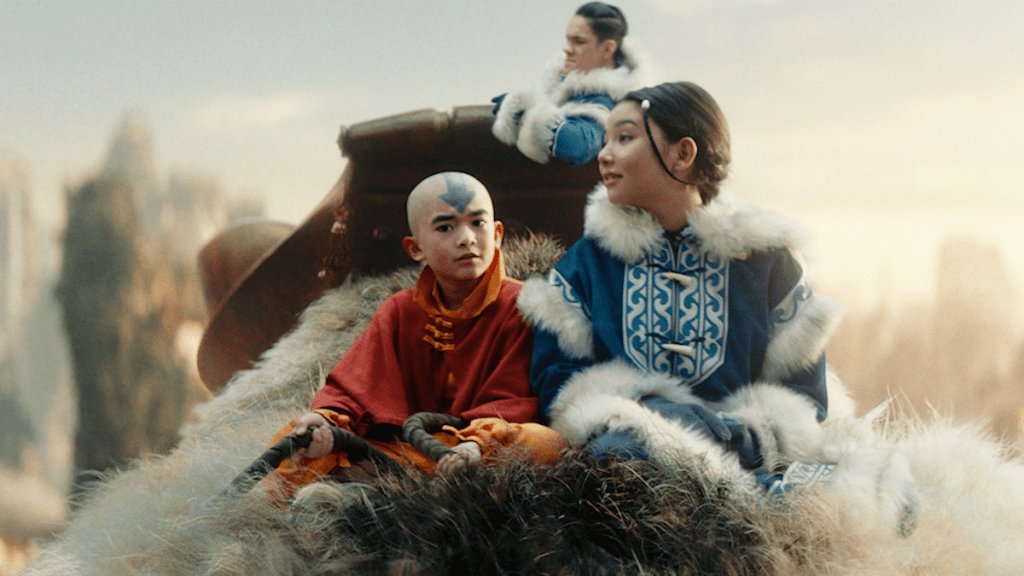
You can tell that the Netflix showrunner Albert Kim, as well as his colleagues, are fans of the original. They’ve included references to tons of Avatar material. It doesn’t seem to come from the cynical point of view of the new Star Wars content since 2015, but instead from a passionate fan bringing it to life.
However, I feel like it’s a passionate fan who doesn’t understand what I said about joy with subtlety. He doesn’t understand – or couldn’t carry out – that subtlety is what made Avatar: The Last Airbender so good. A kids’ cartoon that features genocide, totalitarian governments, Messianic storylines, Eastern philosophy, and detailed martial arts, but also a fluffy giant flying bison with six legs and riding giant koi fish and a self-aware play that dissects the flaws of the show.
This show… isn’t that.
As an adaptation, it’s super interesting. You can tell how Albert Kim and his crew are trying to locate a main storyline.
They’re giving arcs to the characters that last the season, so they draw out some character traits and downplays others. For example, in the original show, Aang does feel guilty about his 100 year disappearance. However, that guilt mainly comes to a head in one episode, The Storm. It’s hinted at multiple times, and then there it’s brought out by Katara. In one quick line, she says, “If you were there then, you would’ve died, Aang. But you’re here now, and you’re meant to be. You give people hope.” That makes Aang smile and he hugs Katara in thanks. However, in the new show, this is constantly Aang’s fear and main plot thread. Aang’s childhood friend Bumi now feels anger and contempt towards Aang’s disappearance. Other plots are warped to fit around this story arc. It doesn’t resolve until the final moments of the show in Aang’s melodramatic ascendance into a giant holy fish. (And yes, for fans, this moment is played almost for horror in the new show).
In addition, they’re adding story to try to “tighten the ship,” so to speak. For example, Zuko, the Prince of the Fire Nation, was exiled for speaking out of turn and disrespecting his father. He spoke up when some fresh recruits were going to be sacrificed in a diversion. In the new show, that happens – but then those recruits become the crew of Zuko’s ship in exile. Other additions occur too – It turns out Zhao was working with Azula the whole time to try to invade the Northern Water Tribe. Things like that attempt to take what were stories connected by characters – if not so much by plot – into a single narrative.
They’re also fitting in an eight episode timeframe, so they combine some locations and plotlines of the show together. Take the Mechanist and his son Teo, the freedom fighter Jet, King Bumi in Omashu, and Iroh’s capture by Earth Kingdom soldiers in The Winter Solstice. These three stories take place in different episodes in the original. However, in the new show, they combine them into two 45 minute episodes. Instead of Jet being in the woods by a small village, he’s in the woods by Omashu. Instead of the Mechanist and Teo living in the Northern Air Temple, they live in Omashu and their stories intersect with the vengeful Jet, which all intersect with Bumi. And Iroh is captured by Earth Kingdom soldiers outside of Omashu instead of in a different episode, but the theme of anger and vengeance plays in as those angry soldiers beat up Iroh. Again, the ship is “tighter.” They’re trying to create more connections in what could seem to be a disconnected original story.
They have the direction of the later seasons, so they include aspects from them, too. This is especially since it seems Season 2 and 3 were not guaranteed. Larger changes include giving Azula and the Firelord their own storyline this season, when fan-favorite Princess Azula doesn’t appear until season 2 of the original, and the Firelord not until Season 3. These seem to be for the dual purpose of fan service and for making the story more “connected.” They also add the later season references of Wa Shi Tong and the Secret Tunnel singers. That just seems to be just for fan service.
They’ve listened to criticism of the original show, so they change some stories to match those criticisms. This reference is for my brother, but yes, Yue’s healing by the Moon Spirit is mentioned sooner than 5 minutes before it happens. In addition, they try to make the Firelord and Admiral Zhao less “one-dimensional” (although neither of those are one-dimensional in the original show on closer inspection. They’re just more subtle).
Some changes, though, are just to be “more serious.” Hahn, rather than an egotistical teenage warrior that butts heads with Sokka, was previously betrothed to Yue (instead of betrothed in the present, so Yue is cheating on him with Sokka technically) and sacrifices his life to save the water tribe. Zhao isn’t angry and vengeful like the show, but conniving and somewhat of a politician-minded soldier. He’s lowly, but is using Azula’s influence and the resurgence of the Avatar to move up the ranks. Rather than a “Saturday morning cartoon villain,” he’s more dimensional now (I disagree with that, but I do get adding variety if you’re putting the psychotic Firelord and Azula into this season).
They’re finally giving fan fiction wherever they can. Aang’s tutor Monk Gyatzo is revealed to be dead in a touching moment. In the new show, though, Monk Gyatzo battles Firelord Sozin in a personal duel, and we get to see it happen – rather than Gyatzo dying offscreen for a reveal later. The references to Wa Shi Tong and the Secret Tunnel singers come to mind too. They are adding fan service where it suits them.
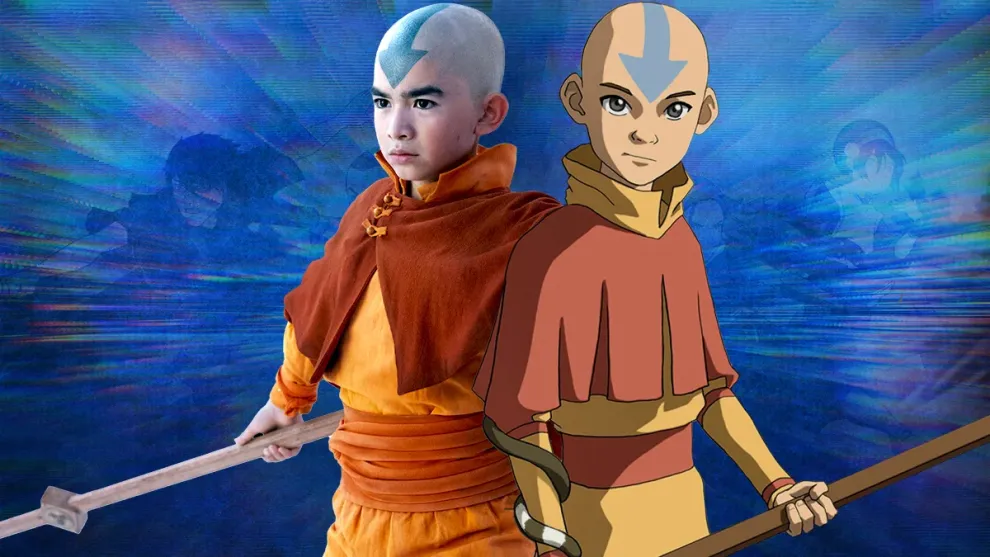
Avatar In Plot, Not In Spirit
These types of choices are extremely interesting to me. As I’m watching, I’m picking it apart, saying, “Ah, I think they’re latching on to this part of Aang’s story as an arc. Ope! That’s going to be Jet. They’ve combined him into this story. Whoa, are they bringing Koh the Face Stealer this early?” I enjoy the philosophy of adaptation. I’m not one of those that thinks an adaptation needs to be like the original to be good. The Lord of the Rings book and movies have several key differences, but I love them both because they’re both good stories in their own rights. Yet in most cases that’s not true.
It’s not true here, either.
This show lacks of the subtleties and joys that make Avatar such an amazing story. When you have 23 minutes, you pack those lines of dialogue. So much is communicated with simple expressions, body language, and faces, especially with the exaggeration that comes with animation. So much is in the background.
But when this show brings Aang’s conflict to the forefront… and makes every. Single. Episode. Be about Aang’s inner drama, with far less of his childish joy and humor… we lose something. When the dialogue becomes flat to make extra sure we’re getting the point, it’s not Avatar anymore. When the actions of the characters aren’t subtly personal choices (after all, they didn’t have to animate that! Every animation choice is deliberate), but instead RIGHT in your face, it ruins the charm.
It feels like the live action replicates fan favorite moments and reorganizes the plot so it’s recognizably Avatar. However, it lacks the spirit of Avatar. There isn’t (as much) humor and joy. Things are grim and bleak. Things are in-your-face rather than small and poignant.
In short, it lacks what made the show actually good.
That’s not to say that it doesn’t have its moments. There are some scenes that tug on the heartstrings simply because they are replicated from the original. There are some added scenes, like when Hahn sacrifices himself during the siege of the North, that actually tugged at me, too.
Perhaps one example clearly illustrates this, besides what’s already been mentioned. There’s a flashback in an episode of the Netflix show where we see Iroh’s reaction to his son’s death, Lu Ten. Then, we see the funeral, where Iroh is broken apart until Zuko sits down next to him and says, “Lu Ten was amazing. I’m so sorry for you, Uncle.” Touching moment, all the more so knowing the context from the show.
But that’s what made the show so great. Watch one of the most famous scenes from the show here. Even with no context, it can make people tear up. You only find out about Lu Ten in, like, one minute long scene. It comes out of nowhere and breaks your heart. You don’t have lines where Iroh is saying, “Lu Ten’s death is what motivates me to help Zuko because I see him as a son! It also motivates me to help others!” No. One simple line: “Happy birthday, my son. If only I could have helped you.” That simple line puts every single action of Iroh throughout the entire show in a different light. One line propels Iroh to many peoples’ favorite character in the entire show. One line makes Tales of Ba Sing Se many fans’ favorite episode. It’s incredible how this show can do so much with so little.
But then the live action version, like a fanfiction, imagines Zuko comforting Iroh in the wake of the death. It’s not wrong, persay. It’s just… normal. Pedestrian. It makes this live action show just feel like a more boring, more blunt, less well acted version of most adventure shows. And it’s filled with dialogue I described above – not in that scene, necessarily, but in tons of scenes throughout the show where characters seem to stare at the audience and explain what’s going on. It takes away the childhood joy mixed with adult subtlety and just makes it a semi-serious adventure drama. What made the show good was its restraint. Lose that, and it’s just really not that engaging.
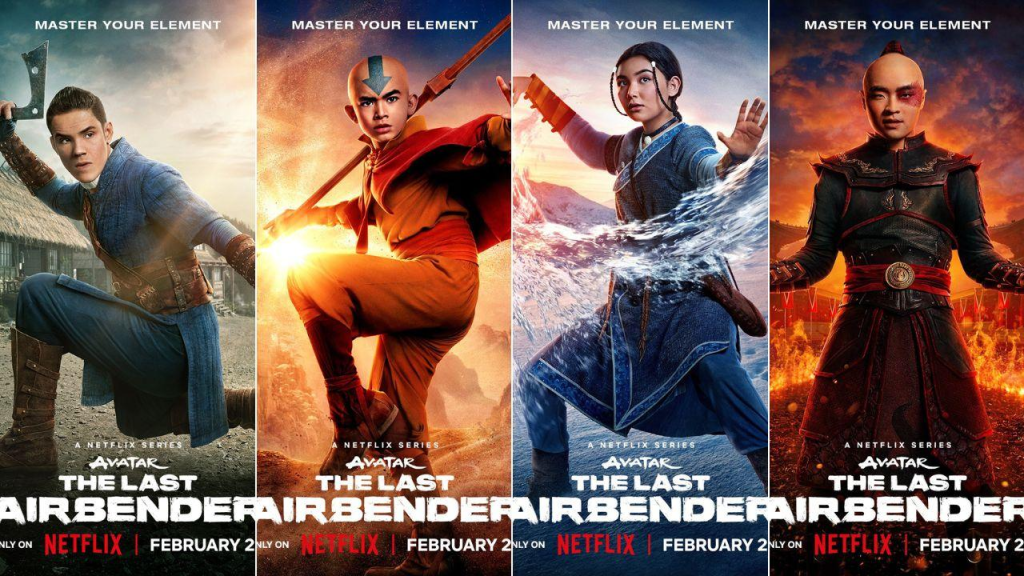
Conclusion
And so this show isn’t really that interesting. It has a few good action scenes. It has some cool spectacle. Some of the jokes landed pretty well. There’s some OK drama. But it’s not enough.
With characters that feel actually less dynamic than the show even though they’re trying to make them more complex and arc-full, crammed full of fan references, and pretty boring line delivery without the dynamic expressions and body language that animation allows… Yeah. It’s just not that fun or insightful. It’s just kind of… blah.
It is at least interesting, though, to see the choices made in adaptation. But that’s only interesting if you care about the original as much as I do.
And if you do, you probably won’t enjoy the show anyways.

𝙷𝚒! 𝙼𝚢 𝚗𝚊𝚖𝚎 𝚒𝚜 𝙽𝚊𝚝𝚑𝚊𝚗. 𝙸 𝚕𝚘𝚟𝚎 𝚜𝚝𝚘𝚛𝚢𝚝𝚎𝚕𝚕𝚒𝚗𝚐, 𝚕𝚎𝚊𝚛𝚗𝚒𝚗𝚐, 𝚊𝚗𝚍 𝚌𝚛𝚎𝚊𝚝𝚒𝚗𝚐, 𝚊𝚗𝚍 𝚊𝚕𝚜𝚘 𝚕𝚘𝚟𝚎 𝚝𝚘 𝚝𝚊𝚕𝚔 𝚊𝚋𝚘𝚞𝚝 𝚝𝚑𝚎𝚖 (𝚜𝚘𝚖𝚎 𝚠𝚘𝚞𝚕𝚍 𝚜𝚊𝚢 𝚝𝚘𝚘 𝚖𝚞𝚌𝚑!) 𝙵𝚘𝚕𝚕𝚘𝚠 𝚝𝚑𝚒𝚜 𝚋𝚕𝚘𝚐 𝚝𝚘 𝚜𝚎𝚎 𝚖𝚘𝚛𝚎 𝚌𝚘𝚗𝚝𝚎𝚗𝚝!
 Go-To Guru: Film, Literature, Television, and More
Leave a comment