

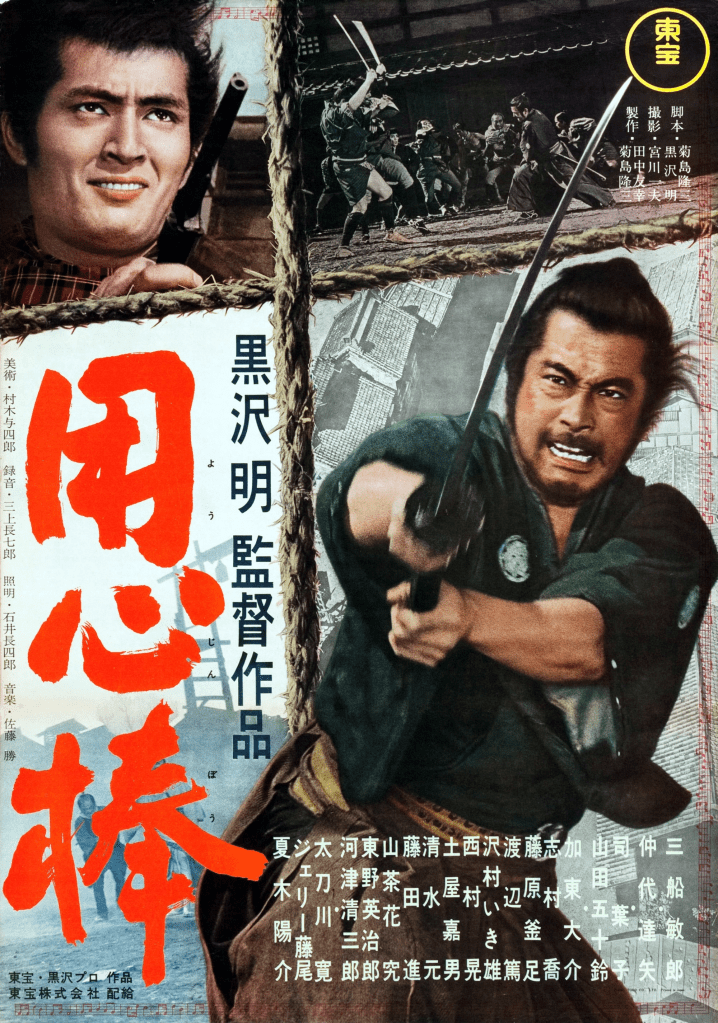
Yojimbo (用心棒, Japanese: Bodyguard) is a 1961 Samurai film by writer-director Akira Kurosawa, considered one of the best filmmakers of all time.
If you’ve been with me for awhile, you’ll know that my first ever review was of Akira Kurosawa’s Ran, his 1985 Japanese Samurai epic. If you’re into movies at all, you’ve probably heard of Seven Samurai, his most famous film, a 4 hour Samurai epic that has influenced hundreds of films and filmmakers.
Well, Yojimbo is no different. It is the direct inspiration for Sergio Leone’s A Fistful of Dollars, the first Clint Eastwood Spaghetti western that revitalized the genre and then culminated in The Good, the Bad, and the Ugly. (Even if you know nothing about movies, that “best Western of all time” probably rings a bell). Yojimbo is ranked as a masterclass in cinematography (how you stage your camera and shots), in acting (from Toshiro Mifune, Kurosawa’s longtime collaborator), and in writing (at only 110 minutes, it is brutally efficient with its time).
There were many things that surprised me about Yojimbo. Spoilers to follow. But let me start with this:
This Movie Is Hilarious
If you are looking for a way to introduce your friends or family into the wider world of global cinema… If you’re trying to reach the peak that is Seven Samurai but are worried that might be too high a target… or if you just want a good time… Yojimbo is it.
This movie is absurdly funny. There were several moments that had my brother and I laughing out loud in this one.
The situation itself is darkly comedic. A crime lord names his mommy-loving son as his heir, and so his second-in-command rebels. Now the two crime lords vie for control of the town. In comes the Yojimbo, The Bodyguard, played by Toshiro Mifune. He decides that he is going to pit both gangs against each other, ping-ponging back and forth between them, trading information and trading blows so that they both destroy each other.
Watching the Yojimbo cleverly deceive the two is a real treat, as you’re never quite sure what he’s going to be doing next, and once he does do something, you wonder why he’s doing it. Suddenly, it all becomes clear a few seconds or minutes after he does it, and the plans all fall into place. He even has no name – he names himself Kuwabatake Sanjuro, “Thirty-year-old Mulberry Field,” when asked. Only problem is, he’s staring at a thirty-year-old mulberry field as he does it.
There are several absurd characters. There’s Inokichi, the younger brother of the rebelling crime lord, who is asburdly dumb. All muscle and no brains, he is tricked several times by Sanjuro with hilarious results, including one where he carries the wounded Sanjuro in a coffin for a few miles and rescues him without knowing it. There’s Sawamura, the town sheriff, who constantly is sucking up to both crime lords and doing their bidding – mostly by announcing the time of day for standoffs, and then scampering idiotically back into his office. There’s the happy coffin maker, who joyfully skips through the streets for the amount of profit he’s making during the war and actively stokes it. These characters and more are the instigators and butts of so many jokes. It feels almost wrong to laugh, but you’re meant to. It’s meant to be darkly comedic, making these silly criminals absurd and fools for destroying the peace of this town.
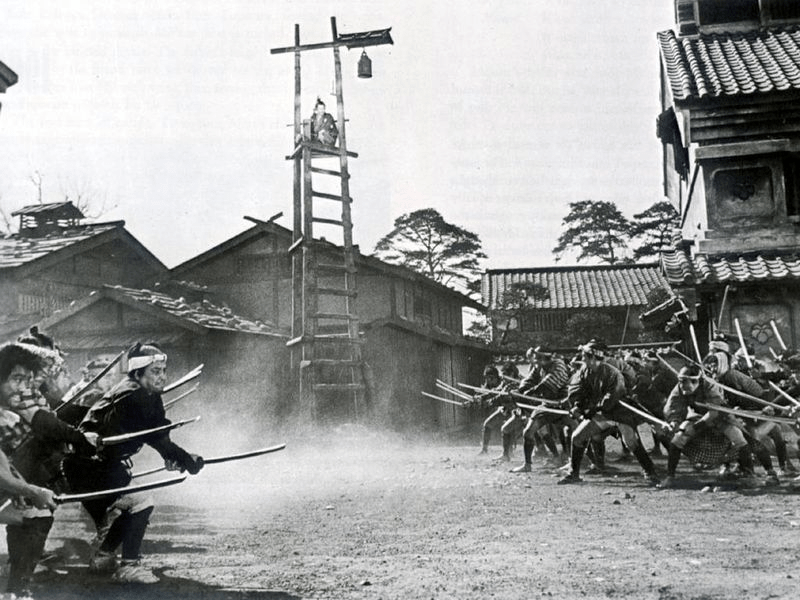
Then, of course, there are several hilarious situations. The one that stuck out the most and sold us on the comedic edge of the film was this scene here. One of the two gangs decides it’s time to duke it out because they have Sanjuro on their side. However, the wife of the crime lord (who’s really controlling the operation) decides to kill Sanjuro right after the battle because he charges an exorbitant amount of money. Sanjuro easily overhears them talking loudly. The minute the battle starts, he declares himself up for hire again and then sits on a guard tower in the middle of the town square. The two sides now terrified, they slooooowly approach each other. One side charges, the other retreats. Then they turn around, and the charging side runs away. Then they get closer and closer and closer all while Sanjuro laughs in the background. It’s really funny and the moment that sold me that this isn’t any adventure action film; it’s a dark comedy, first and foremost.
And Also Serious
Yet, when it pulls out the stops, it really pulls them out.
There’s a tense negotiation scene between the two gangs. After one crime lord gets dirt, through Sanjuro, on the other crime lord to have him legally arrested by higher authorities, Sanjuro goes to the other side and reveals the plot. Then, however, the other side captures the original crime lord’s mommy-loving son. THEN, it’s revealed that the original crime lord captures… a woman we haven’t met in retaliation. They organize a prison exchange in the same main square where only a few weeks earlier they could not face each other.
As the prison exchange occurs, we find out who this woman is: a mother. She has been captured by the upstart crime lord so that one of his assistants can rape her daily. Her family – her husband and five year old son – lives in a hut nearby this lover’s den. Sanjuro fools foolish Inokichi into thinking there’s an attack on this den. Then, he attacks.
Swiftly and brutally, he executes all six guards at the den. He then trashes the place, making it seem like several people attacked it. Then he gives all his money to the woman, her husband, and her son, and tells them to get lost. Go. Now. Before they’re caught.
Now we know why Sanjuro has done what he has done. His whole goal was not to make money, not to have a laugh, not to amuse himself. His whole goal, from the beginning, was to save these weak people who couldn’t save themselves.
This makes Sanjuro into a complex and multifaceted character. It puts all his prior actions in a new light. Although the astute watcher could deduce this core goal already, it still comes as a surprise that Sanjuro would save the family. All of these tricks, laughs, and games aren’t just funny now. Now they’re the actions of a hero trying to save a town from itself.
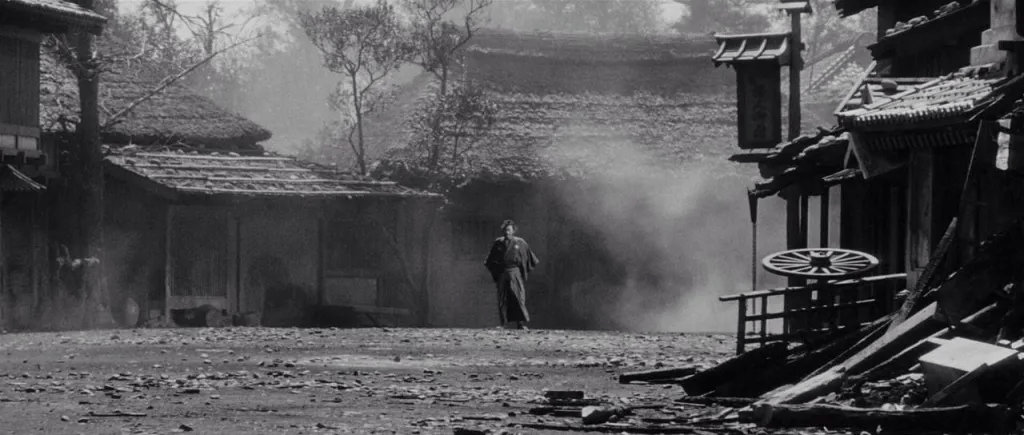
This is also when the movie itself gets beautiful. There are several iconic shots in this movie where Kurosawa and his cinematographer have levels of depth, pitting foreground, mid, and background against each other. There’s one particularly famous shot of Sanjuro emerging from the smoke, which I put above. The distance is just right where Sanjuro seems so small but also so threatening to the last remnants of the gang at the same time. It’s one of several that imprinted on the brain of directors and cinematographers for generations to come.
When Sanjuro’s true motives are uncovered by the upstart crime lord, he is captured and tortured. With the help of his two local supporters, he manages to escape and hide for weeks while recovering his strength. But then one of them gets captured, and in a final standoff, Sanjuro saves the ruined and desolate town from the last remaining crime lord. Sanjuro has won.
It’s not a happy victory, though. With so much death and destruction, so much loss, the town is a shell of its former self. Did Sanjuro do the right thing? Was he correct in freeing a town that was bustling in stalemate, but is now a ruin in victory? Was it all worth it?
In a haunting final scene, Sanjuro watches as the mayor of the town, half-crazed from all of the destruction, crosses the city square and commits the final murder of the final member of the upstart crime lord’s supporters. It’s the assistant who was raping the woman. When he dies, the mayor, covered in blood, walks stunned back into his office.
Was all this violence worth it? Is it saying something when the only time Sanjuro inspires someone to stand up for himself, he murders a fellow town member in half-insane cold blood? Who is to say whether Sanjuro succeeded or not?
You laughed your way through the movie, and then watched silently as a town lay in ruins and ashes. You had a good time. But was it worth it? Was it worth the laughs, the plans, the schemes, when on the other side dozens of men and many innocents lie dead? Who can say?
So have a laugh and ponder
Have a laugh and ponder Yojimbo. It would make a great introduction to foreign films to your friends or family members. Laugh at the schemes of the Bodyguard, then wonder as you see the results of his schemes. Was it worth it?
Whether or not the violence was worth it, watching the movie was definitely worth it.
𝙷𝚒! 𝙼𝚢 𝚗𝚊𝚖𝚎 𝚒𝚜 𝙽𝚊𝚝𝚑𝚊𝚗. 𝙸 𝚕𝚘𝚟𝚎 𝚜𝚝𝚘𝚛𝚢𝚝𝚎𝚕𝚕𝚒𝚗𝚐, 𝚕𝚎𝚊𝚛𝚗𝚒𝚗𝚐, 𝚊𝚗𝚍 𝚌𝚛𝚎𝚊𝚝𝚒𝚗𝚐, 𝚊𝚗𝚍 𝚊𝚕𝚜𝚘 𝚕𝚘𝚟𝚎 𝚝𝚘 𝚝𝚊𝚕𝚔 𝚊𝚋𝚘𝚞𝚝 𝚝𝚑𝚎𝚖 (𝚜𝚘𝚖𝚎 𝚠𝚘𝚞𝚕𝚍 𝚜𝚊𝚢 𝚝𝚘𝚘 𝚖𝚞𝚌𝚑!) 𝙵𝚘𝚕𝚕𝚘𝚠 𝚝𝚑𝚒𝚜 𝚋𝚕𝚘𝚐 𝚝𝚘 𝚜𝚎𝚎 𝚖𝚘𝚛𝚎 𝚌𝚘𝚗𝚝𝚎𝚗𝚝!
 Go-To Guru: Film, Literature, Television, and More
Leave a comment