
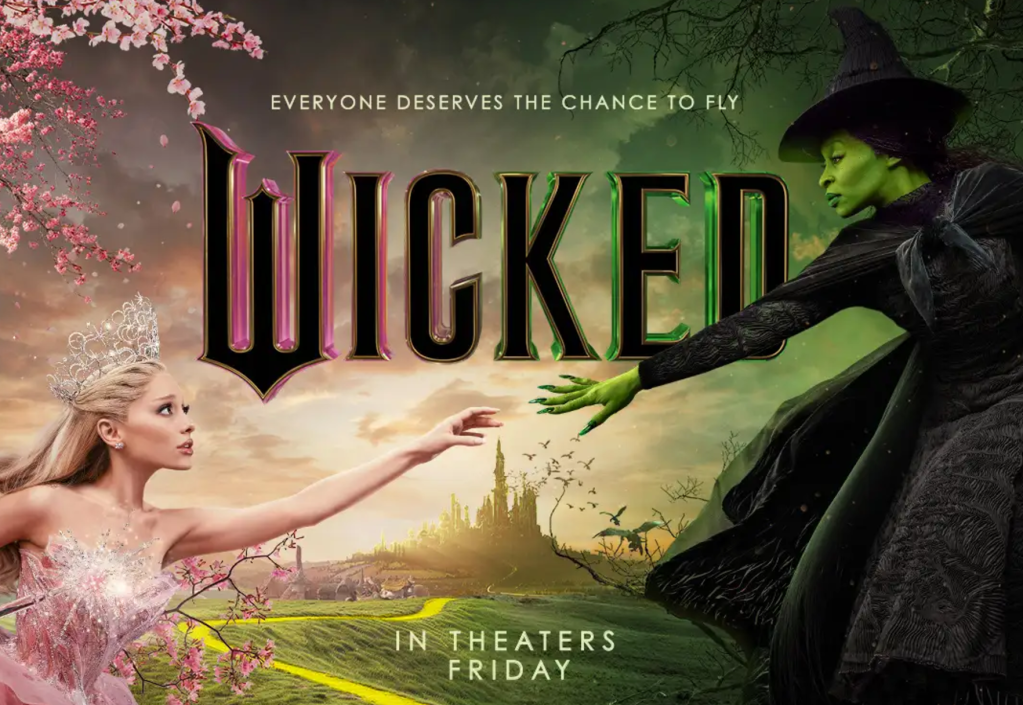
Wicked is a 2024 fantasy musical based on the first half of the Broadway play, based on the 1995 book Wicked: The Life and Times of the Wicked Witch of the West, which is a twist on the 1900 children’s story The Wonderful Wizard of Oz and its classic 1939 movie adaptation The Wizard of Oz.
“I’m sick and tired of all these movies and shows where the whole point is, ‘How about we make the bad guy… girl… misunderstood?’ Oh, brilliant idea! Only let’s do it… for… EVERY show, EVERY movie, ever. Cruella wants to make a fur coat out of puppies? She’s just misunderstood! Maleficent decides to curse a baby? Her wings were StOlEn! The dark side is literally a cancer of pure evil? The Jedi were BIGOTS, stamping out other religions and covering up MURDER! And now, the green-skinned lady of cackling magic evil is, oh guess what, MISUNDERSTOOD! I am tired of all of this. Just give me a straight-up villain with an original idea rather than twisting all the classics!”
I feel you, there, friend. Someday I might review the absolute trashy chaos of Star Wars: Acolyte. However, I ask you to take a chance on Wicked, Part 1. Yes, there is a trend in modern media to just “twist” previous classics, making the bad side good and the good side bad. (“From my point of view, the JEDI are evil!” No, they’re not, Anakin.)
However, Wicked, the book, came out in 1995, before that trend rushed through modern Hollywood. The musical also came out in 2000. While in a way, then, the 2024 movie is also capitalizing on that trend, the musical itself predates that trend. It might not into the same tropes that modern Hollywood does.
So, is 2024’s Wicked worth it? Does it fall into the same tropes, or does it stay above them? Part of it has to do with the nature of The Wizard of Oz in the first place. And part of it has to do with whether or not we judge stories objectively, or subjectively.
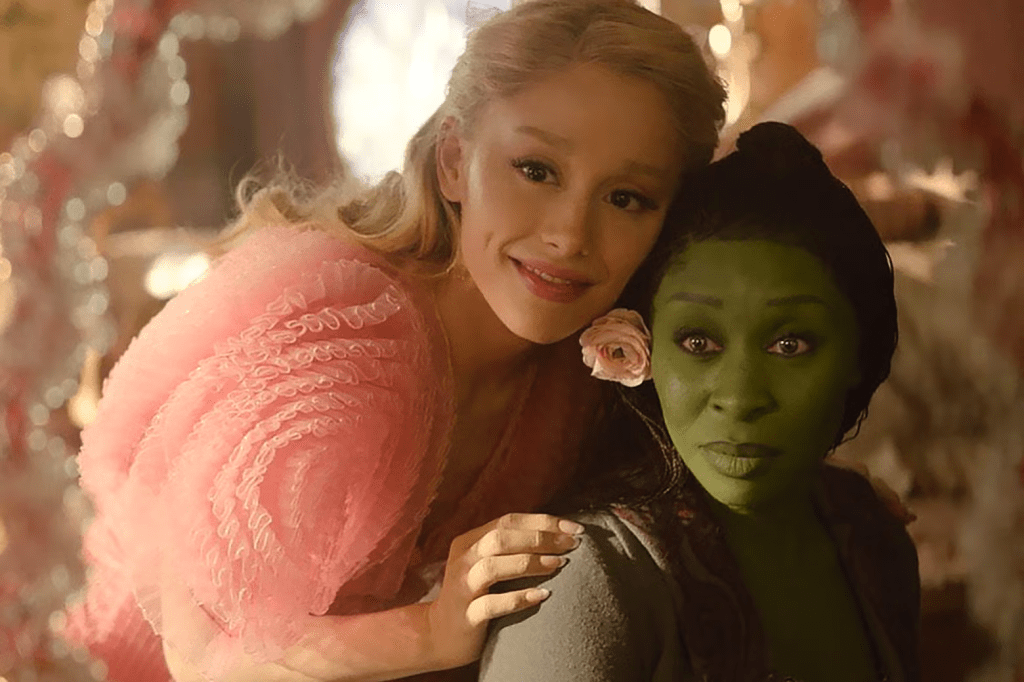
Summarizing Wicked
Here be spoilers for Wicked. I know nothing about the rest of the musical, only this movie. However, this movie gives me enough to chew on regarding the tropes I talk about above. If anything I write is proven wrong by the next installment, forgive me: I’m going off of what is presented to us here. Part two, titled Wicked: For Good, will release Fall 2025.
In Wicked, we follow two primary characters. They are Galinda (later Glinda), who will (spoiler) become the Good Witch of the South, and Elphaba, who will (spoiler) become the Wicked Witch of the West. The movie reveals their fates from the very beginning, as the opening takes place after the Wicked Witch of the West is killed by Dorothy in the original Wizard of Oz (the song, “No One Mourns the Wicked”). We learn that, while whimsy is common on Oz, magic is not; only a rare few possess magical powers. Everyone idolizes the Wizard of Oz, a magical man able to read the mythical “Grimmerie” magic book, and who made the little Emerald City into the capital and center of Oz.
One of those who do is the child Elphaba, the daughter of an affair between her munchkin mother and a mysterious man with a green vial-like potion he drinks with Elphaba’s mother (in this universe, Munchkins are not short, just more “rural” and “uncultured” than those in the cities). The mother’s affair makes her pregnant, but her daughter has green skin because of the vial, as well as magical powers. Her now-stepfather, the mayor of Munchkinland, treats Elphaba like dirt while eventually treating her younger, wheelchair-bound sister Nessarose like a fragile princess.
Fast forward, and Galinda makes her entrance to Shiz University, the finest university in Oz (“Dear Old Shiz”). Galinda hopes to study magic, even though she has shown no sign of rare magical powers. She, however, always gets what she wants. Elphaba and Nessrose’s father gets Nessarose a spot at the university, and allows Elphaba to go too – if only to watch her younger, “fragile” sister. Elphaba and Galinda are assigned to the same room, but are immediately enemies (“What Is this Feeling?”). Elphaba is blunt, intelligent, and prone to wordplay-laden insults, hated by all; while Galinda is spoiled, self-centered, and posh, worshipped by all. On the first day, Elphaba accidentally does magic, catching the eye of the only magical professor, Madame Morrible. She takes Elphaba under her wing, further infuriating Galinda, but making Elphaba fantasize about meeting the Wizard of Oz (“The Wizard and I”).
Prince Fiyero, prince of the Winkie people, arrives at Shiz University. A heartthrob who is kicked out of every school he goes to, he is immediately fawned over by Galinda (“Dancing Through Life”). However, his eyes seems to be for Elphaba, because of how intelligent and just plain different she is. When he throws a party at an underwater bar that students aren’t allowed to go to, Galinda tricks Elphaba into going with an ugly black hat from her great-aunt. When she is mocked, though, Galinda feels pity and starts dancing with her. After this, the two become friends – even as they are aware of their differences (“Popular”).
Elphaba begins uncovering a plot at Shiz University: before, there were many talking animal professors, but all animals have systemically been losing their ability to talk and their positions at the university as well as jobs and homes in the nearby towns. Doctor Dillamond, a talking goat and friend of Elphaba, tells her all (“Something Bad”). Elphaba, used to being bullied and hated and different, cares for the animals. Doctor Dillamond is fired and carted away. While Galinda doesn’t care, Prince Fiyero does, and the Fiyero and Elphaba bond when they later rescue a captured talking lion cub and release him into the forest. Prince Fiyero has adopted his devil-may-care lifestyle as a ruse; in reality, he is passionate, intelligent, and head-over-heels for Elphaba (the astute viewer would have noticed that in “Dancing Through Life,” there were dozens of references to philosophy like nihilism, stoicism, and epicureanism). Elphaba, though, knows he could never steal Fiyero from Galinda (“I’m Not That Girl”).
As Elphaba controls her powers, Madame Morrible receives an invitation for her and Elphaba to go the Emerald City and meet the Wizard of Oz. Galinda, in solidarity with the oppressed animals and noticing how much Fiyero and Elphaba seem to care about them, changes her name to Glinda because Doctor Dillamond always mispronounced her name. Elphaba, seeing how sad she feels about being left out of both the trip to Oz and the animals, invites her to come with to Oz. She accepts gladly.
In Oz, after being wowed by the wonders of technology in Emerald City (“One Short Day”), they meet the terrifying Wizard of Oz. He is guarded by monkey-guards that have lost their ability to speak and now serve him. He uses a mechanical face to project a terrifying image of a monster-god. However, when he notices it’s Elphaba, he comes out from behind the face and introduces himself as well as his plan to expand the Emerald City to new industrial-condo heights (“A Sentimental Man”).
He and Madame Morrible present the Grimmerie to Elphaba and ask her to read a portion of it that would allow the head of the monkey guards to fly. However, the spell has the horrible side effect of causing not just the head, but all the monkeys to go through extreme pain as they grow wings. Elphaba is horrified. The Wizard welcomes Elphaba into their team to remake the Land of Oz, using the flying monkeys as spies and using the talking animals as a convenient enemy to unite the peoples of Oz against.
Elphaba, though, realizes that the Wizard actually has no magic – that’s why he needed Elphaba to cast the spell. It’s all a lie. She steals the Grimmerie and runs away with Glinda. Chased by guards, Elphaba decides to make herself the enemy of the Wizard. Glinda, thinking that the wizard still must have a reason for what he’s doing, says she’s too afraid to run. Elphaba isn’t mad at her. The two tearfully part as Elphaba uses the Grimmerie to enchant a broom to fly. Elphaba escapes, casting a shadow over Oz (“Defying Gravity”). The Wizard and Madame Morrible have found their new enemy to unite Oz against, as well as their new right-hand-woman, Glinda, who they say they will give magic to if she does what they say. The movie ends with the cliffhanger, promising a part two next year, “Wicked: For Good.”

Is It Just A Bunch of Tropes?
First off, there is a lot of care put into the musical that pays off in the movie. I mentioned all of the philosophy references in “Dancing Through Life.” That’s not all there is, too. “Defying Gravity” is of course about the first time Elphaba flies on a broom, but it’s also about “defying the gravity” of people’s expectations, oppression, and attempts to control. Galinda and Elphaba’s relationship is well-developed and fun to watch. There’s a lot of thought that went into the musical that helps the movie.
There is a lot of passion put into this movie in a lot of ways. I’m not a choreography expert by any means, and perhaps a trained eye would shake their head at the dancing, but the crazy choreography for “Dancing Through Life” (including dancing on top of books sliding across a table, and dancing in a 3D rotating tube library a la Inception) had my jaw dropping. That giant Oz head that you see in the picture above? That’s not animated; that’s an animatronic that the actors could actually interact with. Wow. There are several other scenes that were creatively done and executed that I appreciated.
The actors are also having a blast. Ariana Grande was a real standout for me. This is a little subjective, but I found that she balanced well the self-centeredness with just enough self-awareness that didn’t make her infuriating. She is larger-than-life, but not annoying. The other standout
But those tropes! Is that all it is, just a bunch of tropes?
The answer is… I don’t think so.
Sure, the Wizard turns out to be the BAD guy! But… he was always a fake. That is one of the great twists of both the original book as well as the Wizard of Oz movie: “Pay no attention to the man behind the curtain!” He always was tricking the people of Oz in an act of showmanship as a con man. In this telling, he is no longer merely an innocent con man: he is actively evil, oppressing an entire group of Oz-ians for “The Greater Good.” However, this “lying” part of his persona was always a part of who he was.
Sure, Glinda/Galinda ends up being vapid and self-absorbed, unlike the purely good and friendly witch of the Wizard of Oz movie (as I understand it, she is in the book even less than she is in the original movie). But she was barely a character before; and over the course of this telling, she is still good. While she can be shallow and a bully, she is also caring and loyal to Elphaba. She brings a different, more nuanced definition of good.
Sure, Elphaba is the misunderstood villain! trope. But again, there’s more going on here than just, “Everybody bullied her, so she became evil!” The bullying she experienced is not what made her into “the villain.” Her being misunderstood isn’t what made her evil. What made her be perceived as “evil” is that she has deliberately set herself up as the enemy of an oppressive regime, so that the current “enemy” would no longer be oppressed (at least, as I take the ending of the movie). She knowingly makes herself into a villain to save those who are being treated as villains. She is not a perfect person, either, even in her being “misunderstood.” She is stuck-up, sometimes, considering herself better than others intellectually in a way even Galinda/Glinda does not. There are several key scenes where her younger sister Nessarose gets angry at her for babying her. “I’m not fragile, and I don’t need a babysitter,” she says. And there isn’t a point, in this movie at least, where Elphaba apologizes for her attitude toward her. She brushes it off as an outburst, or as her sister not understanding the way the world works. Though she can care for these misunderstood animals, she can’t care for the misunderstood sister right next to her. She is also lying to Galinda/Glinda about her reciprocated feelings for Prince Fiyaro, and I felt that the movie was telling us that this was because she thought herself “superior” to Galinda/Glinda that she can’t trust her with the information. Elphaba isn’t perfect, even if she is misunderstood, and deliberately sets herself up to be THE villain her enemies needed.
I don’t think that these necessarily fit into “the good guys are BAD, and the bad guys are GOOD” laziness that many shows, books, and movies rely on today. I think it does its work setting up this world that is similar to the world of The Wizard of Oz, but with its own little complexities and differences that make it more than just “What if we switched it.”

Even if it is just tropes… Does it matter?
Even if it DID fit into tropes… does that make it bad?
Now, I do think there are flaws in this movie. Sometimes, the worldbuilding is a lazy (“Magic is tied to your emotions!” Well… what does that actually mean?). Othertimes, I think a few more lines could have helped (How come no one else besides the Wizard mentions the world was “chaos” before the wizard arrived? That would have only been like 20-30 years ago. He says that is why he set up the animals as enemies, but 1) there doesn’t seem to be already existing anti-talking-animal prejudice, and 2) nobody mentions the pre-Wizard chaos besides the Wizard).
One of the biggest that sticks out to me is that Madame Morrible uses Elphaba’s feelings of injustice toward the way Doctor Dillamond was treated as a way to learn to channel her magic. But then, they recruit her into the secret group that knows that the animals are just being targeted because they make a convenient enemy. Wha… wha… why? Why would you purposefully reveal your plan to the one person who, you not only KNOW is angry about the animal treatment, but also is the only one that is powerful enough to do something about it? The whole reason why the Wizard reveals it to Elphaba is because he accidentally calls the flying monkeys “spies.” This guy is a MASTER con artist, who has expertly fooled all of the denizens of Oz that he is a terrifying mechanical monster face, and yet he makes an “oopsies” that might make his whole plan fall apart????
So no, it’s not a perfect movie by any means. But…
If it were as good as it is, and it was all tropes…
… Would that make it bad?
This gets into whether or not we judge movies objectively, or subjectively. To judge a story objectively is to, as best as you can, see how interconnected a story is. The less connected a story is, the more things happen by coincidence, chance, or if things simply contradict, the worse a story is. The more connected a story is – the less things happen by coincidence, chance, and things don’t contradict each other but instead feed into each other tightly and inter-connectedly – the better, objectively, a story is.
You can only take the information this story gives you, nothing outside of it – unless it assumes information outside of it. However, the information it assumes has to be accurate. For example, not every movie set in the US needs to explain what the USA is and when it was founded; but if a movie takes place in the US and then says that the US was founded in 1834, then we have a problem. This is often a problem in movies with guns in them; they assume information about how guns work, but then incorrectly present the abilities of the guns. If you just make up a laser gun, though, then there are no rules besides the ones you make – and you have no information to contradict besides the interconnections of your own material.
To judge a movie subjectively, though, is to take information outside the story itself. That information could be your own emotions (for most people, “that movie was good” is the same as “I liked that movie.” Those are actually two completely different statements). That information could be the production (“WOW, that was a REAL stunt” can be perfectly legit, but that doesn’t tell you whether it was stupid that the hero had to do that stunt or not. EG, Mission Impossible: Dead Reckoning Part 1). That information could be in actors (“Anthony Hopkins is really good!” OK, but he wasn’t given anything good to do in Transformers: The Last Knight). That information could be adaptation (“Well, in the BOOK, they did this!” Sure, but is the movie interconnected? If so, it’s good – whether or not it follows the book). Whatever it is, you are no longer judging the movie objectively – on its own merits, on its own interconnections, and on its own justifications for what happens on-screen. I’m not saying that there is no place for subjectivity – I can’t judge the special effects of the original Star Wars the way I would Star Wars: The Last Jedi. But I can judge the story of the original Star Wars the same way I would judge the story of Star Wars: The Last Jedi: “How interconnected is it?”
So, when you judge a movie, show, book, musical, music, or any kind of story on whether or not it conforms to tropes, you’re missing the point. You didn’t answer whether or not the story was good. You only answered whether or not it is like or not like something else, or other things.
Again, there can be good things to the comparison game. It can answer why a story was bad. Perhaps a movie adaptation is bad because the book was full of interconnections, but the movie ditched all of those carefully thought out storylines for doing whatever it could to fight a Hydra in a replica of the Parthenon. That’s ill-thought-out. (Why not just be like the other story that’s good that you’re based on anyways?)
Or, perhaps the story only relied on tropes, rather than doing anything original, and so its connections were poor. It can tell you why a former Jedi youngling stares at a Sith with his shirt off and then suddenly decides to reject the good in favor of evil which is “actually good” (man, Star Wars: Acolyte sucks) – because of the current trope, “WAIT, what if BAD GUYS were GOOD, and GOOD GUYS were BAD?” They made jumps in their story, then, with no connections to previous characterization or information – because they relied on the tropes to BE their connections. That’s sloppy.
Even if Wicked used tropes, that does not tell me whether or not it was good. It just tells me if it was “like or unlike” something else. Search. Find the connections. Does the movie itself justify the decisions of its characters? (It does). Does the movie itself justify its departures from the source material? (It does). Does the movie itself create a believable world in which this story takes place? (Mostly). Then, it’s a pretty decent story… whether or not it followed tropes.

Judging On Tropes
So, ultimately, I think Wicked was pretty good. Whether or not it followed modern tropes (it appears to), I think it succeeds on its own merits. I’m looking forward to the next movie Fall 2025.
What do you think? Do you think Wicked was good? Should we judge things according to tropes? Is this objective/subjective division helpful, or does it miss the point? Comment below… and follow this blog for more!
𝙷𝚒! 𝙼𝚢 𝚗𝚊𝚖𝚎 𝚒𝚜 𝙽𝚊𝚝𝚑𝚊𝚗. 𝙸 𝚕𝚘𝚟𝚎 𝚜𝚝𝚘𝚛𝚢𝚝𝚎𝚕𝚕𝚒𝚗𝚐, 𝚕𝚎𝚊𝚛𝚗𝚒𝚗𝚐, 𝚊𝚗𝚍 𝚌𝚛𝚎𝚊𝚝𝚒𝚗𝚐, 𝚊𝚗𝚍 𝚊𝚕𝚜𝚘 𝚕𝚘𝚟𝚎 𝚝𝚘 𝚝𝚊𝚕𝚔 𝚊𝚋𝚘𝚞𝚝 𝚝𝚑𝚎𝚖 (𝚜𝚘𝚖𝚎 𝚠𝚘𝚞𝚕𝚍 𝚜𝚊𝚢 𝚝𝚘𝚘 𝚖𝚞𝚌𝚑!) 𝙵𝚘𝚕𝚕𝚘𝚠 𝚝𝚑𝚒𝚜 𝚋𝚕𝚘𝚐 𝚝𝚘 𝚜𝚎𝚎 𝚖𝚘𝚛𝚎 𝚌𝚘𝚗𝚝𝚎𝚗𝚝!
 Go-To Guru: Film, Literature, Television, and More
Leave a comment