
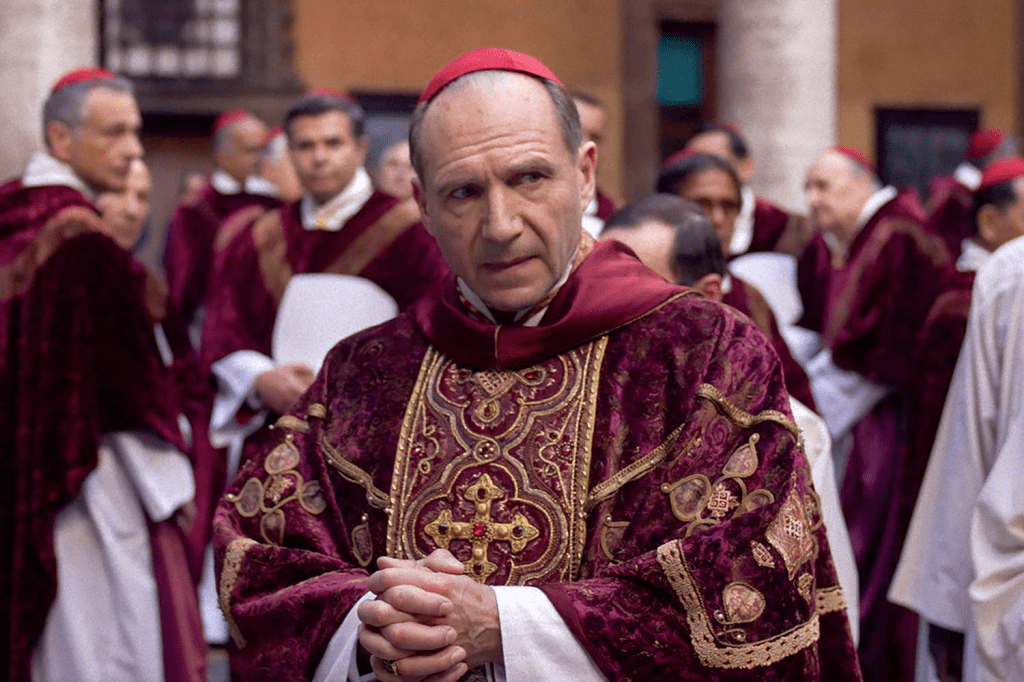
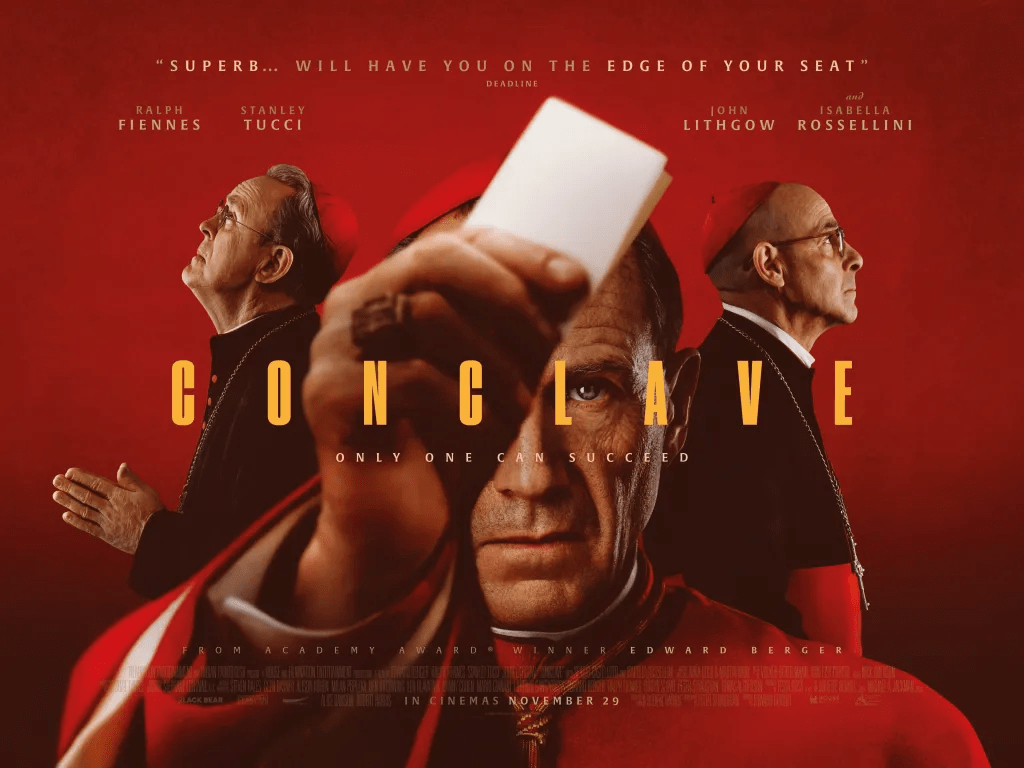
Conclave is a 2024 political thriller starring Ralph Fiennes, directed by Edward Berger and based on the 2016 novel by Robert Harris.
For those reading later on, yes, Pope Francis passed away early last Monday morning, right after Easter on April 21st. A movie that had been on my radar for a long time (and, I think, a lot of people’s radar) now moved up in importance. So, when Peacock re-added Conclave the Tuesday after he died, we had to watch it.
How was Conclave? I think it partly depends on what you’re looking for. If you’re looking for a thoughtful fictional political thriller that tackles a parallel version of issues in the modern Roman Catholic Church – with a bias toward one of the two sides of the issues but still critical of all – here is your movie.
If you were just looking for a political thriller, well, you might get bugged at some of the commentary. If you were just looking for a tackling of issues in the modern Roman Catholic Church, well, this won’t satisfy you, either, because it is a parallel version of the modern issues and not the issues themselves. If you were looking for a documentary on the process of the Roman Catholic conclave, well, this is meticulously researched and detailed, but it’s also made more dramatic this go-around than it seems – for all intents and purposes – the previous Roman Catholic conclaves have been.
So, what is this movie? First, is it any good? Second, what is it trying to say?
Is It Any Good?
Yes. Moving on.
But seriously, if you’re looking for a lower-stakes political thriller, this is your place. What I mean is, there isn’t going to be intense chases on rooftops or gunfights in the streets or secrets discovered by infiltrating hidden vaults or shadow organizations. What there will be are factions, people who represent those factions, dubious backdoor dealings, ambition, compromises, pulling strings, racism, tribalism, opinions, and false faces.
Perhaps a short summary is in order for those who haven’t seen it. In this fictional universe, the current Pope (who is never named), a more “liberal”, populist Pope like Pope Francis, dies. Cardinal Thomas Lawrence, who was appointed Dean of the College of Cardinals by this Pope and was a close personal friend, now has to convene the College of Cardinals.
For those that aren’t up to date on Roman Catholic hierarchy, Cardinals are the highest members of the Roman Catholic clergy besides the Pope. They are chosen from among Bishops, who head a diocese, usually a city and its surrounding area, although sometimes they take up an entire state or country depending on the amount of catholics in the area. They are also chosen from Archbishops, who head an archdiocese – usually larger than surrounding diocese – as well as being in charge over the bishops around them. The most important job of these Cardinals is being able to vote on the next Pope when he dies.
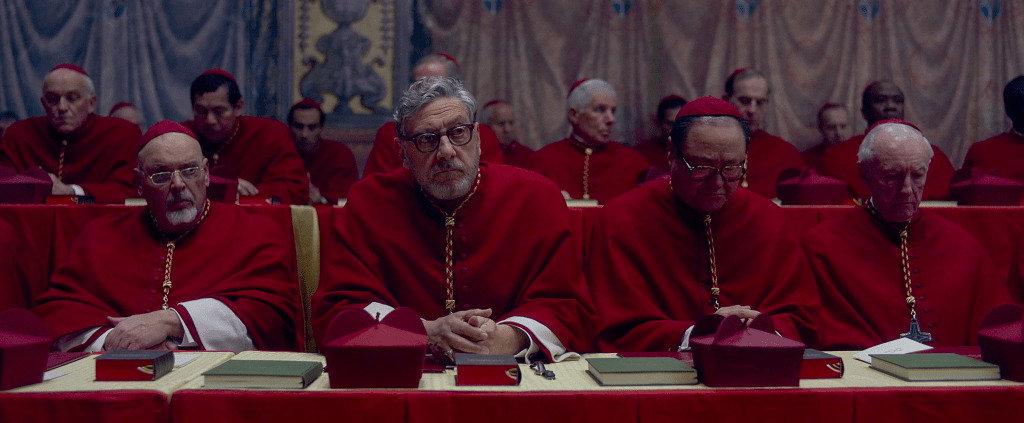
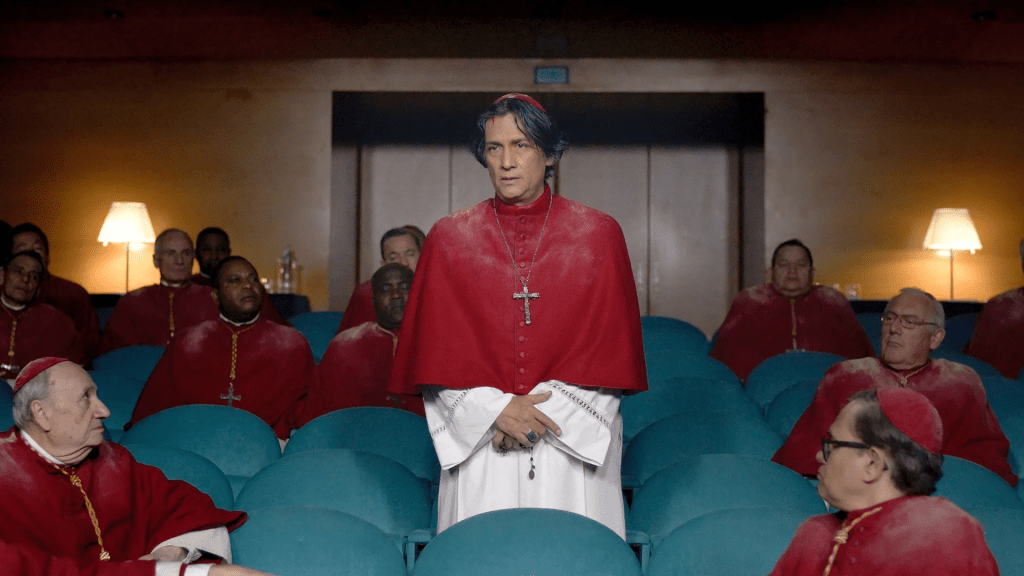
As the College gathers for its conclave, suspicions and secrets fly everywhere. There is an African faction, behind Cardinal Joshua Adeyemi, who is conservative in social issues like LGBTQ+ concerns. There is the Italian and traditional faction, headed by Cardinal Goffredo Tedesco, who wish to return to Latin and an Italian papacy. There is a liberal faction against those two, with Cardinal Aldo Belini at its head, who is Lawrence’s good friend and a good friend of the former Pope. Finally there is Cardinal Joseph Tremblay, a Canadian moderate who tries to get everyone caught in between the sides. Besides those being elected, there is the Mexican archbishop of Kabul, Afghanistan, Cardinal Vincent Benitez, who only became a cardinal in secret under the previous Pope and whose presence is full of suspicion. Each has their secrets, their plots, and their blind spots, and as Lawrence navigates the conclave, he must decide if he is to plunge his hands into the filth and influence the election, or if he must keep his hands clean.
It’s a good movie. It’s a movie you need to pay attention to. You also need to have some knowledge of the Catholic hierarchy – it does a lot of showing rather than telling but it can be easy to miss the showing. It is also a beautiful movie, with really interesting shots and camera angles that make use of the almost haunting atmosphere. Between the monotonous and plain Papal guest apartments that the Cardinals are staying in, and the high roofs of the Sistine Chapel the election takes place in with every window blocked to the outside, you can feel the oppressiveness and stuffiness of the environment. It creates almost a horror-thriller atmosphere with its staccato soundtrack and dark corners. The performances are also great, with Ralph Fiennes always a standout as Thomas Lawrence, but also standouts like Isabella Rossellini as Sister Agnes – a nun whose own part to play slowly becomes apparent – and Lucian Msamati as Cardinal Adeyemi, whose jovial nature hides a guilt-ridden past. One who was just really fun to watch was Sergio Castellitto as Cardinal Tedesco. Watch out for his vape, pulled out at exactly the wrong times.
There are so many questions that slowly become unraveled as the movie goes on. Was the Pope murdered? Who was there the night before he died? What happened? Who is Benitez? Why is he here? Who has a guilty past? Who is bribing to get their position? But one of the many questions that quickly surfaces is: How far is Lawrence willing to go to influence the election?
That is one of the most powerful parts of the movie: the questions it makes you ask. However, the questions aren’t just plot or character related. They are also related to questions of reform and chance in the Catholic Church.
What Is It Trying to Say?
The movie is biased in favor of change and reform. How so? Well, in order to do that, we have to begin to discuss spoilers. If you don’t want spoilers, head to the final heading for my verdict on the movie.
There is a big twist at the end of the movie. It turns out that Cardinal Benitez is joyfully elected Pope after chastising the various factions for not caring for people, and for the mission of the Catholic Church, after a suicide bombing damages the Sistine Chapel. Benitez is elected pope and takes the name Innocent. However, shortly after, Lawrence discovers that Benitez is an intersex man. Born with ovaries and a uterus, but a penis and testes on the outside, he did not discover his condition until he was a priest. The previous Pope refused his resignation, and allowed him if he wished to have surgery to remove his ovaries and uterus. He backed out of the surgery when he arrived, choosing to stay as God made him. Lawrence seems relieved somewhat at this, and the movie ends with him opening windows and letting light into a room as he looks at some chattering nuns.
The movie is asking the liberal faction to put its money where its mouth is. Bellini several times chastised the African faction for being anti-LGBTQ+, because they advocate for laws criminalizing homosexuality, as their African nations do. Now, though, will they support an intersex pope, who while for all appearances is male, he has XX chromosomes?
However, something that I liked about the movie is that though Bellini is strong in his opinions – and many viewers might agree with his opinions – they do not demonize the traditionalist or conservative factions. When Tredesco says, “Look around, Lawrence. Africans sit by Africans, Italians by Italians, Americans by Americans. We are all divided. This was not the case when everyone spoke Latin fluently,” he has a point. They are extremely divided, and Tredesco thinks he sees a way to unite them. He’s also racist (“we can’t let one of them be Pope,” he says about Adeyemi), but it’s interesting how that conflicts with his view of unity. Lawrence, who himself is tolerant of LGBTQ issues, is a good friend of anti-LGBTQ+ Adeyemi and the two share several poignant scenes. And in the process of exposing schemes and lies, no one is without flaw. I liked this quote from the Christianity Today review: “though the film subtly advances progressive convictions, it gives cardinals of all ideological persuasions equal opportunity to fall short.” And fall short they do, each one of them – really, except Benitez.
If I have to give criticism of the movie, it’s that Benitez is too perfect. He’s almost angelic in quality, especially with his ministry to the poor and embattled in Afghanistan, and while that helps him get elected, in this world where no one is clean, he is squeaky clean. You might even say, innocent. The reveal of his intersex condition may seem to come out of nowhere, but I actually assumed throughout the movie he was going to turn out to be non-practicing same-sex attracted, which wasn’t too far off the mark. This came from comments about the surgery and about his relationship with the previous Pope.
However, what’s also interesting is that Benitez does become somewhat guilty by association. Reading between the lines, it becomes apparent that the Pope has rigged the entire election in Benitez’s favor. When Tremblay claims he knew nothing about Cardinal Adeyemi’s affair with a nun, and that the Pope ordered him to bring then nun to the Conclave without knowing it would embarrass Adeyemi, I believe Tremblay. The Pope did rig this so that Tremblay would be discredited… along with Adeyemi. He also rigged it by making Benitez a cardinal in pectore, or secretly. He wanted him to be secret so that no one would discover his intersex condition early. The Pope also had all of Trembley’s simony (bribing) records for buying his office, which Lawrence discovers, and it is revealed that Bellini is linked to some of these records. That takes care of both Trembley again as well as Bellini. The only cardinal that the Pope seems to have no dirt on is Tredesco, but perhaps he hoped his traditionalism itself would be what would push people away from him. And, the Pope did keep his intersex condition a secret, too, though he learned years ago. The Pope rigged this whole thing.
So, how much of a victory for “liberalism” is it, when its own Pope that is supposed to be clean – even if he is intersex – was actually himself the result of machinations and cunning on the part of the previous Pope? How “clean” is the victory then? And how “Innocent” is it when this intersex condition will only become revealed after he is elected? Will that only further divide the conclave for its decision? Will this really unite them? We know nothing about Benitez’s other views besides that he is anti-war and pro-refugee and poor. Does that really qualify him to navigate all of the issues we’ve seen come up so far?
I don’t know how much the movie was trying to ask those questions, but the movie definitely asks those questions, whether on purpose or not. In that case, maybe the ending isn’t as “cut and dry” as it perhaps first appeared to some. I’ve talked with many people who said they thought the twist came out of nowhere and undermined the rest of the movie. I, however, think the twist beneath the twist – that the previous unnamed Pope rigged this all – is what’s really interesting and what really asks the big questions.
A Worthy Watch
If nothing else, this will be a worthy (if sensationalized) watch as we head into the real conclave following Pope Francis’s death. At best, however, it makes you ask questions about characters and plot every step of the way, and at the end it makes you ask questions of legitimacy and bias. When it’s all said and done, Conclave, beautifully shot and acted, is also full of questions. And in a movie where doubt takes center stage, there is no more fitting description than that.
𝙷𝚒! 𝙼𝚢 𝚗𝚊𝚖𝚎 𝚒𝚜 𝙽𝚊𝚝𝚑𝚊𝚗. 𝙸 𝚕𝚘𝚟𝚎 𝚜𝚝𝚘𝚛𝚢𝚝𝚎𝚕𝚕𝚒𝚗𝚐, 𝚕𝚎𝚊𝚛𝚗𝚒𝚗𝚐, 𝚊𝚗𝚍 𝚌𝚛𝚎𝚊𝚝𝚒𝚗𝚐, 𝚊𝚗𝚍 𝚊𝚕𝚜𝚘 𝚕𝚘𝚟𝚎 𝚝𝚘 𝚝𝚊𝚕𝚔 𝚊𝚋𝚘𝚞𝚝 𝚝𝚑𝚎𝚖 (𝚜𝚘𝚖𝚎 𝚠𝚘𝚞𝚕𝚍 𝚜𝚊𝚢 𝚝𝚘𝚘 𝚖𝚞𝚌𝚑!) 𝙵𝚘𝚕𝚕𝚘𝚠 𝚝𝚑𝚒𝚜 𝚋𝚕𝚘𝚐 𝚝𝚘 𝚜𝚎𝚎 𝚖𝚘𝚛𝚎 𝚌𝚘𝚗𝚝𝚎𝚗𝚝!
 Go-To Guru: Film, Literature, Television, and More
Leave a comment