
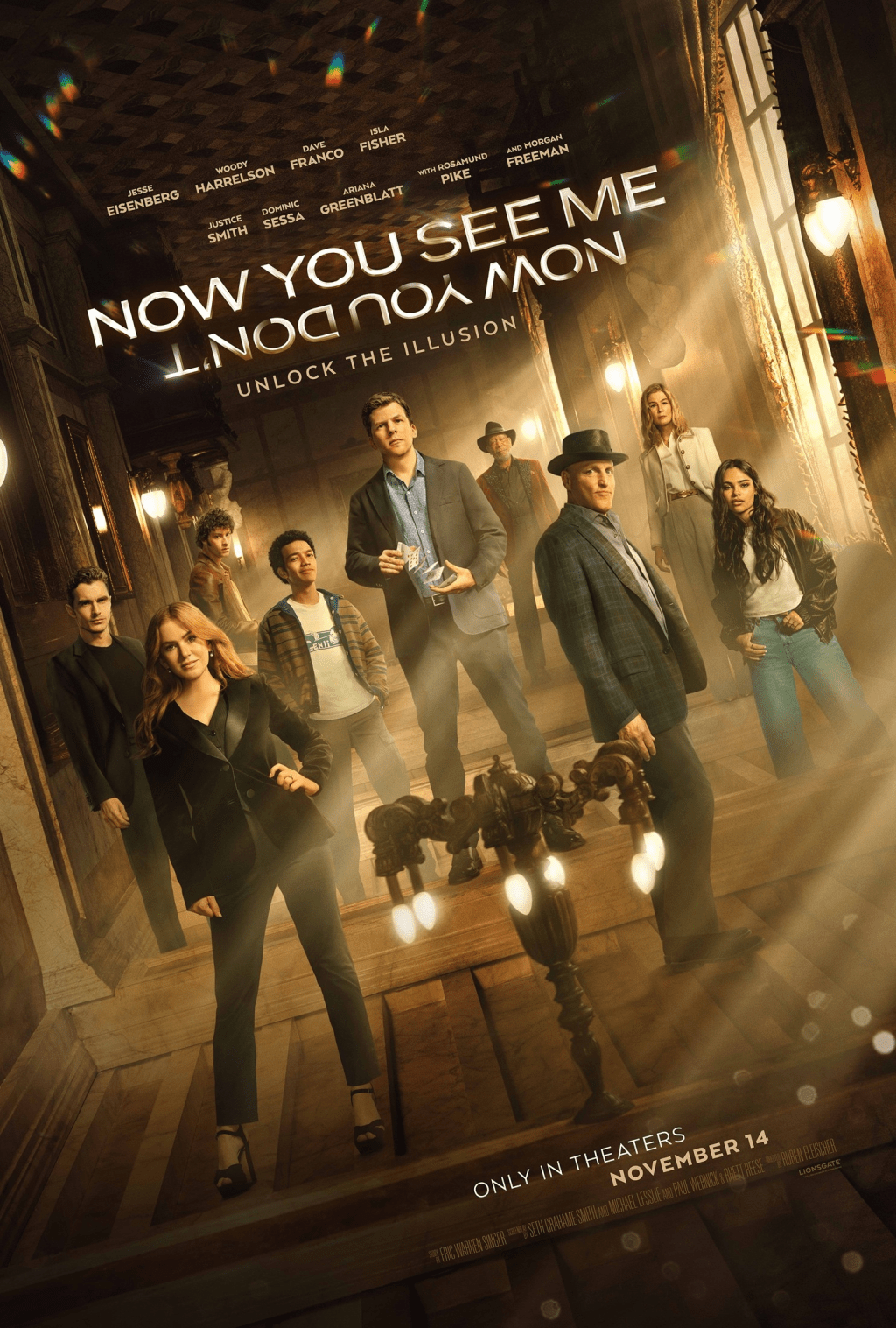
Now You See Me: Now You Don’t is the third installment in the Now You See Me heist franchise that began twelve years ago. Created by Boaz Yarkin and Edward Ricourt, this new installment was directed by Ruben Fleischer.
My wife loves the Now You See Me movies. Something about the mix of mind-bending magic tricks, bloodless violence that uses mostly cleverness to escape foes, and comedy makes for heist films that aren’t as intense while still being a fun ride. We went to go see Now You See Me: Now You Don’t, the third film, after only finding out about it… a week before it came out. The marketing has not been top notch for this movie for some reason.
I’ll take a detour into the numbers for this one quick. However, before I do that, here’s what you need to know:
Now You See Me: Now You Don’t is a worthy successor to the predecessors. I don’t think any of the movies are amazing, but I think they’re original with a fun concept. The mixture of stage magic and heists is a really fun combination. The twists keep you wanting to watch again to see what you missed the first time (although, sometimes the twists don’t fit the information the movie gave us before). And, the main characters all have fun personalities and tension that makes their interactions engaging in between and during the heists. Now You See Me: Now You Don’t continues the trend (including the semi-problematic twists), but I actually think it does it even better than its predecessors. The main reason this is is because the movie went back to some basics of filmmaking to strengthen its character arcs and focus its narrative.
The Numbers
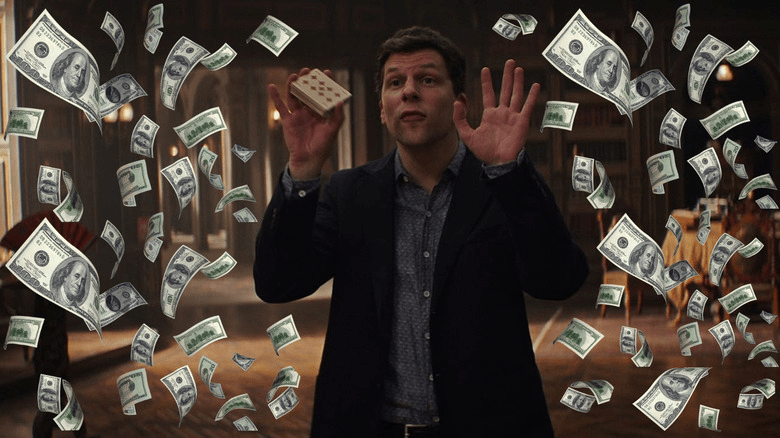
But to get into the numbers for a moment. With a budget of $90 million, and right now sitting at a $80 million opening weekend and a $60 million second weekend, and a $47 million Thanksgiving week haul, I think it’s safe to say it’ll make back its money and have a solid profit. As of today (12/8/2025), it stands at $209 million in theaters against its $90 million budget. It might not be quite as high as the other movies (they had $75 and $125 million budgets, with $350 million before ten-year-ago inflation). However, Lionsgate seems poised to be the only major studio that makes mid-budget movies that are mid-successes and seems comfortable with it.
For example, Hunger Games; Ballad of Songbirds and Snakes had a $100 million budget and made $350 million. Normally, you add a little less than half a film’s budget for marketing, and then double it, and that’s what a movie needs to make a profit (some instead just multiply the budget by 2.5). So, $100 million + $40 million marketing = $140 million, times 2 = $280 million. $350 – 280 = a $70 million profit. Not Disney’s former numbers with Avengers and Star Wars, but better than their recent numbers (see my post here to explore the idea of money and movies more, if you’re interested. It’s a few years old but still holds true).
So, Now You See Me: Now You Don’t probably had a marketing budget of about $35 million. $90 million + $35 million = $125 million, times 2 = $250 million. If you just multiply by 2.5, it’s instead $225 million. Again, neither number is exact, but that’s about how much the movie needs to make before it starts making back money, and it currently stands at $209 million. It seems like it’s got legs going into Christmas. I think with the boost in the holidays it’ll do fine – again, not ludicrous, billion-dollar profits, but fine.
We need more movies like this. When Marvel movie after Marvel movie has $170-250 million budgets (even “smaller” movies like Thunderbolts) and yet only have $350 million grosses, they lose possibly millions of dollars each and every year. We need more “smaller” movies, movies that cost less than $100 million, that are modest successes, rather than each movie trying to be the biggest and baddest yet and failing (see Superman‘s measly success this summer).
But Back to the Movie: What Works
Sorry to nerd out for a minute. We need more mid-budget, mid-gross movies, or else Hollywood might die.
Spoilers below.
But we also need good movies. While Now You See Me: Now You Don’t isn’t a masterclass by any measure, it is a fun heist movie with the interesting element of stage magic and a bickering but lovable cast of characters. It also brings in a new set of characters, two of whom are successful and one of whom is not.
Let’s summarize Now You See Me and this movie, shall we?
Now You See Me features a crew of thieves called The Four Horsemen. However, they’re thieves for a purpose. Recruited by a secret organization of stage magicians called The Eye, they focus on righting specific wrongs done by millionaires and billionaires, often with an element of personal revenge. Their stage tricks are often secretly heists or robberies. The movies always end with the millionaire or billionaire being tricked into someplace they think is somewhere else, and getting filmed live admitting their guilt.
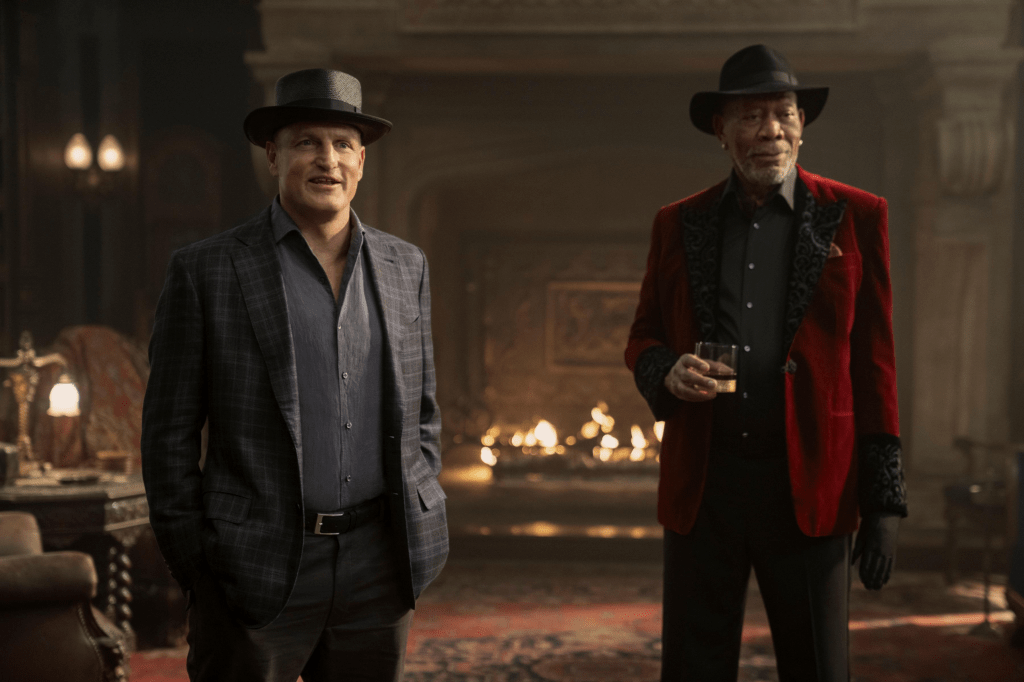
Three of the Horseman have stayed consistent between movies (J. Daniel Atlas played by Jesse Eisenberg, Jack Wilder played by Dave Franco, and Merritt McKinney played by Ed Harris). The final Horseman changed between movies (Isla Fisher played Henley Reeves in the original film, replaced by Lizzy Caplan as Lula May in the second film). In addition, Morgan Freeman played magician Thaddeus Bradley. Originally working to expose the Horseman, it’s revealed in the second movie that he was working for the Eye the entire time. Also, Mark Ruffalo plays Dylan Rhodes Shrike, the FBI agent tracking the Horseman in the original film who’s revealed to be an emissary of the Eye in that film and becomes the Fifth Horseman publicly in Now You See Me 2.
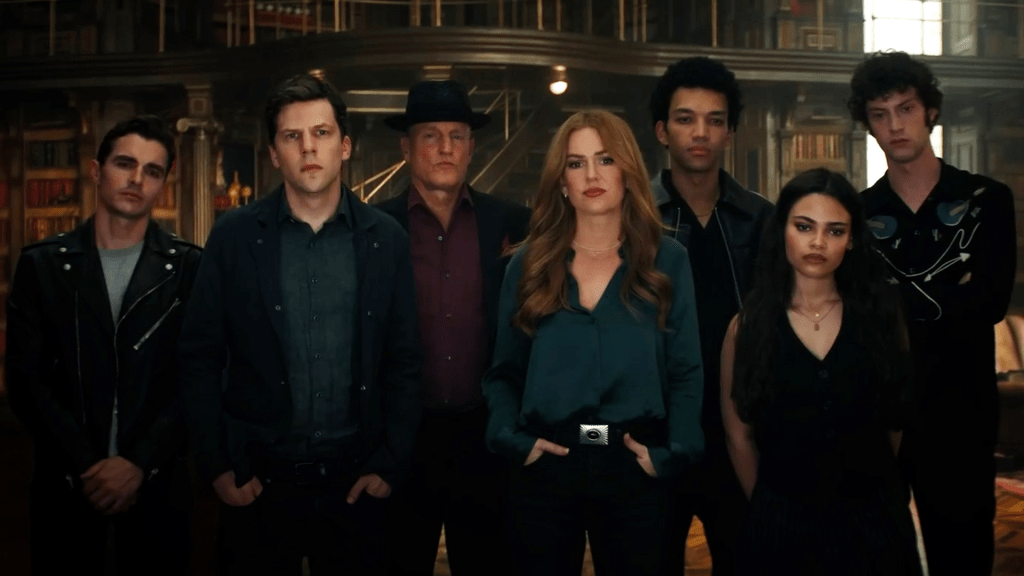
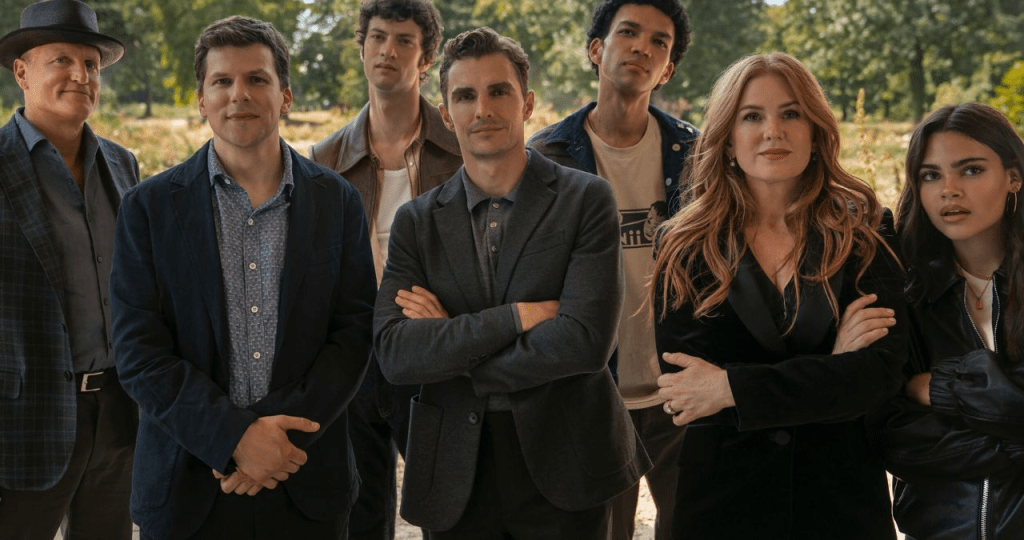
Now You See Me: Now You Don’t fits this dynamic, except it adds a new trio of young leads who are being included with the Horseman. Charlie played by Justice Smith, Bosco LeRoy played by Dominic Sessa, and June Rouclaire played by Ariana Greenblatt, now round out the cast of characters. It’s really fun to have the dynamic of the older Horseman tutoring this next generation. The most fun scene in the movie is a long one-take when the four main Horsemen (Henley returns at the beginning of the movie, Lula suprisingly comes back near the end of the movie) try to upstage the three kids with various magic tricks. Other fun scenes with the crew together include the younger and the older pairing up to explore a trick-filled mansion, talking about their personal lives, and then coming back to those same rooms they explored to lure in and trap police officers who are following them. The action in that sequence is the best in the movie, too, featuring an Inception style rotating room, fistfights in halls of mirrors, and a fight in a Lord of the Rings-esque distortion room that seems like it was a completely practical effect. There seems to be less glaringly obvious CGI in this movie than the others perhaps because of the lower budget, and less overpowered magic (Merritt uses his hypnosis less often, which was godlike in the second movie), which is just a result of good writing, and it shows.
As in the previous movies, there are several fun heist scenes. Standouts for me include that sequence in the “trick mansion,” the first heist of the Heart Diamond (especially the really fun explanation of it, which was one of my favorite “after the heist” explanations in the movies), and the Horsemen working together to escape from the box filling with sand and water. The Heart Diamond heist stands out to me for slowly introducing the other Horsemen back to us – first Jack appears to save the day, then Henley, then finally and surprisingly Merritt. It’s a lot of fun to see each of their tricks come out and say, “Hey, it’s JACK! Hey, it’s HYPNOSIS!” The action in the “trick mansion”, as I said, is the best in the movie, for using all of their unique abilities while providing solid action choreography.
However, what I think makes this movie stand out from the others is the quick and not-so-quick character interactions. While each of the cast kind of has their one “thing” that becomes their “thing” in the movie, it’s good, efficient writing that works well with all of this cast. It’s not particularly deep, but it also hits the right notes.
They purposefully pair up a younger up-in-comer with an older Horsemen with a similar problem. Basco and Atlas make a great pair, and their interactions throughout the movie with both of their egos and then both of them coming to respect each other was a highlight. Henley mentoring Charlie makes a lot of sense (until the twist kind of?) and she seems to bring out a more open side of him. While Merritt doesn’t mentor anyone, his little arc – going from not caring at all and wanting to drink his life away for his guilt over abandoning Dylan in Russia, to a personal vendetta against the villain Veronika Vanderberg for killing Thaddeus, to really wanting to protect his family again – is fun to watch. His mentalism analysis scene of Veronika is one of the best scenes in the movie, as his powers feel really unsettling there (while also being more plausible then in some of the other movies because he had most of that information before). Even Lula has a little arc, going from feeling neglected and not included and not speaking to Jack Wilder, to falling in love with him again. They really efficiently cram in all these interactions in a way that I don’t think the first Now You See Me was quite able to achieve.
One of my favorite moments is when June, Merritt, and Jack are arrested by the French police. Bosco panics, swearing he’s going to rescue June , and he finally opens up that she’s the only family he has left. Something that stands out to me on rewatch as that if this is all the plan of the three younger Horsemen, than this must have been not part of the plan, explaining why Bosco is panicking so much and looking at Charlie in the scene. “This wasn’t our plan,” he seems to be saying if you watch closely. It explains why, too, his “too cool” aesthetic is falling apart.
Finally for what works, Veronika Vanderberg is a really fun villain. While her opening “Swallow the diamond” scene is a little too evil for me, she does bounce back and forth between some level of sympathy and not. It feels good to have a straightforward villain rather than the first movie’s constant misdirection. I also enjoyed the second movie’s Walter Mabry, yet he was a villain “in control” the whole time, masterminding everything, while Veronika is much more on her back foot and trying to keep up, which she does in spectacular fashion. It’s fun to see a villain trying to keep up and mostly succeeding until she doesn’t, which the franchise hasn’t really had before (unless you count Dylan Rhodes in the first movie, where he’s kind of the main protagonist but also kind of the main antagonist).

What Doesn’t Work
Now, for what doesn’t work.
This movie is stuffed, with eight (!) main characters with the Five Horsemen and the three New Horsemen plus the villain plus Thaddeus Bradley. Pretty much each character gets their “one moment” or “one beat” to shine, as I said. It’s basic character writing stuff, and even half-attentive watchers will spot the arcs from miles away, but it’s still cool to see actually functional arcs. They’re just… small, not as detailed.
One of these characters doesn’t work, though, and that’s June Rouclaire. The girl who is a pickpocket and thief of the three younger Horsemen, she is the only of the three that doesn’t really have any flaws to overcome; but June just stays… June. Even the Horsemen get their little arcs; Merritt escapes his depression by being angry at Veronika for killing Thaddeus, then by bonding again with the team (my favorite of the arcs); Jack Wilder overcomes his skepticism of the Horsemen and then falls back in love with Lula; Lula, even with her short screen time, is mad at the Horsemen for not including her then falls back in love with Jack. Also, structurally-wise, I think it was really clever to have them slowly drip in the old Horsemen during the Amsterdam heist, and Lula halfway through, because that gives the new cast time to shine but then the old cast gets their awesome entrances. Everyone has their arcs but is also respected… except for June, who from the beginning everyone pretty much says is awesome, and stays that way.
June just comes off as more annoying and overpowered. It was really annoying when she solved the puzzle to get into the trick mansion when Jack Wilder could not. The point is she is unique from Jack – they’re both pickpockets and thieves, after all, so you need to differentiate them somehow – but it comes off as one of those, “I BYPASSED THE COMPRESSOR!” moments (IE, a moment artificially constructed so that the younger, new, replacement cast of characters one-ups the older cast so that they earn the older casts’ respect and, by extension, the audience’s, when it just comes off as annoying and stupid). Also, when she’s captured by the police and has her mini fistfight to escape, she never really struggles in the fight. She’s able to do things that she shouldn’t be able to at her size. While it’s cool that her choreography mostly involves using the environment – diving under tables, pulling down bookcases, etc – she still pulls off huge punches that just don’t seem like they’d work. Merritt actually saves her, which is surprising (they let the male character save the female character? see: The Super Mario Bros movie, Rey in The Force Awakens escaping before Han and Finn get there). However, it still feels like she doesn’t really have any flaws, struggles, or character shortcomings. Even her talk with Jack Wilder while the two are paired together is mostly her counseling Jack, rather than the other way around. She’s just… too perfect, which stands out when the others, especially the kids, are given believable flaws to work through.
There are a few other things that don’t work, but I think they’re all connected to the logistics of “the big twist.” So, I’m going to go into that and parse through it.
Spoilers: The Logistics of the Big Twist
I actually really like the twist. A lot of little details in the movie begin to fall into place when you consider the twist.
First, Charlie’s seemingly instant knowledge of everything they’re doing. Yeah, he is a walking magician encyclopedia, but there were several times it seemed like the exact right thing at the right time. “Well, because he planned it that way!” makes perfect sense. Also, when J. Daniel Atlas can’t find anything on Charlie’s family background, I figured that would be setting up something later, but I did not guess that he was the son of the mistress. I can pretty often guess twists in movies, but that isn’t one that I guessed. In addition, one scene that felt really cheesy to me was when they were talking about Veronika Vanderberg’s family background and Bosco said, “Yeah, I’ve been googling her. Here’s all this info about her.” I thought, “Come on, that’s just lazy.” But looking back on it, it’s because Bosco was giving the exact right info at the right time to convince the Horseman to do what to do. Also, the scene when Charlie confronts Veronika, I thought he was acting the entire time, and that was going to be the twist – he was pretending to be the son of the mistress. The fact that he actually was the son of the mistress was really cool. I did NOT see it coming, when I usually see twists coming. That’s also why, as I said before, Bosco is panicking so much by that river. “This wasn’t part of the plan,” he’s saying to Charlie. It adds context to that scene that actually deepens character interactions rather than making them weirder, which I think the twist in the first movie does. That twist – where Dylan Rhodes is actually Dylan Shrike – adds all sorts of questions to his dialogue, interactions, and actions throughout the movie. Meanwhile, this seems to deepen them.
However, there is one main place that I think the twist begins to fall apart. That’s besides the normal elements of these movies, like, “How did they have this much money to begin with?” That is something the movies always hand-wave over. The place the twist falls apart is withThaddeus Bradley.
Somehow – although this is never mentioned at the end when Charlie reveals his entire “game plan” to the audience of the magic trick and the movie – Charlie also got in touch with Thaddeus Bradley, faking an invitation from the Eye just like he did for the Horsemen. However, we found out in the second movie that Thaddeus Bradley has a direct connection with the Eye. Wouldn’t he be suspicious of being contacted? Wouldn’t he have contacts within the Eye that he could use to see if this invitation was legitimate? Then, he is shot and killed. Wouldn’t Charlie feel incredible guilt for that? I think what would have fixed it is if, in the final scene when they’re all hanging out at Charlie’s apartment, J. Daniel Atlas and Charlie talk about the guilt of a plan gone wrong, and the guilt Daniel feels for Rhodes being trapped in Russia. Charlie describes how he never even expected Thaddeus to show up, or maybe… that he never even contacted Thaddeus in the first place. That would be cool, too, to see that the Eye was always watching them. Instead, it just comes off as weird and disjointed from the rest of the movie when it could have been a real opportunity.
See Now You See Me
It’s a fun heist movie that’s worth the ride. It’s get inventive action scenes, fun character interactions, a crazy twist I did not see coming, and a unique premise that continues to deliver on thrilling stage magic. While it isn’t flawless and isn’t particularly deep, it also ups the ante of the previous installments. Don’t skip it over the holidays; see it as a fun action ride, especially these days when we need low-budget movies to help take back the big screen.

𝙷𝚒! 𝙼𝚢 𝚗𝚊𝚖𝚎 𝚒𝚜 𝙽𝚊𝚝𝚑𝚊𝚗. 𝙸 𝚕𝚘𝚟𝚎 𝚜𝚝𝚘𝚛𝚢𝚝𝚎𝚕𝚕𝚒𝚗𝚐, 𝚕𝚎𝚊𝚛𝚗𝚒𝚗𝚐, 𝚊𝚗𝚍 𝚌𝚛𝚎𝚊𝚝𝚒𝚗𝚐, 𝚊𝚗𝚍 𝚊𝚕𝚜𝚘 𝚕𝚘𝚟𝚎 𝚝𝚘 𝚝𝚊𝚕𝚔 𝚊𝚋𝚘𝚞𝚝 𝚝𝚑𝚎𝚖 (𝚜𝚘𝚖𝚎 𝚠𝚘𝚞𝚕𝚍 𝚜𝚊𝚢 𝚝𝚘𝚘 𝚖𝚞𝚌𝚑!) 𝙵𝚘𝚕𝚕𝚘𝚠 𝚝𝚑𝚒𝚜 𝚋𝚕𝚘𝚐 𝚝𝚘 𝚜𝚎𝚎 𝚖𝚘𝚛𝚎 𝚌𝚘𝚗𝚝𝚎𝚗𝚝!
 Go-To Guru: Film, Literature, Television, and More
Leave a comment