
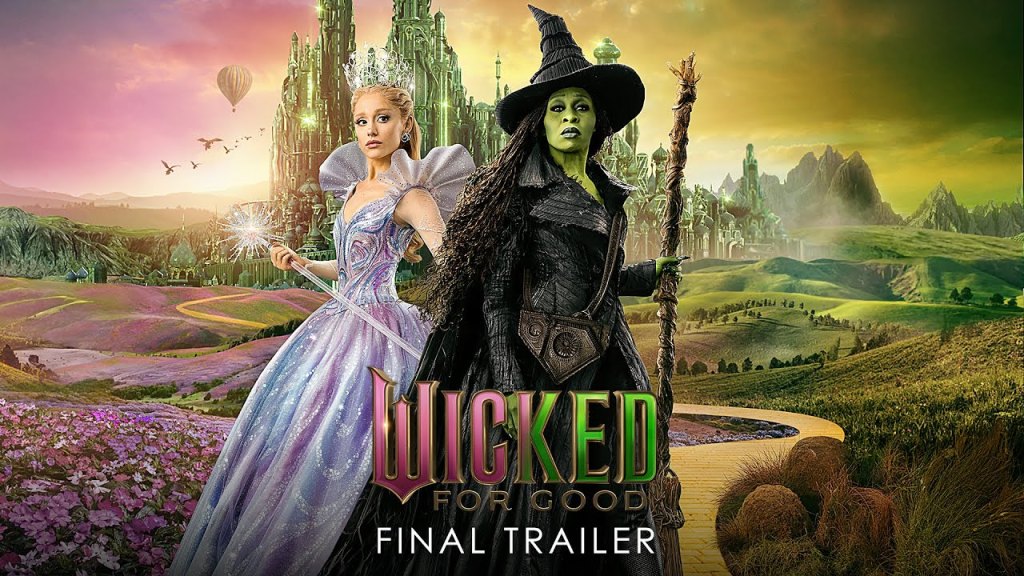
Wicked: For Good is the second part of an adaption of the Broadway stage musical Wicked, directed by Jon M. Chu. The Broadway adaption is based on the 1995 book Wicked: The Life and Times of the Wicked Witch of the West, which is a twist on the 1900 children’s story The Wonderful Wizard of Oz and its classic 1939 movie adaptation The Wizard of Oz.
I reviewed Wicked: Part 1 last year. Yes, that’s it’s title in the movie, so I should probably call it that. What happened to part two? Did I miss it?
Just kidding. Wicked: Part 2 had its title changed to Wicked: For Good this year. Not sure what the planning was, but you could have called it Wicked: Gravity or something like that. Anyways.
Some people characterized Wicked as just another movie where the “bad guy” was secretly “good” all along (like Cruella or Maleficent). Some people are frustrated that all villains today seem to be “twist” villains or “misunderstood” villains. Well, I don’t think Wicked quite fit into the category and I found plenty in this movie that was good and worked well. It has its issues – mainly in the plan of the “bad guys”, Madame Morrible and the Wizard of Oz, as you can see in my review – but overall it was a movie that didn’t rely on tropes. Even if it did, the point isn’t whether something follows tropes, but whether or not its own story is interconnected.
Do I have the same thoughts about Wicked: For Good? Is it a solid movie, with or without tropes, worth seeing in every respect?
Hm.
Hm hm hm.
That’s a tough one.

Summarizing Wicked: For Good
Wicked: For Good is a difficult movie to summarize. Unlike the more straightforward nature of the last movie, this movie is much more all over the place. Sometimes interactions are long and drawn out, and other times they are so quick they don’t feel real. Let’s get to it. If you’ve already seen it and want to skip to where I talk about the movie, skip to the next heading, “For Good.”
Spoilers below.
In the last movie, Elphaba purposely set herself up as the enemy of the Wizard of Oz. Unlike I predicted, this did not make a new enemy out of the her instead of the talking animals. Now, both are persecuted: Elphaba, branded the Wicked Witch of the West, and the animals. The animals are forced to work to build the Yellow Brick Road, which Elphaba tries to interrupt but cannot stop. She lives in a new forest hideout while trying to disrupt the animals. Meanwhile, the people of Oz buy into the propaganda and fear for themselves (the song, “Every Day More Wicked”).
Meanwhile, Glinda, now called Glinda the Good by Madame Morrible’s propaganda and given given a mechanical bubble flying thing and a magic wand for show, visits the same city that opened Wicked: Part 1. At the opening of the Yellow Brick Road, she announces her engagement to Fiyero, the leader of the forces attempting to capture Elphaba. He does it just to make her happy, leaving Glinda unfulfilled even as the crowd celebrates that the wicked witch will soon die (“Thank Goodness / I Couldn’t Be Happier”). At this point, wild rumors about Elphaba spread, like that she can be killed by water. When Elphaba attempts to disrupt the opening ceremony, Fiyero and the soldiers attempt to catch her, convincing Elphaba that Fiyero is evil as well even though he’s just trying to find her before others do so they won’t kill her.
Leaving the scene, Elphaba finds a crowd of animals leaving Oz through a secret hole in the ground, including her old bear nanny, Dulcibear. She tells them they have to stay and fight for their home (“No Place Like Home,” a song and scene newly written for this movie) until the talking lion Elphaba saved in Part 1 comes. He tells them all the horrible things he’s heard about Elphaba, including that she left him all alone to fend for himself in the wilderness and that she created the flying monkeys. She says she regrets that she did it and wishes to save them too. Unbeknownst to her, the flying monkeys are listening to this conversation. The animals still leave, making Elphaba dispondent.
Meanwhile, Nessarose, Elphaba’s sister, has taken over the governorship of Munchkinland after the passing of her father, who died of a heart attack when he learned of Elphaba’s new title. She is angry at Elphaba for leaving her, and does not want her boyfriend Boq, a Munchkin, to leave her either (as we said last time, Munchkins have been changed to “rural bumpkins” rather than “short people”). When Boq learns of Glinda and Fiyero’s wedding, he decides to leave Nessarose to confess his true feelings to Glinda. Angry, Nessarose signs an act into law preventing both animals and munchkins from leaving without a permit. Boq angrily stays with Nessa.
Depressed about the animals, Elphaba goes to visit Nessa, hearing about Nessa’s own acts of oppression and wanting to change her. The two fight until Elphaba enchants Nessa’s silver shoes so she can fly using the Grimmerie. Boq enters the room, terrified, but also telling Nessa that now he can leave because she doesn’t need his help anymore. Nessa instead heads for the Grimmerie and tries to cast a spell to keep Boq’s heart. Instead, she begins shrinking Boq’s heart and killing him. Elphaba tells Nessa to leave the room and that she’ll try to save Boq. Nessa admits she’s just as evil as Elphaba (“Wicked Witch of the East”). Elphaba’s spells instead turn Boq into a Tin Man who needs no heart to survive. Nessa tells the Boq-Tin Man in horror and terror that it was all Elphaba’s doing, and the Tin Man goes to find Elphaba and kill her for what she did to him.
At Glinda’s wedding, Elphaba appears, depressed about her lack of success. Glinda, in her wedding dress, encourages Elphaba to just talk to the Wizard to see if they can strike a deal. The Wizard tells Elphaba that all of life is a performance, so the best you can do is perform for what people expect of you (“Wonderful”). Elphaba seems to agree, promising to turn herself in to the Wizard if they free the flying monkeys. The Wizard doesn’t want to, but agrees to it to get Elphaba and the Grimmerie back. The monkeys are released. But while the wedding is going on, Elphaba realizes all the animals are still imprisoned, too – thousands of them, including a Doctor Dillamond who can no longer speak. In anger at the Wizard, Elphaba releases all the animals and they stampede through the wedding.
Elphaba corners the Wizard and Glinda when Fiyero and the squad appears. He tells them to go grab a bucket of water to kill the witch. Fiyero then turns on the Wizard and Glinda, locking the Wizard in a cage and escaping on Elphaba’s broom. Glinda is heartbroken that Fiyero loved Elphaba the whole time, and Glinda says the two deserve each other for their lies. Elphaba and Fiyero escape. While in his cage, the Wizard offers Glinda a green bottle, of alcohol or something else. Glinda refuses.
When Glinda, the Wizard, and Madame Morrible gather, Glinda laments how she’s not the one Fiyero wants, or anybody wants (“I’m Not That Girl (Reprise)”) while flashing back to her childhood. In her childhood, she convinces everyone she can do magic with her play wand because of a rainbow that appears in the sky. She’s always been a fraud, and she knows it. In her anger in the present, she tells the Wizard and Morrible that the way to lure out Elphaba will be to spread a rumor that Nessa is in danger. Glinda leaves, and Madame Morrible adds that it shouldn’t just be a rumor.
Elphaba and Fiyero escape to Elphaba’s hideout. The two sing of their love (“As Long As You’re Mine”) and spend the night together. It’s right that that Madame Morrible summons a tornado which somehow sucks a house into Oz. The house lands on Nessarose, who is (somehow?) still searching for Boq. Elphaba, sensing the danger, leaves for Munchkinland. Fiyero says it’s a trap, so Elphaba should go to one of his family’s old castles for refuge instead of the forest. At Munchkinland, we see Glinda has given the now-magic silver shoes to Dorothy. When Elphaba arrives, she challenges Glinda: Do you think this was a coincidence? Glinda, angry at Elphaba for stealing Fiyero, gets into a fistfight with Elphaba, fake magic wand against broom. The two obviously aren’t trying to kill each other, but there’s still anger. It’s then that the Wizard’s hunting team shows up: it was a trap. But Fiyero (somehow) is there too, and he points his gun at Glinda saying he’ll shoot if they don’t let Elphaba go. They comply and capture Fiyero. Glinda begs them not to hurt him as they drag him into a field to torture him. Elphaba goes to the castle, Kiamo Ko, and attempts to save Fiyero’s life like she “saved” Boq’s. She believes she is unsuccessful, although the movie shows us Fiyero being surrounded by a cornfield and an astute audience member can make a guess. Meanwhile, the Flying Monkeys – having changed sides and led by the first Flying Monkey that Elphaba made – join Elphaba at the castle. So, Elphaba vows to be the evil person everyone seems to think she is (“No Good Deed”).
Glinda, now back at the Emerald City, rushes to confront Madame Morrible. Madame Morrible tells Glinda that she is a pathetic phony and of course they killed Nessarose: but Glinda has been all too happy to ride the lies until now, so Morrible knows Glinda will continue to until it’s all done and she’s the most popular person in Oz. Meanwhile, the lion, Boq, a mysterious scarecrow, and Dorothy meet the Wizard, who says he will let Dorothy return home if she kills the Witch and brings back her broomstick. They leave the wizard and Boq goes into the crowd, getting them riled up for a riot to go kill the witch (“March of the Witch Hunters”). Boq looks up and sees Glinda in a tower, turning away from her while seething in anger. Glinda reflects on how she can’t be that popular girl high above troubles; it’s time for her bubble to pop (“The Girl in the Bubble,” the other new song written for this movie). Boq continues the riot, so Glinda gets on a horse and rides for Kiamo Ko.
When Glinda gets there, the Flying Monkeys have already captured Dorothy and Elphaba has locked her in a dungeon until she gives Elphaba back those shoes. Glinda and Elphaba reconcile, believing they have become better people for knowing each other (“For Good”). Elphaba makes Glinda promise she won’t tell anybody the truth about Elphaba so that Oz can move on and Glinda can make a better Oz in her place. Elphaba then hides Glinda in a closet while Dorothy comes to confront her, Glinda only seeing shadows as Dorothy sprays her with water. Glinda exits the closet to see only the hat left behind and a green bottle. Realizing what this means, she rides back for the Emerald City to confront the Wizard. Because Elphaba was a child of “two worlds,” the Wizard and the wife of the governor of Munchkinland, she got her magic abilities. The Wizard, stunned, accepts Glinda’s offer to leave Oz on the hot air balloon. Glinda captures Madame Morrible with the flying monkeys, promising to right her wrongs.
Back to where Wicked: Part 1 started, someone asks Glinda as she announces the Wicked Witch’s death if she knew Elphaba. She says yes, and then says that the Witch was a complicated person. Glinda promises the crowd that the animals will be free once again in Oz, bringing them out of hiding, and promising a better tomorrow.
A scarecrow walks up to the hat on the ground in the room Elphaba was dowsed in, opening a trapdoor in the ground. Elphaba faked her death using the rumors of water killing her. The Scarecrow turns out to be Fiyero, his life saved by Elphaba’s spell. The two kiss and then flee, making their way out of the desert of Oz. Elphaba doesn’t like that Glinda doesn’t know they are alive, but Fiyero says they must keep it that way. Glinda and Elphaba “look” at each other over thousands of miles apart. The film ends with a flashback that has flashed momentarily throughout the movie of Boq, Nessa, Fiyero, Elphaba, and Glinda playing in a field near Shiz University, Glinda resting her head on Elphaba’s shoulder, the two friends then and friends still now after all they’ve been through.

For Good
Wow, that took a lot longer than I intended. First, the good of this movie.
There were several twists that I did not see coming at all. The Tin Man / Boq and Scarecrow / Fiyero twists were not ones that I guessed (well, I guessed Boq right before the scene because he’s chopping wood and the movie focuses on his ax, and Fiyero during “No Good Deed” because of the corn fields, but that doesn’t really count because the movie wants you to guess). A movie that you can’t see things coming is a really nice thing, especially when the twists are alluded to in the past. I went back to look at Fiyero’s opening song, “Dancing Through Life” in the first movie, and it is full of references to the Scarecrow – “Dancing through life, skimming the surface / Gliding where turf is smooth / Life’s more painless for the brainless / Why think too hard when it’s so soothing? … Life is fraughtless when you’re thoughtless / Those who don’t try never look foolish.” That’s some clever writing there. At the time, I only noticed this:
(the astute viewer would have noticed that in “Dancing Through Life,” there were dozens of references to philosophy like nihilism, stoicism, and epicureanism).
Well, I wasn’t that astute, I guess, because I didn’t also notice the “only had a brain” references. So, good twists.
The movie is also pretty intense. For PG, I was really surprised how intense it got, actually. The scene of Boq becoming the Tin Man is like something out of a horror movie, including Boq smashing down the door to Nessa’s room with his ax and screaming at Nessa for what she did to him. The death of Nessarose, as the house of Dorothy falls on her, is on the one hand kind of comical with the house but also so sad that she’s searching for Boq for what seems like hours? Days? and can’t find him and then dies. Fiyero’s standoff with Glinda and the soldiers, when he points his gun at his former fiancée, made me nearly gasp. Fiyero’s capture is also really intense as the soldiers beat him and drag him away, and he’s punched in slow motion while hanging from a whipping pole. The “March of the Witch Hunters,” where Boq says, “It’s due to her I’m made of tin / Her spell made this occur / So for once, I’m glad I’m heartless / I’ll be heartless killing her!” Again, both fitting the “not having a heart” part of the Tin Man in the Wizard of Oz, and, as he’s illuminated by torches and angrily shouting into the night, being really ominous and intense. Again, for PG, to just kill her on screen like that when they seem to be gearing Wicked for kids more than the original musical was a bold choice.
Along with that, there’s several special effects sequences that were really great in this movie. The Tin Man special affects are extremely impressive and terrifying. The transformation, as metal objects soar around the room and bind to him, and then his appearance, a bunch of different metal objects fused to him, are impressive. I have to assume they animated out his knees because those joints are too small unless he’s a puppet when we see him from the waist-down. Take a look at those knees!

Several characters are fun to watch. There’s a lot of little moments, like Boq looking up at Glinda before continuing the “March,” or Fiyero shaking as he’s holding the gun up to Glinda, or Boq noticing the “Munchkins Permission to Travel” sign and his face instantly realizing what’s going on and his whole demeanor changing, that sell the emotion of the film in a way that the distance of the stage can’t quite capture the same way (Every medium, after all, has its strengths and weaknesses).
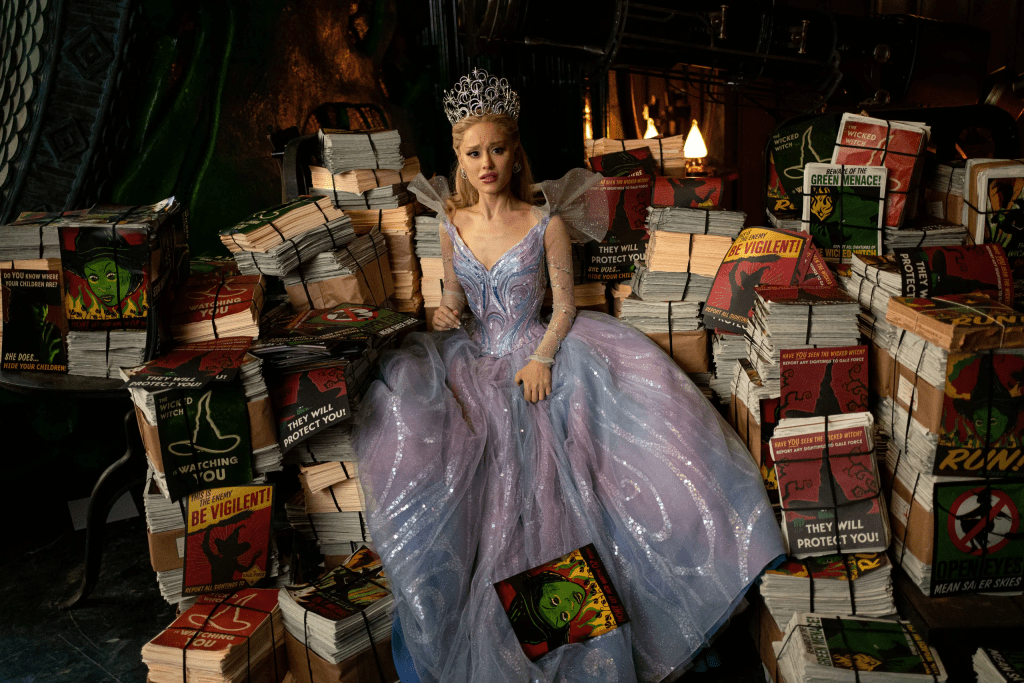
The most fun to watch is Glinda. She goes on the largest arc of the movie and the biggest change. Ariana Granda does a fairly decent job acting the role, and the expressiveness and confusion Glinda shows as her life falls apart is heartbreaking to watch. As she realizes the consequences of her own actions, she tries to make things right, like Elphana – but with far better results.
Finally, the relationships are really what sell this movie. The relationship between Nessa, Boq, and Elphaba is tragic and sad, with each person misunderstanding the other. While Elphaba tries to do the right thing with the wrong results, Nessa tries to do things that are wrong with results that come back to haunt her. While I feel her scenes are too short (and how Boq expects to make it to the Emerald City before the wedding when it seems to be that day that Elphaba flies to the Emerald City, I’m not sure either). the scenes are also effective and powerful.
Fiyero’s relationships to both Glinda and Elphaba shine as well. Fiyero, delicately trying to keep Glinda happy while also hunting Elphaba all to save her; Fiyero attempting to shoot Glinda, only for her to walk to him and put his gun against her forward, causing him to break down. It makes perfect sense for the writers to put him in that situation (although how he got to the city on foot when Elphaba had to fly, I’m not sure) and it’s for maximum drama without being staged or forced.
But of course, the relationship between Glinda and Elphaba is the best part of the movie. They sing the best song of the movie (easily “For Good,” at least for me) and have several of the best scenes in the movie – their “fistfight”, the singing of “For Good” as they reflect on knowing each other, the final scene of Glinda crying in the closet while Elphaba is on the other side crying, those “flashes” of a flashback that illustrate how far things have come. Ariana Grande is definitely the stronger half of the relationship, performance and writing wise, but the relationship does rest on both of them and they sell it well.
That’s it for the good. What about the wicked of the movie?
The Wicked
I honestly feel like there’s a lot more to talk in this half of the review than the previous movie. There’s more “wicked” here, maybe, than the “good.”
The main problem with this movie is its pacing. I talk about pacing in my review of The Chosen, Season 4, but to echo some of those thoughts here: Pacing is the illusive feature of stories where they either feel fast or feel slow, and either of these can be bad or good things depending on what you’re trying to accomplish. This “speed” is hard to capture, but it’s often based on editing, acting, and writing decisions. How long are the pauses between characters responding to each other? How many sentences are there in a conversation, and how much information does each line of dialogue communicate? All of these add up to the feel of a story. A movie might start slow, and speed up over the course of the movie. It might start fast with an opening scene, then slow down, then speed up again. It might start fast and slow down and down as the movie falls apart at the climax. There’s tons of ways this can go. But often, pacing is a smooth arc. When it stops-starts, stops-starts, fast-slow-fast-slow-slow-fast, the movie or show feels choppy and strange.
The pacing in Wicked: For Good is strange. Obviously designed to originally be the second act of a two-act show, at first it starts more intense without introducing the characters and just picking up mostly where we left off. But then, things slow down as Glinda sings about how she’s not totally happy where she is right now. Then, things get exciting when the Wicked Witch interrupts the opening of the Yellow Brick Road, but that scene lasts less than a minute and then Elphaba is singing a stirring solo ballad at the Yellow Brick Road. But then, we cut to Boq and Nessarose and it slowly introduces their situation again with scenes featuring only them (is this happening at the same time Elphaba is singing? Before? Even earlier? When is this taking place in relation to the stuff we just saw?) and this scene ratchets up its own internal tension to a climax with the Tin Man, but then Elphaba prepares to dramatically confront the Wizard but it’s not an intense song, “Wonderful” is kind of… humorous and whimsical, not intense.
This happens throughout the movie. We accelerate, slam the brakes, accelerate, slam, back and forth. The movie feels like a climax that’s been interjected with other things to stretch it out. What should have been a smooth-ish arc (with, obviously, some pauses in between) of escalating intensity instead looks like the heartrate monitor of someone having an anxiety attack.
Case in point is the timing of the new song, “The Girl in the Bubble.” Listening to it on its own, it’s a completely fine song about Glinda’s need to reconsider the “popular girl” who floats in her bubble above it all and needs that bubble to pop. However, the tone and speed of the song doesn’t fit the scene. She just found out she is directly responsible for the murder of Nessarose. As she looks outside her room and she sees Boq screaming as he riles up the crowd, she is about to be responsible for the death of Elphaba, too. “March of the Witch Hunters” is horrifyingly intense. But in the middle of this song – not after, not before, in the middle – she breaks out into this stirring, reflective ballad, “The Girl in the Bubble.” It does not match the tone and the “acceleration” of the scene. If the song had been more intense, more rhythmic, more fretting and fearful as Glinda sees the consequences of all of her actions catching up with her (losing Fiyero, losing Elphaba, killing Nessarose, enslaving the animals, and now this) before Glinda, maybe in a final verse, calmly coming to the conclusion that she has to actually be good and then running off to tell Elphaba, I think it would have fit both the tone of the “March of the Witch Hunters,” Glinda’s own state of mind after the previous scene and during the next scene, and would have been more impactful going into the climax rather than bringing the momentum to a screeching halt. Instead, it’s another slow ballad inserted into the climax that should be continuously climbing, not accelerate-brake-accelerate-brake.
This fits with the other problem of the pacing. The songs are mostly stirring ballads in this half of the movie (I might not be using my terminology correctly, so forgive me – but the point stands as “slower, reflective, mostly-solo songs”). “I Couldn’t Be Happier,” “No Place Like Home,” “I’m Not That Girl reprise,” “As Long As You’re Mine,” “The Girl in the Bubble,” and even “For Good” are all slower, reflective, mostly dance-less. This clashes mightily with Wicked: Part 1, which featured a big introduction, calming down for the opening, and then escalating the tension slowly, first between Glinda and Elphaba and then when that calms between Elphaba and the animal injustice, until the very end when Elphaba confronts the Wizard. It features several choreography-heavy songs (“No One Mourns the Wicked,” “Dear Old Shiz,” “What Is This Feeling?”, “Dancing Through Life,” and “One Short Day,” and “Popular”) but intermixes ballads too (“The Wizard and I,” “I’m Not That Girl,” “Sentimental Man”) as well as the power ballad of “Defying Gravity.” It’s always hard with a “part 2” to keep up the momentum of the original going into the movie, but also to treat the whole movie like a climax. Wicked: Part 2 fails at that, I think, and that is its greatest failure.
A couple of other minor nitpicks. The CGI is great in some places, and the mix of practical and real works well, especially in the Emerald City. However, “No Good Deed” features a really awfully animated Kiamo Ko, with Elphaba jumping and flying through the structure and looking really rubbery while doing it. I don’t know what part of production was rushed to result in that, but the rest of the film looks better overall.
Second in the nitpick department, I just don’t think Cynthia Ervio delivers that great of a performance. I don’t know if it’s her as an actor, or just her choices within the role. She starts Wicked as a know-it-all, believing she’s better than everyone else, and that slowly softens. She ends dramatically with “Defying Gravity.” I didn’t note anything that seemed off in that movie and I think she did a pretty ok job. In Wicked: Part 2, she is mostly distant, angry, and/or depressed. I don’t know if it’s her range or if it’s the difficulty of swinging between emotions, but she either comes off as not giving enough and remaining too stoic (“No Place Like Home,” for me) or giving almost… extra, screaming almost in a cartoonish way (“No Good Deed”). Maybe I need to rewatch it, but something just felt off for her this time, especially compared to Ariana Grande.
My third nitpick isn’t really a nitpick so much as a warning. You need to know The Wizard of Oz movie well in order for this story to make sense, but also can’t know too much about the source material. From characters, to references, to events that are just glossed over and assumed that you understand and know about them, you need to know about The Wizard of Oz for this to all make sense. But then, there are weird times where the original film is ignored or what happens doesn’t entirely make sense based on the movie. For example, the Wicked Witch in the original film dies because Dorothy just so happens to hit her with a bucket of water when trying to save the Scarecrow who has been lit on fire by the Wicked Witch. Obviously, that does not happen in Wicked: For Good, as the Scarecrow is Fiyero and it’s a “known fact” that water melts the witch. However, if you were unaware of the original movie, you’d be very confused about the whole “water melting the witch” thing. So you have to know the original movie – sometimes pretty well – and you have to not know the original movie – or at least, not remember it exactly. It’s a weird combination that is hard to resolve.

Not Very Good, Not Very Wicked
Wicked: For Good is a strange combination. On the one hand, it has some great characters, great character relationships, heartfelt songs, and good performances. On the other hand, it has weird and stretched pacing, too many slower songs, an off performance, and a weird relationship with the source material.
It’s just… somewhere in the middle. It’s neither “For Good” nor “Wicked”; it’s just… fine. And maybe, that’s fine. But I like a movie that’s not just ok, but great. And Wicked: For Good isn’t that. It’s not solid. It’s not worth seeing in every respect. If you liked Wicked, you’ll probably like this one. But its weird downfalls might make it harder for the average person to enjoy the conclusion to this supposed “Event” movie.
𝙷𝚒! 𝙼𝚢 𝚗𝚊𝚖𝚎 𝚒𝚜 𝙽𝚊𝚝𝚑𝚊𝚗. 𝙸 𝚕𝚘𝚟𝚎 𝚜𝚝𝚘𝚛𝚢𝚝𝚎𝚕𝚕𝚒𝚗𝚐, 𝚕𝚎𝚊𝚛𝚗𝚒𝚗𝚐, 𝚊𝚗𝚍 𝚌𝚛𝚎𝚊𝚝𝚒𝚗𝚐, 𝚊𝚗𝚍 𝚊𝚕𝚜𝚘 𝚕𝚘𝚟𝚎 𝚝𝚘 𝚝𝚊𝚕𝚔 𝚊𝚋𝚘𝚞𝚝 𝚝𝚑𝚎𝚖 (𝚜𝚘𝚖𝚎 𝚠𝚘𝚞𝚕𝚍 𝚜𝚊𝚢 𝚝𝚘𝚘 𝚖𝚞𝚌𝚑!) 𝙵𝚘𝚕𝚕𝚘𝚠 𝚝𝚑𝚒𝚜 𝚋𝚕𝚘𝚐 𝚝𝚘 𝚜𝚎𝚎 𝚖𝚘𝚛𝚎 𝚌𝚘𝚗𝚝𝚎𝚗𝚝!
 Go-To Guru: Film, Literature, Television, and More
Leave a comment