
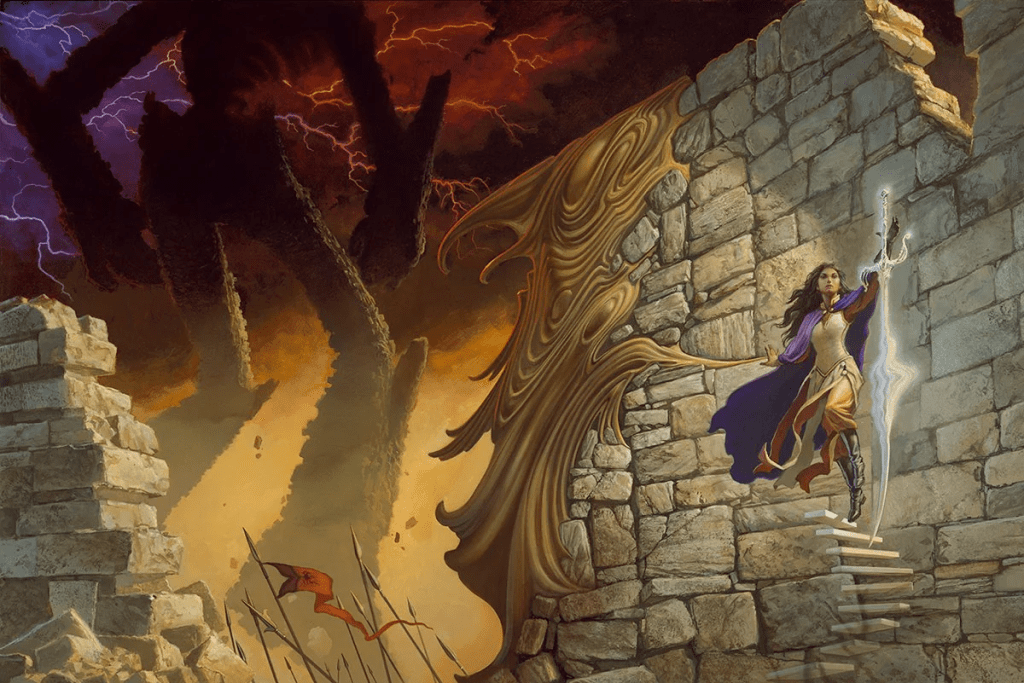
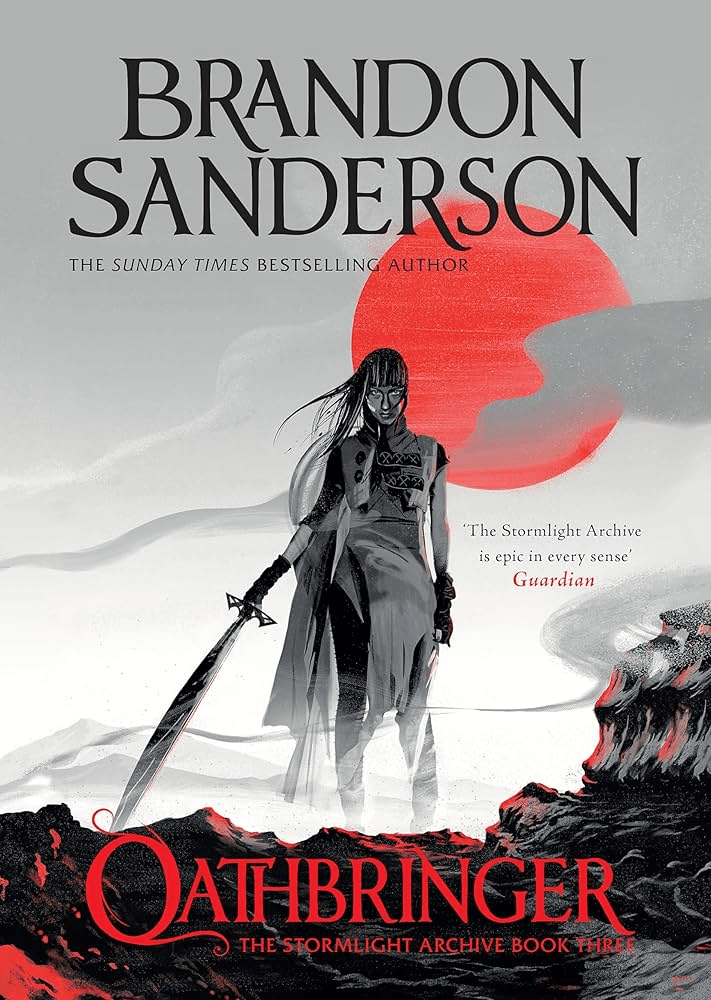
Oathbringer is the third book in The Stormlight Archive, a still-being-written high fantasy series by acclaimed author Brandon Sanderson. It was published in 2017. EDIT: Don’t forget to read my review of Rhythm of War once you’re done here!
Wow. That was an adventure.
I started The Stormlight Archive in January of 2024. Within three months, I finished Way of Kings. You can read my review of it here. Then, within a few more months, I finished Words of Radiance. You can read that review here. I started the third book, Oathbringer, soon after.
And then life got crazy.
I was listening on Audible, and my gift 6-month subscription ended, and I didn’t feel like paying for it. So I was only a couple hours in when that happened. I got in a queue on Libby, our library’s audiobook streaming service… for six months. Then, once I got it, I had a baby (yay!) and so there was much less driving and much more time with babes. Then I moved, got a new job, and still hadn’t gotten around to reading much of it. Finally, I found a physical copy at our new library and committed… and I couldn’t finish it. Too many things. Finally in November, I got it from the library again, and buckled down and committed. On December 17th, exactly a year and a half after I started, I finished Oathbringer. And a month an a half after that, as the news breaks about Brandon Sanderson’s TV and movie deal for Mistborn and Stormlight Archive with Apple TV, I’m publishing this review.
Because of this, I have less to say about Oathbringer as a whole than perhaps the other books. Some of my memories of it are a little disjointed because of the amount of time I spent reading it.
But I think I’ve got a couple of new things to say about Brandon Sanderson, The Stormlight Archive, and Oathbringer in general. I already commented a lot on Brandon Sanderson as a writer in my Way of Kings review, but there’s more now that I have more experience. And I already commented a lot on the worldbuilding, both in Way of Kings and Words of Radiance, but there’s more of that, too. Let’s get started.
The World and Story So Far
If you’re reading this, you probably don’t need this, but here goes.
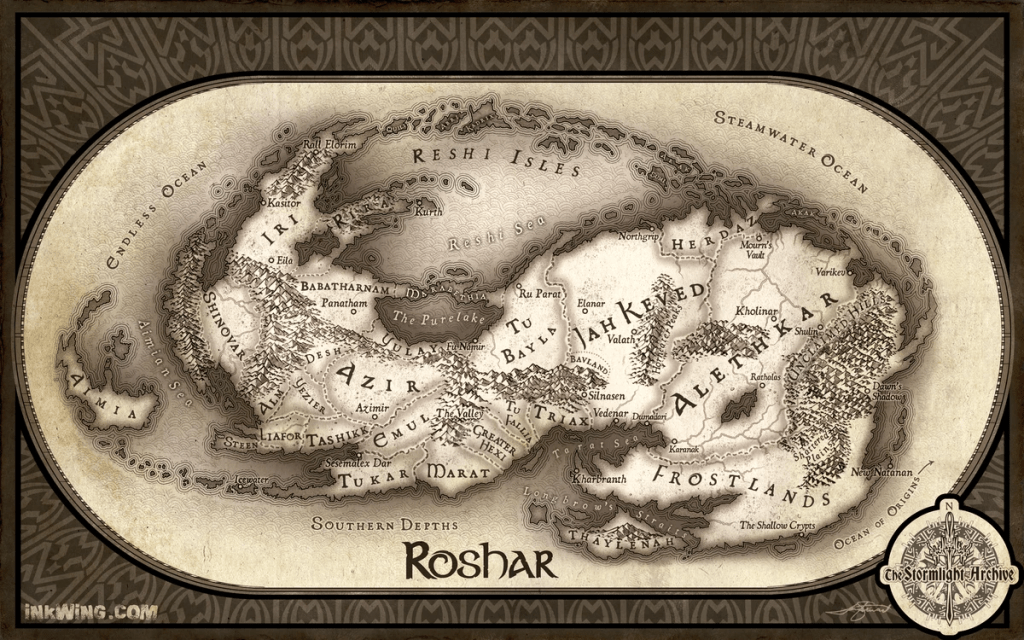
Roshar is in a solar system and world alien to our own. In this solar system, the Cosmere, each planet receives a different magic system related directly to the Shard or Shards located on that planet. Shards are fragments of Divine Command, each taking on an aspect of the universe, like Honor, Passion, or Cultivation. In fact, those are the three Shards located on Roshar. The person who possesses the Shard becomes a god, more akin to a Greek god, with whims and personality and faults but also incredible power. Sanderson has a half-dozen different book series, each taking place on a different planet in the Cosmere. The Stormlight Archive takes place on Roshar.
The Cosmere also has three “planes of existence” – the Physical, the Cognitive, and the Divine. (If you notice the similarity to Platonic idealism, my dear philosophy student, then you’d be correct on Brandon Sanderson’s influences). The Physical plane is the material, real world. The Cognitive is a world of thought, inhabited by Spren, creatures that range from little more than animals to much grander and greater than humans and everywhere in between. Their world is often called Shadesmar. Spren may be spren of things – like lifespren or windspred, which are little more than animals. Spren may be spren of concepts – Honorspren or Cultivationspren. Spren may be spren near to gods – like the Stormfather, the Spren of a giant storm that rakes Roshar every few weeks. In the Material world, spren break through, creating a world that must be something like our Native American, Greek, Norse, Shinto, or whatever ancestors imagined the world as centuries ago, with spirits animating every river, every emotion, and every conversation. Draw a picture well, and attract ball-like gloryspren or spinning lines of Creationspren. Stand near a river in a forest and draw lifespren bouncing back and forth and wavespren dancing in the river. Spren can be “trapped” in gemstones in order to power a machine – a gravityspren can be trapped in a gemstone and cause a platform to raise and lower, for example. This technology is new to the world of Roshar and so new inventions emerge between each book, completely changing the dynamic of the world. Finally, the Divine Plane is much more mysterious, and its discovery by the characters is only found in this book.
Besides the Spren, Roshar is already a planet much more alien to our own. It truly feels like an alien world, rather than just being “Europe with dragons” or something like that. Everything works differently. A gigantic storm, called the Highstorm, blows across the entire planet once every week or several weeks. Every time it blows across, it changed the season on the planet. It can destroy buildings and level houses. Every plant, every person on the planet has adapted to it. Plants are “alive” – they often live in little shells called “rock buds,” expanding when there is no storm and contracting when a storm comes nearby. Some trees will lie flat on the ground as soon as they feel touch. Home are built with stormward sides and leeward sides, storm sides with no windows and thick walls and leeward sides with decorations and doors and artistry. The Highstorm also fills every gemstone with Stormlight, a mysterious substance that can both power the machines with captured Spren and do far more that is only just being discovered. Related to this, those with “lighteyes” – eyes that are blue or green or other light colors – are always upper class in the religion of much of Roshar, leading to a divide in Darkeyes and Lighteyes. Some cultures worship the storms, other cultures curse the storms, but no one is untouched by them.
Finally, there are the Parshmen. Alien-looking humanoids, they have carapace over their entire body like a crab or beetle. They are unable to speak or feel, at least so the humans think, and they use them as slaves and have for thousands of years.
Until now. We’ll get into the story in a second, but first, thoughts on the world. The world of The Stormlight Archive is so unique and well-thought-out. Since Sanderson’s greatest strength is his worldbuilding, he fully leans into it here, using the world itself as a series of mysteries to be uncovered one step at a time. There’s so much to unpack and so much to find that it’s really fun to be a part of. You feel like you’re on a journey of discovery along with the characters – even if, sometimes, you can guess what’s coming before they can.
Spoilers from Way of Kings, Words of Radiance, and the beginning of Oathbringer. More spoilers for Oathbringer to follow in the next sections.
When newly-conquering King Gavilar explores the Shattered Plains, a mysterious land right next to where the Highstorms begin, he finds Parshendi. These Parshmen can talk in a singing language and fight. Though they can’t make steel weapons or trap spren, they can go out into the storm themselves and take in a Spren to change forms – from workform to mateform to so much more. Gavilar – without telling anyone – realizes that these Parshendi are actually Voidbringers, ancient creatures that fought in a war against Humans thousands of years ago. Gavilar thinks that if he can bring back the Voidbringers, he can also bring back the Knights Radiant, the ancient order of heroes who “bonded” spren to gain powers in the spren’s area of control, and the Heralds, ten immortal champions who now are worshipped as gods in most cultures on Roshar but who were once warriors leading the battle against the Voidbringers. When the Parshendi realize this, they send an assassin to kill Gavilar and trigger a war with his country, Alethkar, uniting them in a war of revenge.
In Way of Kings, this war has ground to a bloody standstill, neither side gaining any ground. When slave Kaladin, forced after running away to be on the front line “bridge crews” who cross the gaps in the shattered plains, begins to discover Knight Radiant powers, he uses them first to save his slave friends and then to save Dalinar, Gavilar’s brother and uncle to the current King, weak and ineffectual Elhokar, and Adolin, Dalinar’s son. Dalinar was setting out to unite the kingdom beyond merely petty battles for glory, but was betrayed. He also is receiving visions during Highstorms, which he realizes are warning him about the Voidbringers coming again. Meanwhile, Shallan, sent by her brothers to attempt to steal from Elhokar’s sister Princess Jasnah in the city of Kharbranth, finds out that both she and Jasnah are Knights Radiant as well. Shallan has the ability to create illusions and alter the properties of objects, while Jasnah has the ability to alter objects and to teleport between the Physical and Material realms. Meanwhile, Szeth, the assassin who killed Gavilar, is ashamed of all the war he has brought the world but is used by a puppet master to kill world leaders across the continent. And Taravangian, the king of Kharbranth, is revealed to be behind the plot the whole time, orchestrating a plan to stop the Voidbringers from returning with their God, Odium, the owner of the Shard of Passion.
In Words of Radiance, Kaladin has become Dalinar’s new bodyguard, along with his bridge crews, but he hasn’t revealed his powers to anyone but his men. They begin training him as he trains them, grasping the full extent of his powers and his bond with his Spren, Sylph, an Honorspren. Dalinar and Adolin still seek to unite the kingdom of Alethkar, as Dalinar’s visions tell him to, and he reveals his visions to an inner circle. From his visions Navani, father of Elhokar and Jasnah, is able to uncover ancient secrets long thought forgotten. For the first time, we see the point of view of the Parshendi leaders, Eshonai in Warform and Venli in Scholarform, who are tired of fighting. Eshonai wishes to make peace, while Venli wishes to find more forms. Venli’s plan works, finding Stormform, which is actually a form under the control of Odium, the god the Parshendi escaped thousands of years ago to live in peace on the shattered plains. Shallan and Jasnah travel to the Shattered Plains, but Jasnah is caught in a trap while on the boat and the boat is shipwrecked, forcing Shallan to find her way to the Plains herself. Once she does, she is engaged to Adolin and starts unraveling the plots of a group called the Ghostbloods, the group that tried to kill Jasnah and trying to uncover the people who knew Gavilar’s original plans.
Kaladin’s closest friend in the bridge crews, Moash, reveals he’s part of a group trying to assassinate King Elhokar. Kaladin is completely torn, hating the Lighteyes for what they’ve done to him, but knowing that that isn’t honorable. Kaladin’s struggle almost kills his spren of honor, Sylph. Meanwhile, Shallan, Dalinar, and Adolin travel to the heart of the Shattered Plains, with the twin plan of both dealing a decisive blow to the Parshendi Voidbringers and to find an ancient city that might be in the center of the plains. While on the journey, Moash’s plan goes into action and they try to kill Elhokar and Venli’s plan goes into action on the Stormform Parshendi shoot lightning at Dalinar’s soldiers and bring a new storm – not the Highstorm, but the Everstorm, the Storm of Odium. Kaladin stops Moash by speaking the new Words, as oaths are what give Knights Radiant their powers, the oath: “I will protect even those I hate, so long as it is right.” This gives him the power to stop them. Then, while the Everstorm comes, Szeth arrives, sent to kill Dalinar. Kaladin appears at the same time, flying as a Knight Radiant. This makes Szeth panic, as the reason he has his own powers is because his people told him that the Knights Radiant and the Voidbringers were not returning even though they were, kicking him out. Szeth and Kaladin duel while flying through the storms, and Kaladin kills Szeth. Shallan discovers the city at the center of the Shattered Plains, Narak, and manages to get much of the army onto a platform. The platform is actually a teleporter, used by Knights Radiant to teleport to Urithuru, the mythical city of the Knights Radiant. Now on Urithuru, Dalinar seeks to bring back the Knights Radiant and fight the war against the Voidbringers. Unite them, his visions say. That’s exactly what he’ll do: unite the world.
I thought Words of Radiance was a better book than Way of Kings. Way of Kings is much easier to summarize because it’s much more repetitive, characters making the same mistakes over and over again as they try to accomplish their goals. Meanwhile, Words of Radiance leaps and strides, revealing so much about the status of the world and the past. So much is going on, but so much more can happen because of the situations of the people involved. While Kaladin tries for hundreds of pages to save his bridgecrews in Way of Kings, in Words of Radiance he is put through several increasingly difficult and complex situations morally and physically and mentally. It made me enjoy Words of Radiance much more. That’s not to say Way of Kings still isn’t great; I just think Words of Radiance is better paced and more enjoyable to read.
That brings us to Oathbringer. How do I think Oathbringer matches up?
Highlights of Oathbringer
Honestly, Oathbringer has been my favorite of the three books so far.
The book had some of the greatest mysteries of the books so far. The mysterious deaths in Urithuru, the strange happenings in Kholinar, the curious plan of the Parshendi and the Voidbringer armies, the mysterious past of the humans and how they came to Roshar, there were a lot of twists and turns that I personally did not see coming. I was able to guess some of the twists in the previous books miles away, but that wasn’t necessarily the same this time.
One point of view I really appreciated was Venli. Singer culture and identity is so alien yet so similar to humans, and seeing the point of view of the last Singer mourning her dead people while realizing the evil of Odium was heartbreaking. It’s rare that you’re given the view of both sides of a conflict in which one side is still the bad guys, but that you appreciate so much more about why they are the bad guys and how they got here.
Taravangian is one of my favorite characters. Revealing (most of) his plan to Dalinar was one of my favorite moments of the book. The man who thinks he has done everything in service to humanity – even great evil – is terrifying to behold while also so dynamic to behold. You never quite know what he’s going to do next.
A few highlights are in order, too.
The entire sequence in Shadesmar was really fun to me. Adolin, Kaladin, Shallan, and Azure, along with Syl, Pattern, and the discovery of Adolin’s deadeyes Maya, was another glimpse into an alien world. It definitely feels like the entire series is planned out. Oftentimes, you get to a sequel or a second installment and it feels like things are added to the world that just did not seem to exist in the first installment. Case in point: In How To Train Your Dragon, Hiccup is the revolutionary first dragon rider and a visionary who sees a different world. They defeat the Dragon Queen at the end. Suddenly, in How To Train Your Dragon 2, oh! His Mom has been a rider the whole time… and she has a nest with an Alpha, which is different from a Queen because he’s nice, even though if it was the same Queen raiding Berk, how did she somehow meet an Alpha? It just doesn’t seem to fit the world that we were given in the first movie. Instead, this trip to Shadesmar fits everything that has come before. You’ve seen hints and glimpses but you finally get to see it all, and it’s so creative and interesting. A world where land is sea and sea is land, a world where some Spren are like animals and some much more like people, a world that affects the physical world and is yet separate from it… I haven’t read a lot of fantasy, but how well-thought-out the world of the Shadesmar is was really cool and inspirational. Yes, you can create sequels that expand on the original while slotting in nicely with it, instead of sequels that just repeat the original.
Another highlight to me was the death of Elhokar and the fall of Kholinar. I was not seeing it coming that they were going to just completely lose. But once you begin to see how much is wrong – the triple Unmade taking over the palace, the falling apart of the wallguard, the gangs and groups that Shallan has to deal with – you begin to realize it’s probably doomed. But the absolute horror of what Elhokar’s wife Aesudan has done, as she swallows the gemheart of the Unmade, watching the entire assault fall apart as the Singers and Moash break into the palace, watching Moash go to Elhokar and kill him just as Elhokar is becoming competent and even a Knight Radiant, it’s just the perfect storm of everything converging at once in the way only Sanderson can do. The element of horror is especially stronger in this book between of the Unmade in Urithuru and Kholinar. I did think it was a little convenient that of course Moash and the Singers that Kaladin had met were the vanguard and they came first into the castle, but perhaps there’s a rationalization for that that I can’t find.
The last highlight (for now) is Dalinar’s flashbacks. I’m going to get into this more in a minute, but some of the characters’ backstories I don’t really like for a few reasons. One of them is that a lot of the characters have trauma, but not necessarily flaws. Or, their trauma creates some kind of flaw. That is kind of true of Dalinar, but really, his flaws cause his trauma which makes his flaws even worse. The moment you find out what happened to his wife Evi is one of the most heartbreaking in the entire series. When Evi went into the city, the Rift, that Dalinar was attacking and tried to encourage them to surrender, they captured here and a battle started. Unknown to her, Dalinar orders the burning of the entire city because they tried to assassinate him and they almost succeeded. However, he also burns his wife to death, trapped inside the city. It’s such a perfect convergence of flaws, actions, and consequences that follows precisely because Dalinar is who he is and Evi is who she is. It is such an interesting exploration of why he is the way he is. I was really looking forward to this round of flashbacks once they started, and they did not disappoint at all.
Problems with Oathbringer (and Sanderson in general)
However, that does get into some of the problems I noticed in Oathbringer as well as the rest of the books in the series. I’m not sure if the same holds true with other Sanderson works, but I see it a lot here.
First, is what I just talked about: trauma VS flaws – or maybe to expand, mental illness and trauma VS flaws. Sanderson writes many of his characters to have some kind of traumatic or mental-illness-filled past. Kaladin has depression, and the trauma of war, slavery, and losing his brother Tien. Shallan has dissociative identity disorder, and the trauma of an abusive father and killing her mother accidentally. Dalinar had PTSD and alcoholism, and had the trauma of killing his own wife (now that I write that, I see how similar Shallan’s is to Dalinar too). Szeth kind of has PTSD, and has the trauma of killing all these people he feels responsible for. Renarin has Autism, and has the trauma of his dad Dalinar’s alcoholism growing up and the death of his mother.
While it is of course not necessarily wrong to have characters with mental illness, I remember one writing tip I heard once: “The cheapest way to get character development is to just give a character PTSD or depression. Then, they miraculously get over it right when you need them too.” Now, the comment was about character development in a TV show or sequel more so than in a book that begins with characters with mental illness. And I don’t think that Sanderson miraculously lets his characters get over it – Kaladin, in particular, is beat up by his depression. But I think there can be a cheapness to having a flaw be a mental illness. The point of a flaw in a story is that the flaw is a character or personality deficient that hinders a character’s progress and keeps them from achieving their potential. Maybe they’re reckless and naive (Luke Skywalker). Maybe they’re indecisive (Hamlet). Maybe they’re egotistical (Tony Stark / Iron Man – speaking of which, he had PTSD he magically got over in Iron Man 3). But whatever the flaw is, it’s best if tied to a moral deficiency – they’re not merely mistaken, they’re wrong in some way and have to overcome it. Not every character needs flaws. Indiana Jones doesn’t really change as a character and doesn’t really have “flaws” to overcome, except his fear of snakes, and that’s kind of the point. We see a character’s values tested, to see if he cracks, rather than if he grows, and it’s so fun to see. But it can feel a little cheap if the flaw is a mental illness, because then it’s not really their fault, or at least it feels that way. Their growth isn’t overcoming their moral failures, but overcoming a mental disease as the result of trauma.
Now as I said, Dalinar is a good example of this because his PTSD and trauma come from his own actions. He was always a fighter and a drinker, until his flaw goes too far and kills his wife. Renarin, though, simply has autism, and makes it difficult for him to communicate and make his thoughts known, and he slowly overcomes the innate flaws of this autism as he finally becomes communicative of his problems at the end of Oathbringer. Kaladin sits somewhere in the middle – he always had depression, but his own actions and the actions of others have made it worse. Shallan sits somewhere in the middle – her abusive father and her own actions to her mother made her have dissociative identity disorder to deal with the problems. She also has flaws of naiveté and callousness, but most of her flaws come from her inability to deal with bad situations and so she avoids bad situations. I think that’s partly why I like Taravangian so much – his flaw isn’t a mental illness, persay, but the fact that he wanted to save the world, but arrogantly believed only he could do it. His curse and boon of the Nightwatcher – which are a kind of mental illness, you could say, extreme intelligence with no emotion one day and extreme emotion with no intelligence the next – are just a really interesting concept and his character is always a treat.
So while I don’t think this is a flaw necessarily in his writing, I do think it can feel less powerful when the character’s flaw is not their fault, but instead a disease that is their obstacle and prevents them from growing.
Second, is the concept of the Deus Ex Machina. This is a Greek term meaning “God from the Machine.” In Greek plays, often when all hope seemed lost, a god like Zeus or Poseidon would descend from a wooden crane onto the stage and announce a solution to all the problems. Greek play critics began to call this cheap, “God from the machine,” a way that characters didn’t actually solve their problems. Now, “Deus Ex Machina” means any time that coincidence, correct timing, or crazy and extremely unlikely series of events leads to a solution to a problem, especially at the climax of the story.
While I love Sanderson’s worldbuilding and plotting, the amount of times a character gets exactly what they need at exactly the right time is frustrating to me, especially when it comes from their Radiant powers. I mentioned above how the Singers / Parshendi that Kaladin travel with, along with Moash, are very conveniently the first enemies to enter the palace of Kholinar. There seemed to be no justification for that, and it’s kind of the “opposite” of a Deus Ex Machina; everything coincidentally going wrong at the same time. However, the one that sticks with me is at the climax, when Dalinar unlocks his powers as a Knight Radiant and then, right when Adolin, Shallan, and Kaladin are trapped and no one has Stormlight, Dalinar unlocks a perpindicularity, a bridge, between the Beyond, Shadesmar, and Roshar. That charges all their gemstones and allows the three to escape Shadesmar, exactly what they need at exactly the right moment. The Stormfather says this is new and hasn’t happened before, so it’s not even a power that is alluded to over the course of the story. While it comes from a character moment – Dalinar rejecting Odium – it’s very convenient that the answer is a power unlocked exactly at that moment.
The third thing I want to critique, which I’m not sure is really a critique but here goes, is a world that is constantly changing. Now, again, I’m not sure if this is a solid criticism, persay, or if commenters can tear me apart for this one. But Sanderson sets up this amazing and complicated world in the first books. There is so much going on. Right when you think a dynamic is settled, that dynamic changes on you. What do I mean?
For example, in the previous book, the Listeners summoned the Everstorm from Shadesmar, which rakes across the world. Having a world with the Highstorm was really cool and lent unique culture, technology, and more to the world of Roshar. Now, with the Everstorm, the entire dynamic of most cities and places are changed. Now instead of reacting to the Highstorm, they also have the Everstorm to deal with, and all that unique culture and worldbuilding is lost in this transformation of the world. While the Highstorm is still present, it plays much less of a role than it did previously.
Or, for example, the religion of the world. The religion, Vorinism, is a complex mix of cultic rules about men and women, prayers, and the ability to find your Calling in life to practice until you die. This is a really cool storytelling device and it’s intriguing to be a part of, again, and alien culture and an alien world. But it’s revealed especially in this book that Vorinism is a collection of myths and rules developed from the reality of the Knights Radiant and the Heralds and Tanavast, the Shard of Honor, who has died. Now, many characters flaunt the religion, especially Dalinar himself, who at the end of the book breaks his culture and learns to read and write.
The world is constantly changing, and I feel like you don’t get enough time to really let these cultural elements inhabit and live in your story. Instead of the Highstorm being an omnipresent presence, it’s been surpassed and doesn’t have as much of an effect anymore. It’s almost trite compared to this Everstorm. Instead of the culture and religion of Vorinism fueling your story, it serves as obstacles in the story for the characters to transcend beyond and overcome. Of course Dalinar would learn to read, we think as modern people! But those cultural habits are ingrained so strongly that they are hard to get rid of. Because of this, it’s hard to really fall in love with this world, to want to live in it the same way you want to live in Middle Earth, because the world isn’t consistent enough throughout the story.
But I am willing to be persuaded otherwise on these. Because this climax really is the highlight of the entire series.
The Highlight of the Series
Even though there is a convenience here – Dalinar opening the perpindicularity at exactly the right moment – this climax is still the highlight of the entire series.
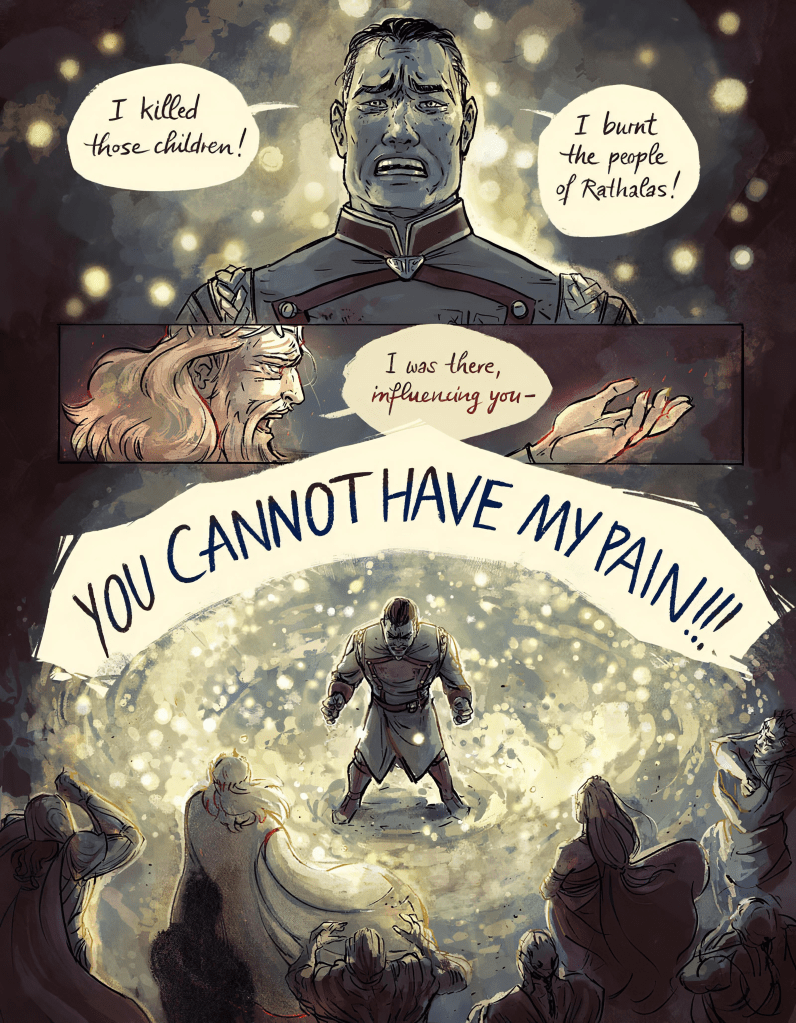
“You cannot take my pain.”
Dalinar, confronted by the Thrill, the Unmade spren of Odium that has corrupted the hearts of Alethi and others for millennia, the Thrill that in his anger was at least partially responsible for killing his wife and for all of the killing he did, or at least for driving him on, almost gives in it. Then Odium, the Shard of Passion, whose final weapon to drove others to his side is to take their emotion, to take their pain away so they are captive only to him, tells Dalinar to give him his pain. And for a moment, you are so worried that it’s going to happen. That then Dalinar will become Odium’s champion to defeat the world of humans.
But then an awareness breaks through Dalinar’s mind.
Ok, just read it:
“You cannot have my pain.”
“Dalinar—”
Dalinar forced himself to his feet. “You. Cannot. Have. My. Pain.”
“Be sensible.”
“I killed those children,” Dalinar said.
“No, it—”
“I burned the people of Rathalas.”
“I was there, influencing you—”
“YOU CANNOT HAVE MY PAIN!” Dalinar bellowed, stepping toward Odium. The god frowned. His Fused companions shied back, and Amaram raised a hand before his eyes and squinted.
Were those gloryspren spinning around Dalinar?
“I did kill the people of Rathalas,” Dalinar shouted. “You might have been there, but I made the choice. I decided!” He stilled. “I killed her. It hurts so much, but I did it. I accept that. You cannot have her. You cannot take her from me again.”
“Dalinar,” Odium said. “What do you hope to gain, keeping this burden?”
Dalinar sneered at the god. “If I pretend … If I pretend I didn’t do those things, it means that I can’t have grown to become someone else.”
“A failure.”
Something stirred inside of Dalinar. A warmth that he had known once before. A warm, calming light.
Unite them.
“Journey before destination,” Dalinar said. “It cannot be a journey if it doesn’t have a beginning.”
A thunderclap sounded in his mind. Suddenly, awareness poured back into him. The Stormfather, distant, feeling frightened—but also surprised.
Dalinar?
“I will take responsibility for what I have done,” Dalinar whispered. “If I must fall, I will rise each time a better man.”
That is how you write flaws, ladies and gentlemen – but also acknowledging, beating, overcoming those flaws. The rest of the climax that follows uses this idea of accepting pain as a hingepoint for all the characters, and it’s Sanderson’s best climax I’ve read so far (I’m currently right in the middle of Rhythm of War‘s, which went a lot faster than Oathbringer for me as a read, and I got to say it doesn’t match up). It’s the climax of all the worldbuilding – the reveal of the nature of the Thrill as the Unmade, which has been building since the first book; the reveal of the plan of Odium, that he was grooming Dalinar to be his champion the whole time; the reveal of the nature of Odium as the god who does not just give passions, but takes away pain. It’s the climax of all the character of Dalinar, all the way back to his visions of The Way of Kings and Nohadan in the first book. Just so much of the best of Sanderson is weaved into this one moment:
You. Cannot. Have. My. Pain.
It is a glorious moment, the climax of three books’ worth of storytelling, and a crowning achievement in The Stormlight Archive and for Sanderson. Bravo, sir. Bravo.
Conclusion
While I don’t think his plotting or his characters are perfect, Oathbringer brings what Brandon Sanderson does best: stunning climaxes, a deeply layered world, twists baked into the worldbuilding, and characters overcoming unbelievable flaws and pasts.
Oathbringer more than keeps the legacy of The Stormlight Archive alive.

𝙷𝚒! 𝙼𝚢 𝚗𝚊𝚖𝚎 𝚒𝚜 𝙽𝚊𝚝𝚑𝚊𝚗. 𝙸 𝚕𝚘𝚟𝚎 𝚜𝚝𝚘𝚛𝚢𝚝𝚎𝚕𝚕𝚒𝚗𝚐, 𝚕𝚎𝚊𝚛𝚗𝚒𝚗𝚐, 𝚊𝚗𝚍 𝚌𝚛𝚎𝚊𝚝𝚒𝚗𝚐, 𝚊𝚗𝚍 𝚊𝚕𝚜𝚘 𝚕𝚘𝚟𝚎 𝚝𝚘 𝚝𝚊𝚕𝚔 𝚊𝚋𝚘𝚞𝚝 𝚝𝚑𝚎𝚖 (𝚜𝚘𝚖𝚎 𝚠𝚘𝚞𝚕𝚍 𝚜𝚊𝚢 𝚝𝚘𝚘 𝚖𝚞𝚌𝚑!) 𝙵𝚘𝚕𝚕𝚘𝚠 𝚝𝚑𝚒𝚜 𝚋𝚕𝚘𝚐 𝚝𝚘 𝚜𝚎𝚎 𝚖𝚘𝚛𝚎 𝚌𝚘𝚗𝚝𝚎𝚗𝚝!
 Go-To Guru: Film, Literature, Television, and More
Leave a comment