

Ran is a 1985 Japanese samurai epic from writer-director Akira Kurosawa.
“One of these days,” I tell myself, “I will get around to reading more Shakespeare.”
That probably isn’t something you tell yourself often. Most people don’t scrounge through Pluto TV just hoping to turn up on Romeo and Juliet, much less Much Ado About Nothing or, God forbid, one of those weird ones like Coriolanus.
But that is something I tell myself. Weird, right?
It started with a white-haired, bushy-bearded Professor Dose rolling Shakespeare quotes off of the top of his head as he picked apart every character, word, action, and scene. Since then I’ve felt drawn to the Bard. Even more so once I heard the director and writer of Seven Samurai also made an adaption of King Lear but based on a semi-mythical samurai warlord in the 1500s. Yet then again, I told myself, “I have to read King Lear first. I really should.”
Then the opportunity comes. Instead of reading the play, I’m scrawling through a Wikipedia summary. My brother and I are reexplaining the plot to each other to try to memorize it before the DVD loads (thanks Muskego Public Library!)
No Wikipedia (or Seven Samurai for that matter) could have prepared me for what was next.
One of these days I’ll explain “Go-To-Guru’s Philosophy of Storytelling 101.” Part of my highly developed and oh-so-special (not) philosophy is the recognition that different types of “telling” impact stories in different ways. Film and television have the unique ability to direct your focus and gaze, to shape you through controlled visual perspective. Not that theatre can’t do this: but film can tailor and time and perspective-ize the visual experience of all viewers in a way plays or opera or musicals can’t.
Why go on this tangent? Because Ran‘s magic and majesty is visual, just as much as it is complicated characters, clever dialogue, and philosophical musing. Yes, its name means Chaos (Ran, 乱, alternatively translated as “The Chaos of War,” referring to the dynastic carnage of war the movie depicts, or “Disturbed,” referring to the mad king at the center of the film). But for a movie named Chaos, though, the sights we see are anything but chaotic. They are the most controlled chaos.
For a movie named Chaos, the sights we see are anything but chaotic. They are the most controlled chaos.
A case study:

First off, the technical impossibility. Yes, that is a real Japanese castle, built just for these shots. Yes, it is actually on fire. Yes, they had only one take to get this right because after this there isn’t any castle to film anymore. And yes, there are hundreds of extras gathered in front of the castle, all having to be organized and timed. And don’t forget the hundreds of handmade costumes.
But mentioning the costumes leads to the color palette and stylistic choices beyond the purely technical ones. (I know—always dangerous for a color blind person to talk about color palettes. But bear with me). The bright yellow army and the blood red army are the armies of two brothers. They are the sons of the ethereal white-robed figure, Ichimonji Hidetora (in Japanese culture, your “last name” or family name comes first). The yellow is the army of Hidetora’s oldest son and heir; the red, of the second son. Both the clothes worn by the sons and the color of their factions stay consistent. You always know which son is which, and which people are affiliated with each son. The bright primary colors stand in stark contrast both to the dirty, dark background of smoke, stone, and timber, matched by the cloudy sky. The white robe stands out most of all. The white robe is just below dead center the middle of the shot, applying the rule of thirds (the idea that visuals in art, film, and television are most comprehensible and at their strongest when divided into three equal sections). It feels like a painting.
But sure, the scene is pretty. Plenty of movies have pretty scenes. But the elements all coalesce—not to hide the story under layers of makeup but to heighten the beauty and richness of the story already present.
Hidetora, watching his small band of valiant guards die one by one by one while under siege from his sons, wanders out of the castle. Hidetora was born an unassuming lord. From years of conquest and savage brutality, he conquered an entire valley of minor lords until he became the warlord of the entire region. He decides to retire, leaving his newly established state to his sons. The two oldest claim their authority. It’s left ambiguous whether they do so out of ambition or out of concern for order. Eventually, the oldest sons attempt to once-and-for-all silence their belligerent father. Hidetora watches his honored guard die around him as their wives and concubines commit suicide. This is the same fate Hidetora brought on dozens of villages and castles. Hidetora’s sword breaks so he cannot even perform seppuku with his concubines, who are now consumed by fire. Covered in white ash, his castle burning around him, in a mad daze from violence and destruction he brought upon himself, Hidetora wanders out of the castle. The two armies are so terrified they think he is a ghost, the specter of Hidetora who has just killed himself. But he’s not. He’s just the shell of the great warlord, gone insane in the carnage. And he just walks out of the battle, unscathed. Unharmed physically; but mentally, broken.
It’s a classic scene in the film, not simply because it’s technically brilliant, or beautifully shot, but because it moves you. It shakes you. There are hundreds, thousands, an infinite number of ways to tell this story of betrayal, war, revenge, inheritance, honor, and honesty, and an infinite number of ways he could have depicted this scene. He chose this way. In telling it this way, he shapes the story itself. Telling it this way then shapes you.
It is a classic scene not simply because it is technically brilliant, or beautifully shot, but because it moves you.
The story, while complicated, is made more easy to follow through its visuals. Getting a summary of King Lear first was helpful; while the children of the mad king are gender-swapped, many other elements stay the same (especially the role of the fool who follows Hidetora/Lear). This movie is a heavy-hitter. Unlike Seven Samurai, which gives plenty of laughs and enjoys the intensity while never glorifying it, this is the type of movie that I don’t have a desire to watch year after year. It’s barbaric, savage, brutal, and philosophically complex. It’s clearly a labor of love.

While there is always a language and culture barrier in translated dialogue—and in acting especially—the gravitas of the actors communicates past it brilliantly. Of special note is Mieko Harada as Lady Kaede (left in the image above), the wife of the first son. She is outright despicable, but not so much as to be beyond pity and understandability, and the actress is clearly having a blast.
The soundtrack is strangely enthralling. Unlike the jollity pitted against silence in Seven Samurai (again, my only experience of Kurosawa), the soundtrack is occasionally grand but is more often ghostly and screeching and grating. It plays to the falling sanity of Hidetora beautifully.
We need not compromise on style over substance. Just have both.
The shot above began this topic, but my gosh, the scale of this movie. There are several battles where I have no idea how they did them. Perhaps it is simply my ignorance, but oftentimes I hear, “There weren’t any great large medieval battles in movies until The Lord of the Rings trilogy.” It’s true the Massive software allowed for Computer-Generated Imagery to add to the size of battles. Yet Kurosawa organizes what appears to be thousands of extras into understandable battle formations. Even still, these large battles still hinge on the individual choices of a few key characters that we grow to love, hate, and understand. This film demonstrates that we need not compromise on style over substance. Just have both.
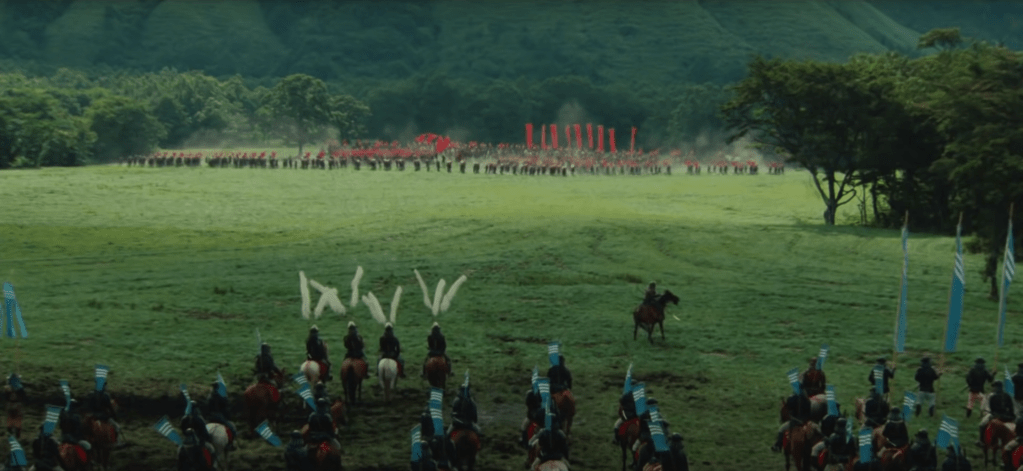
A final note, including spoilers for the final shot (thought without much for the plot): Akira Kurosawa is commenting not just on war in general. He’s not simply saying “War is Hell” as a soldier grabs his arm from the ground before he’s shot. (Sidenote: Steven Spielberg was a big fan of Kurosawa, and there’s no doubt in my mind that the siege of Hidetora’s castle in this film heavily inspired Saving Private Ryan‘s opening scene). As the vengeful blinded Tsurumaru trips and drops the image of Buddha off his ruined castle, the loss of faith extends beyond the characters of the film. The fall is of all of their own making. They bring it on themselves, and innocents die because of it.
Akira Kurosawa lived through World War II. Kurosawa saw the changes in his culture, his country, and his faith. He captures the questions his people faced only forty years before him. After a decade of conquest and glory and honor, coupled with savage brutality, the Empire of Japan collapsed. Its own destruction caught up with it. Where is God when you stand in the ruins of your own making? Who are you if all you have to show of your “honor” and “pride” is wreckage? The questions he asks challenge all people, whether or not they have faith. They are similar questions to what Shakespeare and King Lear ask, but he’s not beholden to them. He’s free to ask his own, to add his own subtlety to the work of a great master of storytelling who came before him.
Ran is sometimes considered the greatest achievement of Akira Kurosawa. He himself is one of the most influential filmmakers in cinema, certainly of Japanese cinema. If nothing else, it is his grandest and most epic work. One of these days I’ll get around to watching more Kurosawa. But even if Ran is all I had of him, it’d be enough to recognize his genius.
Ran was directed by Akira Kurosawa, with screenplay by Kurosawa, Hideo Oguni, and Masato Ide. Cinematography is led by Takao Saito. It was produced by Katusmi Furukawa, Masato Hara, and Serge Silberman. It features a large cast, with Tatsuya Nakadai, Daisuke Ryu, Mieko Harada, and Jinpachi Nezu in key roles. Music is by Toru Takemitsu. 162 minutes.
𝙷𝚒! 𝙼𝚢 𝚗𝚊𝚖𝚎 𝚒𝚜 𝙽𝚊𝚝𝚑𝚊𝚗. 𝙸 𝚕𝚘𝚟𝚎 𝚜𝚝𝚘𝚛𝚢𝚝𝚎𝚕𝚕𝚒𝚗𝚐, 𝚕𝚎𝚊𝚛𝚗𝚒𝚗𝚐, 𝚊𝚗𝚍 𝚌𝚛𝚎𝚊𝚝𝚒𝚗𝚐, 𝚊𝚗𝚍 𝚊𝚕𝚜𝚘 𝚕𝚘𝚟𝚎 𝚝𝚘 𝚝𝚊𝚕𝚔 𝚊𝚋𝚘𝚞𝚝 𝚝𝚑𝚎𝚖 (𝚜𝚘𝚖𝚎 𝚠𝚘𝚞𝚕𝚍 𝚜𝚊𝚢 𝚝𝚘𝚘 𝚖𝚞𝚌𝚑!) 𝙵𝚘𝚕𝚕𝚘𝚠 𝚝𝚑𝚒𝚜 𝚋𝚕𝚘𝚐 𝚝𝚘 𝚜𝚎𝚎 𝚖𝚘𝚛𝚎 𝚌𝚘𝚗𝚝𝚎𝚗𝚝!

 Go-To Guru: Film, Literature, Television, and More
Leave a reply to Zach W Cancel reply