
The Chosen is a streaming TV drama based on the Christian Bible from showrunner, writer, and director Dallas Jenkins.
You can catch my reviews of the first four seasons at these links: Season 1, Season 2, Season 3, Season 4
I have had a roller-coaster relationship with the Chosen. I had heard of it for a long time due to their COVID marketing push, and finally watched Season 1 in winter 2021. Since then, I’ve watched the ongoing seasons as they’ve released, or, more often, several months afterward (case in point: it’s been a year since the release of Season 5 and I’m finally getting around to it). In order to get to my thoughts on Season 5 – is it good? Is it bad? Is it worth it? – let’s continue with my thoughts on each season so far.
The Seasons So Far
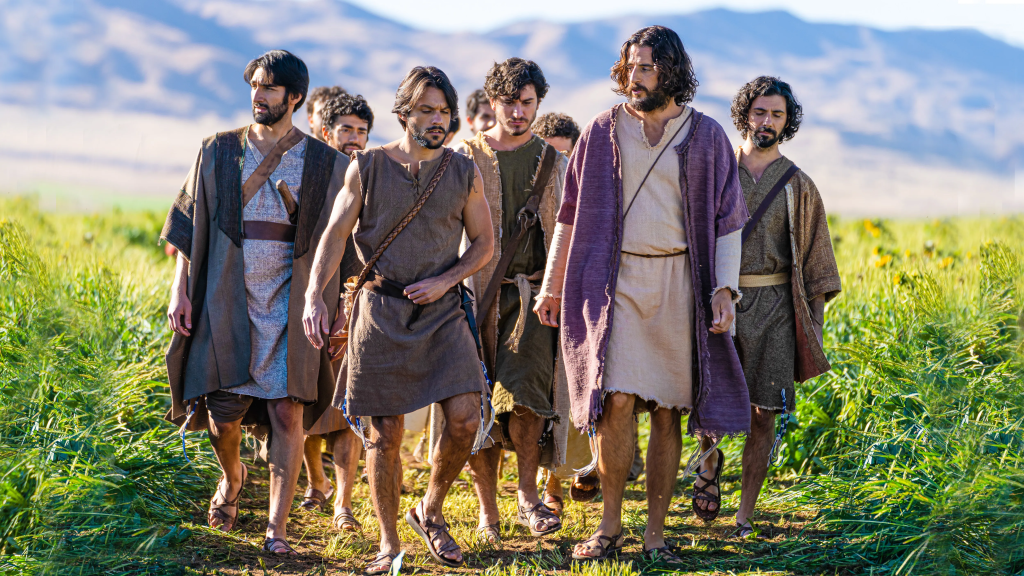
The first season takes us from the lives of some of the disciples before Jesus, to the Samaritan woman at the well and the public ministry of Jesus beginning with 7 of the 12 disciples in tow. I was absolutely wowed by the first season of the show and think it perfectly understood both the Bible and how to make a good streaming show. The season is near-flawless and I think everyone should watch it, even if they stop after Season 1, Episode 8.
Season 2 starts right after the first season, and ends with the arrival (but not the call) of all twelve Disciples, with Judas arriving to hear the Sermon on the Mount by the end. I watched the second season as it released in 2021, and was less impressed. It did not have the tight structure and total grasp on streaming show season structure that the first season had. It also had some problems with adaptation, like the influence of the Romans or the appearance of Gentile characters with Jesus’ disciples. It also had problems with characters “popping-in” and appearing with no prior connection to events. While it had some amazing moments and what still is my favorite episode of the show (“Matthew 4:24” if you’re wondering), the cracks were showing.
Season 3 now shows sections of the Sermon on the Mount, and goes through various major events in the gospels, such as the Disciples going out two by two, the feeding of the 5,000, and Jesus walking on water. Season 3 was an improvement on the second when it came to structure, interweaving of plot, and thematic coherence. The two themes of “Jew Vs Gentile” and “Suffering” were woven into every interaction and event. It experienced problems of bloat and lack of focus on the Disciples over other side characters, but in the end it showed more “Season 1” attributes than “Season 2”.
Season 4 sets Jesus toward his suffering in Jerusalem, and is the first season that includes a time skip halfway through. It begins with the death of John the Baptist, includes various sermons from the gospels, and ends with the resurrection of Lazarus and the start of Palm Sunday. Season 4 is the worst season of the show. While is has some highlights, it features the worst timeline problems, manufactured drama problems, and pacing problems of the entire show. Here, the episodes feel really bloating, each clocking at over an hour and featuring a lot of scenes that could have easily been cut in half timing-wise with redundant lines, extended sequences, and awkward camera focus.
After season 4, I wrote this:
“It’s hard for me to write this. I have a Chosen sweatshirt. I have been following the show since 2020 and have been invested through all of it. It has extremely good moments to me that I think would be very appropriate to use for illustrating Bible stories. It also has moments that are just exemplary storytelling in any medium, movie or book or show. But I think as an overarching story, this season struggles just like the second season did, but even more so. I hope the best for season 5, but some of my investment – and all of my wife’s investment – is gone. And maybe that makes me like all the other viewers who decried the show at one point or another, saying ‘This is the last straw!’ But for me, there was no one last straw. It’s just a sink in quality and thoughtfulness, with a rise in ponderous grimness and pacing problems, that makes me less eager to watch this show than I ever have been.”
So, did Season 5 grab my investment back? Did it WOW me, entice me, pull me in, make me a Chosen fanboy again?
No and yes.
The Good of Season 5
First off, for the good, I think that this is the best season since Season 1.
Whoa. Bold words. You’re going to get whiplash from that roller coaster. But seriously, I think this season is the best. But… it’s not my favorite since season 5.
Wait, what?
So, I think this is the season that is the highest quality since Season 1. Part of the reason for this is that it sticks far closer to the “storyline” of the Bible and fills in gaps in between stories, rather than inventing stories out of whole cloth. There were even a few plot points from previous seasons that came back, that I did not expect and was happy to see even if I don’t like how we got here. I also think it’s better because the episodes – while still suffering from ponderous pacing problems – are more thematically focused and plot focused than before, marching toward that central goal of the trial and crucifixion of Jesus. At the same time, this season is grim and hard to watch, exacerbated by its pacing problems. It also does have a few points of adaptation that I do not enjoy. So for those reasons it is not my favorite season. But the good first.
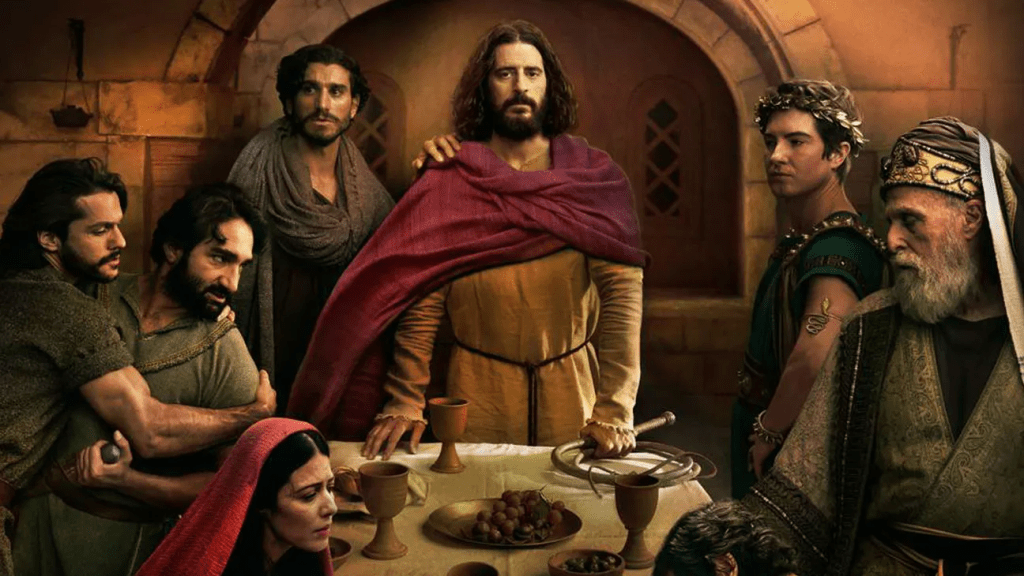
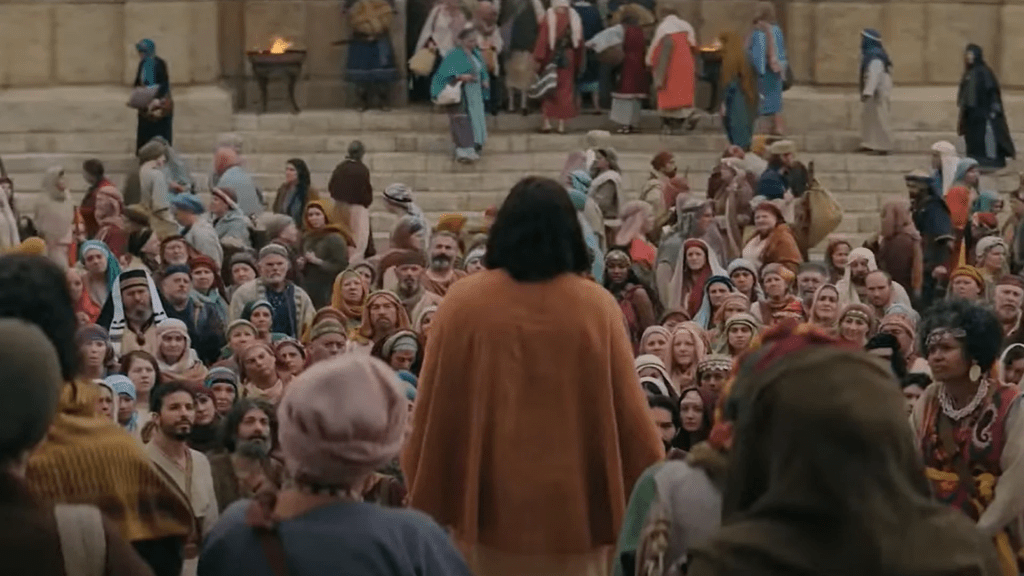
First, it sticks closer to the storyline of the Bible. Unlike seasons two, three, and four, the primary plot is completely from the accounts of Holy Week that we have. Palm Sunday. Clearing the temple on Monday. Preaching and being questioned on Tuesday. The Sanhedrin trying to find a way to capture him on Wednesday. The Last Supper and the garden of Gethsemene on Thursday. Broadly speaking, every event that takes place is Biblical, even as context is added and gaps are filled. The most “filling in” is in the Sanhedrin, as well as Pilate, Atticus, and Herod, where we have several additional scenes that attempt to explain how we get to Maundy Thursday night and Good Friday. While those scenes were pretty repetitive (They don’t know where Jesus is! It’s illegal to have a midnight trial! What are we willing to do to kill or arrest him! Pilate is mad at Caiaphas and Caiaphas is mad at being manipulated by him! Herod is interested in Jesus!) they are still filling in Biblical gaps. While an adaptation doesn’t have to stick to its source material, and some of the best moments of the show have been “added” scenes, the overall season has always benefited from being more Biblical in its contours. For example, the Sanhedrin arc in Season 2 with Yanni and Shmuel is, bluntly, very hard to follow and seems very disconnected from the rest of the show. This “Sanhedrin” arc in Season 5 is tightly woven in to the rest of the story and Biblical in many of its contours, if not all its details.
Second, I was very pleasantly surprised about the plot points that come back. For example, I wrote at length in Season 3 about the boring, overdrawn, and monotonous Olive Grove storyline. I wrote:
“In episodes already packed-full of content (unlike the first season, every episode is close to an hour long or more), the olive grove just didn’t add much. Arguments about which olives to use, how the oil ended up, tasting the oil, buying or negotiating for the grove, scenes with Zebedee selling stuff or deciding stuff (really below a tertiary character… what’s below tertiary, a quaternary?)… it’s all a little much. We’ve only got this much time; I feel like similar things could be accomplished with far less time” (Season 3 review).
I still stand by that at the time. What I did not expect is that the ceremonial oil produced by John and Zebedee would then be presented to the Temple, and this would be the way that “The other disciple, who was known to the high priest, came back, spoke to the servant girl on duty there and brought Peter in” (John 18:16 NIV). John is said to have been known by the high priest, and the way they accomplished that was through the olive grove storyline. I was very pleasantly surprised to see it actually tie in, and I enjoyed the conversations between John and Malchus.
Another storyline that I was surprised to see tie back in was the storyline of Nicodemus. I heard he was coming back next season, in season 6. One of his previous moments (in John 7:50) was given to Joseph of Arimathea – I mean, Yusef, instead. I figured it was the cost of bringing the actor back for that one scene. Now, he’s returned, and he’s been sending a servant of his, Matthias, to follow the disciples for the whole last season. I didn’t remember him, but he’s in the background of several scenes, including the raising of Lazarus. Matthias would end up being the disciple chosen to replace Judas. I was impressed by how they managed to weave Nicodemus credibly back into the storyline, and making him almost a “conspiracy theorist” hiding away, obsessed with Jesus, was a very interesting way to do it. Using him to bring Matthias into the storyline was a really smart idea too.
The other storyline I was impressed they wove back in was the story of Kafne. Now, I despise (that is the word I’m looking for) how Ramah died in Season 4. It was contrivance upon contrivance, and many characters acting completely out of character in order to facilitate what the writers wanted. However, they are now bringing that plotline back by having Kafne be the “instigator” of the opponents of Jesus, angry at him due to Ramah’s death. It will be Kafne’s voice in the crowd shouting, “Crucify him! Give us Barabas!” in the next season during Good Friday, and I was impressed by how they connected him back to the main storyline.
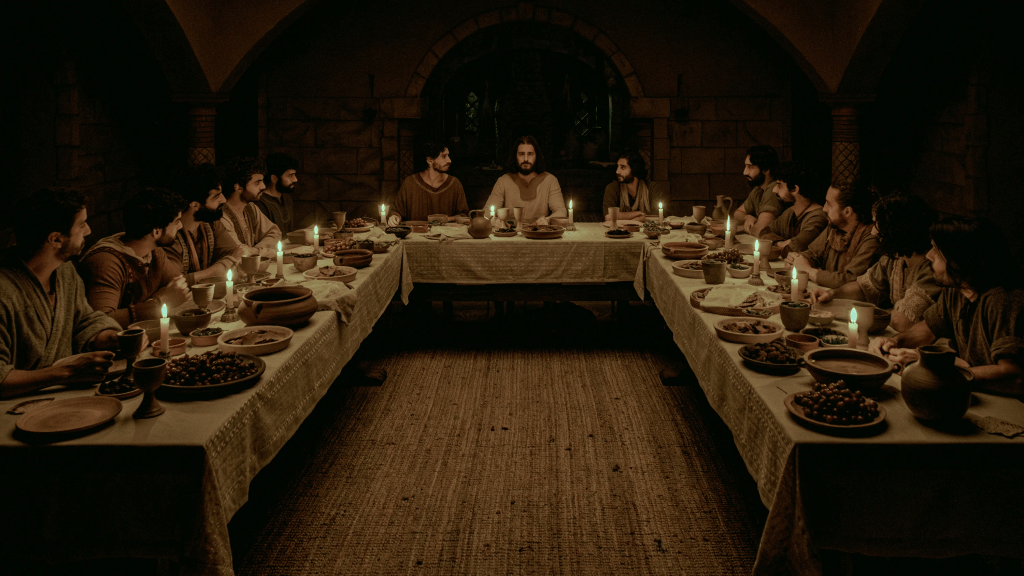
The third reason I think this season is the highest quality since Season 1 is that it is plot and thematically focused on the trial and crucifixion of Jesus. Beginning each episode with an “opposite-chronology” of the Last Supper was a helpful way to do that, and those beginning-of-the-episode flash-forwards really helped focus each episode on a particular topic. So, the plot is focused on the Crucifixion. It’s all leading to that. Every step we take is toward that goal. Everything – from the anger of the Sanhedrin, to the statements of Jesus, to the reactions of the Disciples – points to and leads up to Jesus suffering and dying for the entire world. Because of that, this season feels focused. The plot doesn’t change halfway through the season, as it did in Season 2. The plot doesn’t feel meandering but become more clear at the end, as Season 3 did. The chronology and timing isn’t all over the place, so we’re constantly confused where we are and how much time is passing and what’s the point of this, as in Season 4. No, we are walking day by day through Holy Week. You can’t really mess up the timing of that. You can’t really get confused where we are or how we got here. No, we’re laser-focused on the goal of Jesus dying and how we got there, and it makes all the storylines feel focused.
The themes are carefully interwoven in the season as well. Again, the “Last Supper” flash forwards really help with that. I am torn about separating the clips as they did, with respect to the understanding of the content of the Last Supper. I constantly had to explain to my wife what the point of that “flash forward” was, where it was happening in the Last Supper, what Jesus was talking about in that scene. Without the context, it’s harder to understand. And I think forces you to keep a lot in mind – “wait, so this is further back in time; so it ends where the last episode began; how did the last episode begin? Where have we been?” The Chosen YouTube page posted a video for Holy Thursday this year, featuring all those “flash forward” clips in a single video making a new “episode” of the Chosen. Watching through that, it really helps the separate clips make more sense to see them in context. Perhaps that’s just clever audience engagement. On the other hand, maybe it works better to cut it into pieces because Jesus does a lot of talking at the Last Supper (one-fourth of the entire gospel of John is devoted just to what Jesus says during the Last Supper, John 13-17) and it’s easier to digest broken into pieces than all at once. Yet I do think it’s harder to follow in these little chunks overall.
While I’m torn for what this chopping up does to the experience of the Last Supper itself, I’m not torn for what it does to episodes one through six. Each clip really focuses that episode on the themes discussed in that portion. Palm Sunday features Jesus praying for the disciples’ joy despite the suffering they will all soon experience, and seeing the disciples crying while Jesus speaks is a great contrast to whooping and hollering on Palm Sunday we cut to minutes later. Episode two, Jesus tells them he will die for them, and Peter will betray him, and they will all fall away; then it’s the clearing of the Temple, and the disciples wondering if Jesus is setting himself up to be killed by the leaders through his actions. Episode four, Jesus talks to Judas about betraying him, and about how Satan has entered him; in that episode, Judas has a hard conversation with Jesus where Judas puts his own ideas for how Jesus should do things, making Judas angry when Jesus doesn’t listen. Each episode features that kind of cohesive flash forward that helps put the episode in context, both kind of a “spoiler” for the plot (we know Judas will betray Jesus, even if we don’t know why yet) and a thematic introduction to the episode (despite the joy of Palm Sunday, this is all going to be about suffering). Overall, the plot and themes were very connected this season, making for a much more understandable and tight experience to watch.
A few more highlights. That scene with Judas and Jesus in episode 4 is another great character conversation moment invented for the show. Judas is feeling like he does not know why Jesus called him. He’s a businessman, who knows how to close a deal, and it seems like Jesus is not closing the deal of claiming his birthright as king. Jesus, meanwhile, attempts to persuade Judas that it’s not about Judas’ own ideas, but about God’s ideas for what it means to be a king. The conversation is the culmination of two and a half seasons of Judas’ arc. I have felt in the past that Judas didn’t get enough time to have conversations or bonding with the rest of the disciples, and so this scene would have been even better if we had seen Judas trying to “close deals” before or use his skills in “human persuasion.” But this scene stands on its own as a great performance by two actors with good writing. My favorite moment is when Jesus says, “And if I don’t do whatever big thing you have imagined me doing, will you still believe in me?” Immediately the conversation flips, and Judas is no longer in control. He spends the rest of the conversation lost, confused, and unsure of himself after being so confident.
Another general highlight is more time spent with the disciples. The previous seasons have lost focus on the disciples, giving them less and less to do while focusing on other characters even more. For example, in season 3 when the disciples are sent out two by two, the sequence is a black-and-white montage of moments. Instead, I was hoping that we would get an entire episode of the disciples in various situations, showing their personality, character, and trust in each other. Give little mini-conflicts that get resolved, six seven minute scenes, like Avatar: The Last Airbender’s “Tales of Ba Sing Se.” But it was just a montage, and a great opportunity was lost to continue to distinguish these disciples and their views.
However, in general, I feel like this season gave a lot more chances for the disciples to shine. There are many moments where they are all struggling with what Jesus has said, and as they argue each shows their personality. For example, in the “flash forward” when Jesus says, “One of you will betray me” in Episode 5, we pan around the room in a one-shot to various disciples as they argue about what Jesus meant. They all show their personalities: Thaddeus and Little James go right to Jesus and each ask if he is the one to betray Jesus. Thomas waits a moment, then storms to Jesus and asks if his anger at Jesus is the betrayal. Judas talks with Philip and Simon the Zealot about how it could be Thomas. Nathanael, John, and Andrew talk about who it couldn’t be, and Andrew tries to put himself on that list. It all shows their personality in unique ways. There are also extended flashbacks in episode 7 and 8 to early memories of the disciples, including when Little James was called (a moment referred to before but never shown) and when the first disciple in the show, Thaddeus, is called. He’s a character that hasn’t seen much attention, and so it was cool see that moment even though I don’t know if we needed to see it, and it is rather long (we’ll get to that as an issue across the show in a moment).
Two more highlights. I’ve heard it said (I can’t find anyone online, but people I knew) that Jesus in The Chosen is “Therapist Jesus.” He’s kind, compassionate, gives you some therapy, makes you feel better, than you go on your way. He tends to give more psychological than spiritual advice. His visions of the destruction of the Temple of Jerusalem, and his clearing of the temple, refute that. Several times this season, Jesus sees all kinds of things – blood seeming to flow from stones of the temple, flashes to a bloody war and destruction as people are killed. Jesus foretells the destruction of Jerusalem in the Gospels, and the show captures it vividly by having him see these flashes of the destruction to come, so strong to him that he cries several times, gasping for breath as he mourns what will happen to these people. It’s not therapist Jesus, but torn and mourning Jesus. Then, the clearing of the temple. First, seeing some Gentile believers have to walk through giving the sacrifices with the disciples was a really cool way to show how corrupt the system all was. Then, watching Jesus “make a whip out of cords” (John 2:15) and wreak havoc in the temple was crazy, exhilarating, and vivid. To actually see the reactions of the people, the damage that’s done as a tent catches fire and spreads, everything thrown around and the chaos that ensues, makes the moments where Jesus is calmer, jokier, and caring in the show stand out all the more strongly. It’s one reason why this season is so good, because it adapts and brings a Bible story to life.
All of these parts of the season add together to make not just good TV – although a lot of it is – but a more faithful adaptation of the Bible itself. It feels like the Bible is being brought to life, rather than the Bible being brought to life alongside some miscellaneous stories that are difficult to fit in with what the Bible says – or, worse, extremely contrived, like Ramah’s death. Because of its tight focus, its thematic consistency, its ups and downs of drama, its easy geography and timeline, and several scenes that make the Bible real like never before on TV or movies, Season 5 is the best written and made season since Season 1.
The Not So Good
That’s not to say it’s my favorite since Season 1, though.
There are three things that I think make this season less rewatchable and less enjoyable to watch in the moment, even as overall it is better written. First, its ponderous pacing. Second, its grimness. And third, a few strange adaptation choices.
First, ponderous pacing. This season can be so. Slow. I’ve written about this before, which was the biggest problem of Season 4:
“Pacing is the illusive feature of stories where they either feel fast or feel slow, and either of these can be bad or good things depending on what you’re trying to accomplish. Some times you want a story to feel fast, sometimes feel slow; sometimes they start slow and speed up, or start fast, slow down, speed up, and slow down again. This ‘speed’ is hard to capture, but it’s often based on editing and writing decisions. How long are the pauses between characters responding to each other? How many sentences are there in a conversation, and how much information does each line of dialogue communicate? All of these add up to the feel of a story.”
Season 5 has that same problem. For example, in the beginning of Episode 3, after the clearing of the Temple, we see Jesus leave with his disciples while the crowd shouts “Hosanna!” and the Sanhedrin watches him go. We spend a minute on that, getting every reaction of the crowd, Pharisees, whoever as he walks out. My wife looked down at her phone, looked back up, and then said, “Is he still walking out?” Yes. Yes he is. Why do we need to see everyone’s reaction? Do we have to hear one minute of chanting, “Hosanna to the Son of David”? Nothing new is communicated by what we see. We could have had ten seconds of chanting, three seconds on Shmuel, and that would be all we needed. Instead, we have a minute of walking. Or, when Judas betrays Jesus. It’s two minutes long of slow motion Judas slowly approaching Jesus and every disciple’s reaction – which are all the same sad faces and open mouths – going back and forth between Judas crying and Jesus looking sad, and the “ladies” (the chanting of the soundtrack) are crying in the background. It’s really quite something for a scene where we already know what’s going to happen and already have a pretty good idea of how the disciples will react.
Compare that to this scene in The Lord of the Rings: The Fellowship of the Ring after Gandalf dies. This time, we have eight characters, each reacting in their own way to how Gandalf dies. We have Boromir looking angry and sad, holding back Gimli who wants to run back in; Legolas, who looks like he can’t even comprehend it; Pippin, weeping because it’s all his fault, and Merry in shock; Aragorn, already moving on to the next thing because Gandalf told him: “Lead them on, Aragorn.” Then the double reaction, as Aragorn encourages them and gets them on their feet. Then, Frodo’s single tear, as he already knows he has to leave the group even as he sets out on his own. Each reaction tells you something about each character, and there is dialogue, and there’s slow motion, and the scene is still shorter than the scene in Season 5. And yet, so much more is communicated than just, “Shock and sadness.”
All of this adds up to a show I wish I could put at 1.25 speed, but can’t at least in The Chosen app. You might say, “Well, it’s good to see every disciple’s reaction! It’s good to keep those characters in view, especially with so many!” But a better way to do that is not with characters’ reactions, but actions. For example, that Last Supper scene where Jesus says one of them will betray him. By their actions, all the characters show how different they are. Judas, Simon Z, Little James, Thaddeus; we see how they’re different because of their actions. But in that betrayal scene, they’re all pretty much just making the same Pikachu face. It’s not an action, but a passive reaction, and that doesn’t really further their character. It just makes me laugh. And it makes the season much harder to rewatch because you know you’re going to sit through several minutes in each episode of just wasted time.
Another thing that is not so good about this season is just the ponderous grimness. Yes, I get that we’re getting closer and closer to the death of Jesus, and things are intense. But maybe that’s why not to adapt it in this way, because a full season of this repetitious action couple with a lot of grimness is just… a lot. For example, the full minute we have of Jesus weeping over Jerusalem. There are multiple instances of focusing on characters, especially Jesus, crying for minutes. Again, no new information is communicated. Just a minute of that information. And you might say that that is the point; to focus on his sadness, or the sadness of the disciples (there are multiple scenes in the Last Supper of the camera sweeping around the table and every disciple crying or sad in a similar way). But all of that contributes to this slow, monotonous, funeral-march pacing. You might say that that is the point: To be ponderously grim. But then it’s just not enjoyable. It’s not fun to watch eight hours of this kind of grimness, where the tone doesn’t vary as much. Even in really intense movies or shows, there is a variety of tone.
Take, for example, this hilarious scene during some of the most intense scenes of Breaking Bad. When trying to move Walt’s money, two of his henchmen that we’ve followed throughout the last three seasons take a moment to just… lay on the pile of money. It’s sandwiched in between really intense argument scenes between Saul Goodman and Walter White. You can vary your tone, even in some of the most grim shows. And it only lasts for a minute, but that minute really helps take a breath from the more intense scenes. (It also helps that arguments in the show last 2-3 minutes with lots of ups and downs in who’s in control, rather than the 3-4 minutes of Season 5 where not as much information is communicated). Judas’ conversation with Jesus is a great example of the ups-and-downs, who’s in control aspect. The writers know how to do it. But there are major conversations where they just don’t.
While the story itself is more coherent than previous seasons and more focused, it is not as enjoyable as previous seasons because of the way the story is told. It is told with slow pacing and ponderous grimness that really undercut both watchability and rewatchability.
And on to that one larger adaptation decision that I don’t like as much, and those are Jesus’ visions of the dead. He has a vision of David on the Mount of Olives as he weeps. He has a vision of John the Baptist at the Last Supper. In the Garden of Gethsemane, he has visions of Abraham sacrificing Isaac, Ezekiel sacrificing Isaac, and Joseph his earthly father coming to comfort him. I’m assuming, at least in the Garden, that these are adaptations of Luke 22:43’s, “An angel (literally ‘a messenger’) came from heaven and strengthened him” (NIV). I think it results in some more poor pacing (especially Jesus slowly walks through the valley for two minutes without explanation).
It also makes me uncomfortable, because “the silence of the dead” is a key feature in Biblical theology. For example, Psalm 115:17, “It is not the dead who praise the LORD, those who go down to the place of silence.” Or Isaiah 8:19-20, “When someone tells you to consult mediums and spiritists, who whisper and mutter, should not a people inquire of their God? Why consult the dead on behalf of the living? Consult God’s instruction and the testimony of warning. If anyone does not speak according to this word, they have no light of dawn.” In the Bible, the dead – in heaven or in hell – do not speak with the living. Only God speaks with the living, sometimes through angels. In fact, the only time the “dead speak” in the Gospels is at the Transfiguration, when Moses and Elijah appear. That event is remarkable for its uniqueness. And they did not adapt that scene. Instead, they add these scenes which do add something to the narrative, but take away from Jesus’ awareness of his situation and add something that is contrary to explicit Biblical instruction. As a Confessional Lutheran, who believes “in those things which concern the spoken, outward Word, we must firmly hold that God grants His Spirit or grace to no one, except through or with the preceding outward Word” (Smalcald Articles, Part 3, Article VIII, Paragraph 3), I don’t really believe in continued visions of God. Not that Jesus could not have had visions of Biblical events, but that doesn’t seem supported by the Gospels in which Jesus’ communion with his Father and his own omniscience and his place in salvation history make visions like that unnecessary. Plus the added element of communion with the dead, which is a big Biblical no-no.
It’s also just a lot. The Valley of Dry Bones is several minutes long, and the only thing communicated besides Jesus walking over the bones is Jesus going to Ezekiel and saying, “Son of Man, can these bones live?” To which Ezekiel responds, “Lord, only you know.” You can draw all sorts of things from the vision, but it requires so much knowledge of the source material (Ezekiel and the Gospels) that I wonder why it was portrayed at all. Unless that’s exactly why; so people would watch Bible roundtables or behind-the-scenes stuff or scour the internet like I did. Which I guess is a good audience engagement strategy, but still feels a little cheap.
So overall, the pacing is bad, again. Worse than Season 4. The tone is grim, again. Even more so than Season 4. There are some strange adaptation choices, as usual, but these make me personally more uncomfortable than some other choices.
Conclusion
Overall, this season is better written than seasons two through four, with a tighter focus and a more interconnected storyline, as well as more consistent expansion and adaptation of Biblical scenes rather than additions to Biblical scenes. However, it is told in a worse way than previous seasons, with atrocious pacing, a grim tone, and a few weird adaptation choices. And a story is not just how it is written – although that is the most important. It is also how it is told.
So, is it worth it? I’d say yes, if you’ve been following so far. I think if you haven’t, then watch some clips on YouTube and you’ll honestly probably get as much out of it, like the clearing of the temple. I still don’t think the show is worth the total investment beyond Season 1 because of the other issues with pacing, adaptation, and tone.
𝙷𝚒! 𝙼𝚢 𝚗𝚊𝚖𝚎 𝚒𝚜 𝙽𝚊𝚝𝚑𝚊𝚗. 𝙸 𝚕𝚘𝚟𝚎 𝚜𝚝𝚘𝚛𝚢𝚝𝚎𝚕𝚕𝚒𝚗𝚐, 𝚕𝚎𝚊𝚛𝚗𝚒𝚗𝚐, 𝚊𝚗𝚍 𝚌𝚛𝚎𝚊𝚝𝚒𝚗𝚐, 𝚊𝚗𝚍 𝚊𝚕𝚜𝚘 𝚕𝚘𝚟𝚎 𝚝𝚘 𝚝𝚊𝚕𝚔 𝚊𝚋𝚘𝚞𝚝 𝚝𝚑𝚎𝚖 (𝚜𝚘𝚖𝚎 𝚠𝚘𝚞𝚕𝚍 𝚜𝚊𝚢 𝚝𝚘𝚘 𝚖𝚞𝚌𝚑!) 𝙵𝚘𝚕𝚕𝚘𝚠 𝚝𝚑𝚒𝚜 𝚋𝚕𝚘𝚐 𝚝𝚘 𝚜𝚎𝚎 𝚖𝚘𝚛𝚎 𝚌𝚘𝚗𝚝𝚎𝚗𝚝!



Leave a Reply