
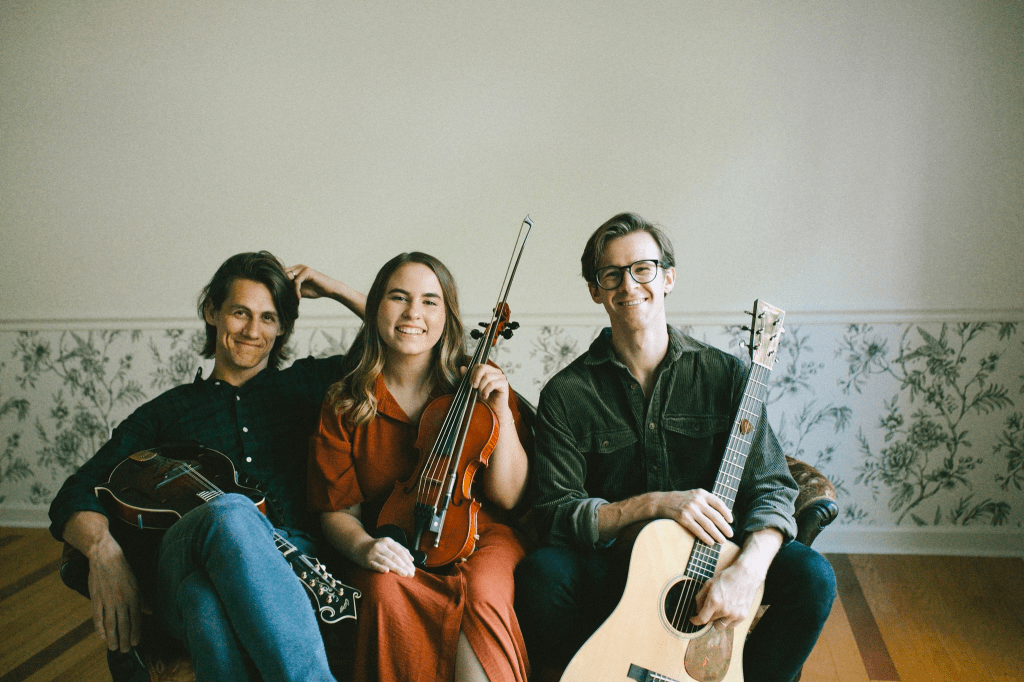
The Arcadian Wild is a Newgrass band based in Nashville, TN. Their primary members are founders Lincoln Mick and Isaac Horn, as well as Bailey Warren on the fiddle. They have a rotating roster of fellow musicians playing bass, fiddle, and banjo, singing, and more. Their first album was released in 2015. All photos are from their Facebook page.
Sixty chairs sit facing the stage. Tables are scattered around the edges of The Bur Oak in Madison, WI. Over the crowd, a chandelier sways, made of two french horns, a few trumpets, and a trombone with incandescent light bulbs stuck in their bells. There’s white hair, black hair, pink hair, and blonde hair; the band’s appeal crosses generations and ethnicities and social identities. The small group feels like almost like a family. They’ve come from far around, myself and my wife included, to hear The Arcadian Wild.
I attended my first Arcadian Wild concert just two nights ago. I first heard of them a year ago when a classmate of mine attended a concert of theirs in Milwaukee. I took the recommendation up, and… it changed my life.
Well, maybe that’s a tad overdramatic.
But the band hit a niche that had been empty in my life for awhile. For reasons I’m about to get into, they tap into that narrow area where entertainment meets expression, science meets art, and sacred meets skepticism. I haven’t been able to stop listening to them since first hearing of them in February 2022. I hope you won’t either.
Entertainment Meets Expression
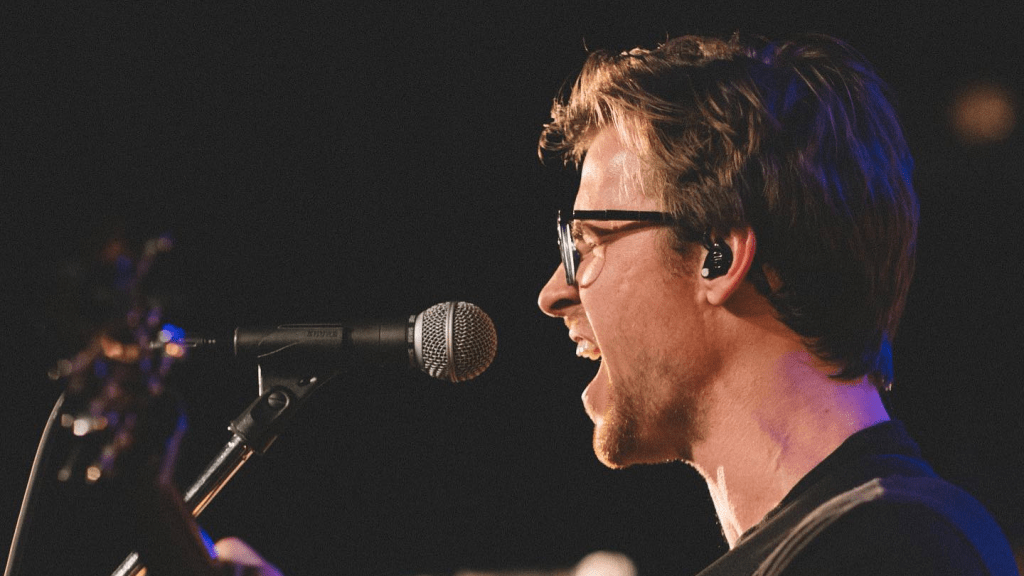
The band is obviously having tons of fun up there.
Lincoln Mick’s man bun bobs as he jams out on his mandolin. Bailey Warren smiles, mouthing the lyrics Isaac Horn calls out at the top of his lungs. You look at these people, and you can’t help grinning. They’ve found something they’re not just comfortable doing; they’ve found something they can laugh and dance with. Songs like the quirky and bluegrass-y Food Truck Blues and the foot-stomping The Storm illustrate this perfectly.
But then, they play a song Horn recently wrote, called Barefoot Kid. It’s about the loss of innocence, of entering a world that knocks you down like a train, where you can’t play on hay bales or swim in creeks anymore; you’re
struck down by epiphany, hit by a runaway train hauling everything; let down by the hand that was meant to be good, I never noticed mine were dirty too.
Horn tells the story of his grandparents and the farm in Arkansas he grew up playing on. At some point, you’ve got to leave the farm behind. Imagery of fireflies and forests, of winter winds sweeping over dry dusty fields dormant despite our best efforts, saturates the song. It’s dripping with expression, not just pure entertainment. It tackles the feeling many have, whether old or young; nostalgia for the past as you try your best into the future. Then a hand reaches down, and pulls you out of the winter, and saves you too: people save. People can be the warmth in other people’s lives.
Maybe it seems adolescent; but the charm of their lyrics mixes with the depth of what they’re communicating to express deep personal truths. It’s all the more personal for two reasons. One, because they’re just having so much fun doing it. They enjoy playing this music for us. Two, this is all the more personal because of how they use those words and notes to paint a picture that’s as technically impressive as it is artfully satisfying.
Science Meets Art
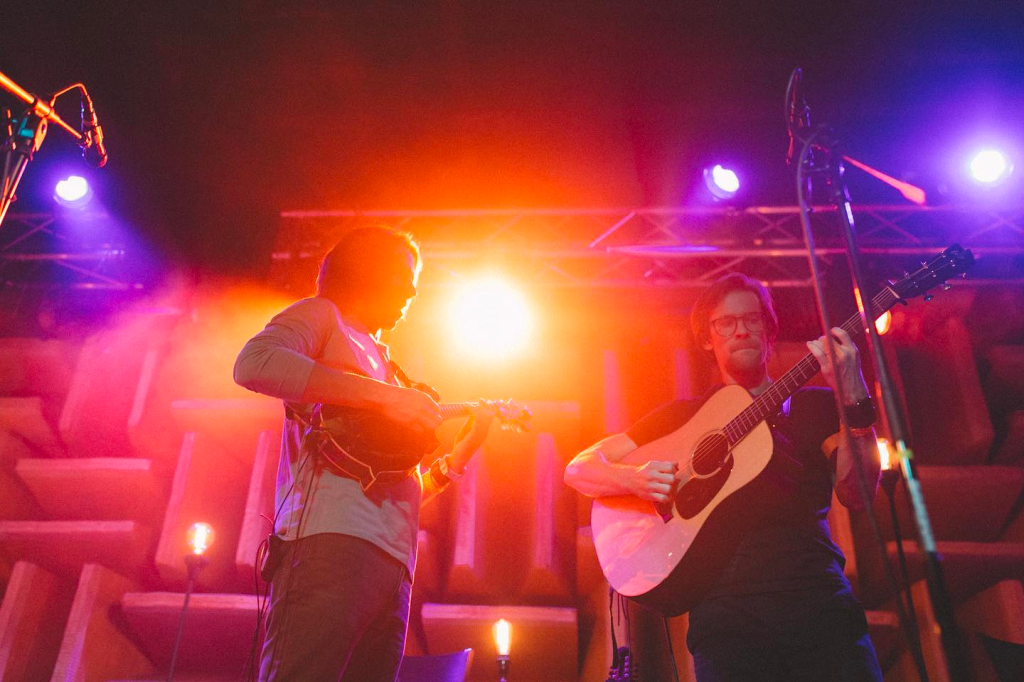
Watching the concert, I was in awe once again of the technical skill of all those in the band.
Hey, Runner! is dizzying. Isaac Horn comments jokingly after the song, “We shouldn’t have played that one this early; we won’t have enough for the rest of the concert.” I’m an amateur guitar player; nothing impressive, but I can figure out a song from chords or tablature, and I know enough about music theory to be dangerous. So, as he climbs back and forth all over the neck of his guitar playing notes faster than they even are in the recorded version, my jaw dropped. The harmonies are tight, and the words of the song in the refrain are just as fast as the notes on the instruments. I leaned over to my wife. “They’re good,” I understate.
Music this good is a science. It’s precision, like surgery or measuring chemicals into a vial, or mixing ingredients into a cake; but for those who master the science, it becomes a language, intuitive and structured. They’ve obviously mastered their instruments and voices scientifically. Every note, chord, and harmony is carefully layered. It’s a well-oiled machine, joints and pistons moving flawlessly so all you see is the corvette cruising at a hundred down the interstate. This corvette’s got glass in the back, though, so the drivers can see the engine blaze as they drive. They’re letting you see under the hood as their fingers dance.
Yet the science is in service of something.
Metaphors are carefully selected. “Silence is a Stranger I’ve never let inside,” in a song about how the quiet, alone, in a busy world, kills; the metaphor doesn’t stop there but carries in several lines of the song. It’s woven with several other language tricks, including alliteration and assonance and similes and personification and the whole sixth grade english bag of tricks. But there’s a reason you learn those early. They’re strong. They’re powerful. Yes, still a science; a technical skill, the ability to use language this way. But it’s more.
It’s art.
A great example of where rubber hits the road is in Isaac Horn’s song, Civil War, which poetically describes his experience with Tourette’s Syndrome (detailed in this article by Bandwagon magazine). The song is in 7/4 time, beginning with a syncopated rhythm of 3/4 and ending in an off-putting 4/4 measure (again, not a music master, so pardon my lack of technicality). This rhythm holds throughout, characterizing his mental struggles, his divided mind. The music is technically extremely difficult; the language is creative throughout; all in service of telling this man’s story in a heart-impacting way.
Yet there’s something deeper, something more to these songs. Many musicians tackle depression and anxiety, growing up and growing old, and falling in love. But how many on the popular scene also tackle the sacred, the spiritual, that aren’t purely Christian pop or classical creations?
Sacred Meets Skepticism
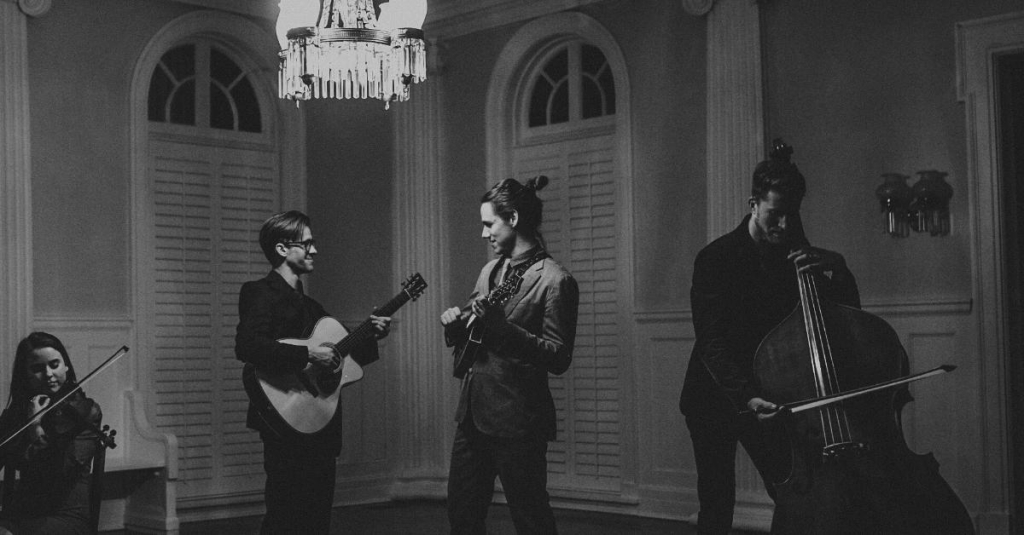
If you didn’t know, you’d miss it. But looked as someone intimately familiar with the Christian religion, you see them everywhere.
“The Storm” features extensive references to the book of Ecclesiastes in the Christian Old Testament / Hebrew Bible. “Silence, a Stranger” says stillness is “a hallowed thing to hold before my unclean lips,” referencing Isaiah’s vision of God in the temple of Jerusalem in Isaiah 6.
“Envy Green” keeps falling back on the temptation of Eve as it tells how we all envy and overreach and, by doing that, lose “our Eden.” “Liar” doesn’t just feature references to Isaiah 53 and 1 Peter 2; it sounds and feels like a confession of sins in a worship service, as we confess a dual nature that does what we don’t want it to do. “A Benediction” features extensive allusions to Christianity, such as “Death has lost already” in the resurrection of Jesus, and the famous C. S. Lewis quote, “I believe in Christianity as I believe the Sun has risen; not just that I see it, but by it I see everything else.” And a benediction is the closing blessing of a worship service, just it’s the closing blessing of their second album.
What I consider to be their magnum opus, Principium, is a four-song suite describing the creation of Adam, then the creation of Eve; and the fall into sin, and the driving out of the Garden of Eden. But not only do they reference Genesis 1-3; they reference Romans 1, Psalm 2, Isaiah 11, Ephesians 2, and more that I’m sure I’m not noticing. It’s magical. There’s no better word for it, especially when they ended their setlist with the four-part movement.
The band members were raised Christian; they are intimately familiar with the religion and its Bible, especially the Old Testament. Their poetry gains a sacred edge, tied to holy words and three thousand years of history. Their music has a certain type of depth to it; or, perhaps, a flat shape gains a third dimension, the dimension of the sacred. They often sound like hymns, both in their three part harmonies, and in their subject matter that’s beyond what much of music has today. You won’t hear of drinking or parties or break-ups; you listen in as the songwriters retell ancient stories of pride, grief, loss, love, and hope.
However, mixed with that sacredness is a skepticism. Their songs sound like hymnody, but they aren’t hymns. It’s references and retellings, not worship and teaching. They’re adapting these sacred stories to broaden and deepen their poetry, but they aren’t tied to them or are ever even very explicit about their influences.
To me, the references seem clear. How could you see the songs any other way? But people must. Not that I can see into people’s hearts, but my guess would be that in Madison, WI, you’re not getting a lot of people who believe the same things the band did as kids.
Yet these words are carried into a universal experience. You might even say their songs are 100% both: 100% sacred, 100% secular. You can take them either way: because either way, they communicate the same truths. We are all tempted. We all seek hope. We all feel the need for a sacred space or place or people or time. The band provides that: an hour of sacred space, where hushed tones follow stomping feet, where entertainment meets expression, science meets art, and religion meets skepticism.
Maybe that’s why younger and… more experienced, gathered that night, people from everywhere and anywhere. The Arcadian Wild provided, for one little hour, a taste. A taste of more.
𝙷𝚒! 𝙼𝚢 𝚗𝚊𝚖𝚎 𝚒𝚜 𝙽𝚊𝚝𝚑𝚊𝚗. 𝙸 𝚕𝚘𝚟𝚎 𝚜𝚝𝚘𝚛𝚢𝚝𝚎𝚕𝚕𝚒𝚗𝚐, 𝚕𝚎𝚊𝚛𝚗𝚒𝚗𝚐, 𝚊𝚗𝚍 𝚌𝚛𝚎𝚊𝚝𝚒𝚗𝚐, 𝚊𝚗𝚍 𝚊𝚕𝚜𝚘 𝚕𝚘𝚟𝚎 𝚝𝚘 𝚝𝚊𝚕𝚔 𝚊𝚋𝚘𝚞𝚝 𝚝𝚑𝚎𝚖 (𝚜𝚘𝚖𝚎 𝚠𝚘𝚞𝚕𝚍 𝚜𝚊𝚢 𝚝𝚘𝚘 𝚖𝚞𝚌𝚑!) 𝙵𝚘𝚕𝚕𝚘𝚠 𝚝𝚑𝚒𝚜 𝚋𝚕𝚘𝚐 𝚝𝚘 𝚜𝚎𝚎 𝚖𝚘𝚛𝚎 𝚌𝚘𝚗𝚝𝚎𝚗𝚝!


Leave a comment